The law of the paper industry
How rules, insurance and financing displaced the real work
Lead article · 14 min read
In the previous edition we described the law of the modern bank: credit goes to those who do not need it, and those who do are left to suffocate. That is not an unfortunate side effect — it is the logical outcome of a system that measures the past and ignores the future.
What many people do not immediately see is that exactly the same mechanism operates on the other side of the money spectrum — in the granting of subsidies by governments and foundations. There it is even more perverse, because the money does not belong to the bank. It belongs to everyone. And it systematically ends up with those who need it least.
This article is edition 4, number 1. It builds on the 7D feeling model, the three brain layers, and the understanding that institutional decisions everywhere in society have shifted from the bottom layer (feeling, judgement, antenna) to the top layer (rules, models, forms). What follows is the same law, made visible in the most public money circuit we know.
The law repeats itself
Subsidy goes to whoever has the time, the people, and the money to do the application well. That is by definition whoever no longer needs it. Those who do need it — the startup entrepreneur, the small business in trouble, the inventor with an idea but no organisation, the teacher with a new curriculum concept, the care worker with a better method — do not have that time. They are surviving, building, working. They cannot free up three months for a hundred-page application with appendices, evaluation matrices, impact assessments and sustainability declarations. They fall out at the first question.
And who remains? The large company with a subsidies department. The university with a grant office. The foundation with three fundraisers on staff. The municipality with a policy officer dedicated to European funds. The consultant who takes over the entire process for twenty per cent of the allocated amount. All parties who can manage the application because they have the overhead. And all parties for whom the subsidy is marginal — useful, a nice bonus, but not existentially necessary.
And all parties for whom the subsidy is marginal — useful, a nice bonus, but not existentially necessary.
The filter is transparent: the less you need it, the better your chances. The more you need it, the worse your chances. Those who truly need it do not even enter the competition, because they have long known they will never get an application across the line.
What a subsidy was meant to be
In the original conception, a subsidy is a lever. A small push that makes something possible that would otherwise not come into being. Someone has an idea, a proven need, a beginning, and society says: here, we will help you over the threshold, because we believe this is good for all of us.
That is not money for those who already have it. That is money for those who just fall short. Otherwise it is not a lever — it is a bonus for entrenched power.
The idea behind public subsidy is essentially social courage: society says to someone with an unproven idea, "we believe in you enough to give you a push, even if we cannot be certain it will work." That is precisely what a community can do for its members that an individual cannot do for themselves. It is a moral decision, not a technical one.
What a subsidy is now
A subsidy is now a prize for whoever masters the procedure best. Not for whoever has the idea, not for whoever truly needs it, but for whoever knows the right formulations, hires the right consultants, uses the right words, ticks the right boxes. It is a competition in application writing, not a competition in social value.
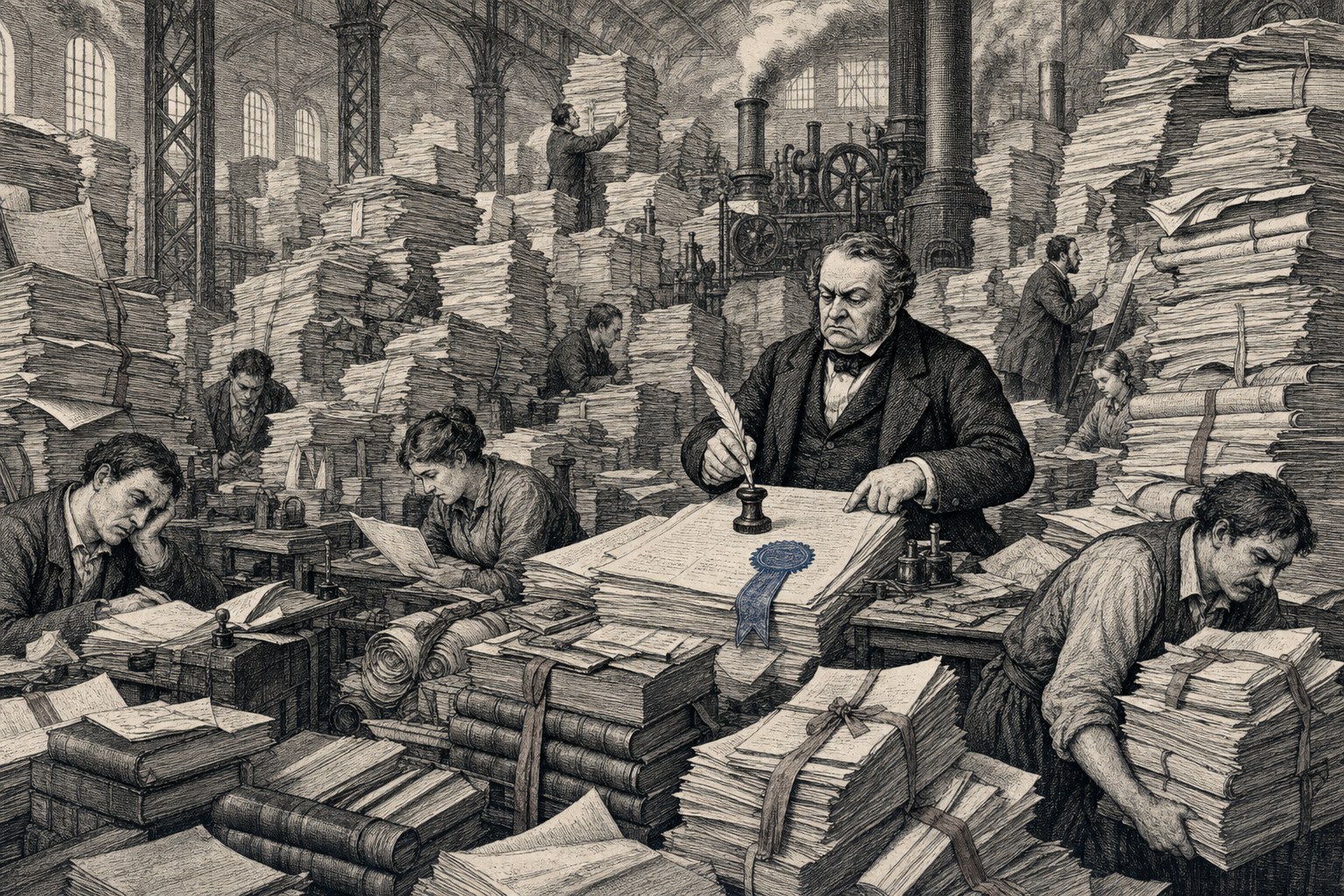
And that competition meanwhile costs so much that a considerable portion of the subsidy money never reaches anything real. It is consumed by writing the application, guiding the process, the interim reports, the final accountability statement, the audits, the evaluations. A subsidy of a hundred thousand euros costs, over its full lifecycle, seventy or eighty thousand euros in paperwork — at the applicant, at the grantor, and at the audit firms in between. Everyone involved knows this. No one can fix it, because each piece of paper is defensible on its own terms.
The three brain layers in subsidy allocation
At the primal-sense level, the subsidy assessor would feel: does this person have something, is this going somewhere, is there soul in it? That should be the first filter. It is entirely absent.
At the mammalian brain level, there would be a relationship — the assessor would know the applicant, their history, their environment, their development. Also largely gone. Applications are assessed anonymously or semi-anonymously, often by rotating panels, often by people who do not know the sector.
At the human brain level stand all the checkboxes, criteria, KPIs, objectives, evaluation matrices, SMART formulations, theory-of-change diagrams. This swallows everything. This is what remains when you cut away the other two layers: a form factory that mistakes itself for policy.
And here is the treachery: without the bottom two layers, the top layer has no anchor point. The criteria become ever more detailed, because every ambiguity must be sealed off legally. The evaluations grow ever heavier, because every expenditure must be accounted for. The applications grow ever longer, because every question must be answered unambiguously. The system expands without limit, because it has no point at which it says: here is enough, from here we trust judgement.
The pattern becomes ever more visible
Anyone who has ever applied for a subsidy for something truly new — not for their institution, but for an idea — knows this. The questions do not fit the idea. The fields ask for data that does not exist for a new initiative. The format forces you to translate your idea into terms that drain it of its power.
"What are your measurable objectives after three years?" — while in year one you are still discovering whether the idea works at all.
"How many beneficiaries will you reach?" — while your beneficiaries only come into existence once the idea lands.
"What scientific basis does your approach have?" — while your approach is precisely new and therefore cannot have a literature.
"With which partners are you working?" — while you have no network yet because you do not yet exist.
Whoever answers these questions neatly is lying. Not out of bad faith — out of necessity. They invent figures they cannot substantiate, promises they cannot keep, goals that have nothing to do with their actual intention. They play the game, and if they win, they may carry out their idea under a continuous obligation to report on the fictitious figures they promised.
Whoever refuses to answer these questions — because they recognise it would be dishonest — receives no subsidy. The honest fall away. The adroit remain.
And so a professional class is trained that excels at filling in, convincingly, questions that do not fit. That has become an entire profession. Subsidy consultants. Grant writers. Policy advisers. Application specialists. All useful within the system, all entirely unnecessary in a healthy one.
And so the whole culture is pulled out of shape
When this continues for decades — and that is what has happened — you end up with an entire culture of organisations that have learned to play the game. Universities where a substantial part of the department is occupied with grants, not with research. Charities that spend more on fundraising than on their cause. Cultural institutions that report more than they perform. Researchers who must rewrite their work to fit the fashion of the moment. Care organisations that write their annual reports for the funder, not the patient.
Those who refuse to join in can no longer do their work. Those who do join in do their work less and less, because the overhead consumes the substance. And the government that distributes the subsidies genuinely believes it is making policy. It is not making policy. It is funding a paper industry. The paper industry itself needs a paper industry to account for its own workings, and so it goes on without limit.
The entrepreneur who has no time
There is a fundamental point here that is rarely made explicit in the whole debate about subsidies. The entrepreneur who truly innovates has, by definition, no time for subsidy applications. They are building. They are selling. They are occupied with their customers, their product, their people. They have no department, no consultant, no budget for paperwork. They do everything themselves, and what they cannot do themselves must wait.
By the time they have grown large enough to maintain a subsidies department, they no longer need the money. They have their own cash flow. They have credit. They have investors. The subsidy is now a dessert on top of the existence they have built without it.
So the subsidy never helps at the point of origin. It only rewards what already exists. Which is a complete inversion of what it should do.
The same applies to the lone individual with an idea. The inventor in their workshop. The mother who wants to set up a neighbourhood centre. The former teacher who wants to test a new educational form. The doctor with a better clinical method. All people who could add something, all people for whom it is unthinkable to free up three months for an application they will probably not win. They do not do it. They do not even try. The system has turned them away at the door.
The filter works as a class mechanism
Just as at the bank, this too works as an invisible class filter. Those who come from an environment where people know how subsidies work, how to fill in forms, which consultant to call, which network to tap — they have a chance. Those who come from an environment where that is unknown — a working-class family, an immigrant, an autodidact, a first-generation entrepreneur — have no chance, not because their idea is worse, but because they do not command the codes.
The subsidy therefore reinforces the existing distribution of who participates and who does not. It is an instrument of conservation, not of renewal. And it is funded by the taxes of everyone, including those who will never receive it.
There is a political dimension here that is rarely named out loud. Subsidies are often presented as an instrument of redistribution, of solidarity, of supporting those who struggle. The reality is the opposite: it is a redistribution from below to above, from those without access to those who already have all the access. It is regressive dressed up as progressive.
The irony at its peak
And then comes the bitter irony. The parties that receive these subsidies — the established organisations, the big players, the subsidy offices — are also the ones who shape policy. They sit on committees, they write the advisory opinions, they evaluate the programmes. They have a hand in deciding the criteria to which they then turn out to be the only ones who still qualify. The system reproduces itself, because the winners of the current round are the designers of the next.
Outsiders see this. Insiders no longer can. For them this is simply how it works, how it ought to work, how it has always been. The thought that it could be otherwise is inconceivable to them — just as water is invisible to a fish.
The thought that it could be otherwise is inconceivable to them — just as water is invisible to a fish.
And whoever as an outsider raises doubts is told they do not understand the system. That there are good reasons for the procedures. That without those procedures fraud would arise. That the evaluations are necessary for democratic oversight. All defences that are not wrong in themselves, but that together form a wall making any conversation about the real question impossible: are we actually helping those we say we want to help, or are we primarily helping those who already command the system?
The symmetry with the bank
It is exactly the same structure. Two apparently different institutions — the private bank and the public government — arrive by different routes at precisely the same mechanism. Money flows to whoever can map the past well, not to whoever can make the future. Both have switched off the antenna. Both trust only models and forms. Both have traded the human measure for procedures that look fair on paper and consistently go wrong in practice.
And this is not coincidence. It is the same social movement producing the same pattern in every corner. The top brain layer has taken over all institutional decisions. The bottom layer has no place left. Whether it is shareholders' money or citizens' money — the outcome is the same distortion. The large players get larger, the small ones stay small, and those who are not yet there will not get in any more.
The silent costs no one measures
What is never included in any subsidy evaluation are the ideas that were never born because the system never reached them. The projects never started because the founder had no time for paperwork. The innovations never made because the right people knew before they even began that they could not win the game.
These absent outcomes appear nowhere in any annual report. They do not exist as a category. And yet they are probably far larger than everything that has come about through subsidies. We measure the visible return of the system and ignore the invisible losses. That way any system can call itself successful, even as it impoverishes society.
This is a general principle: what an institution refuses to see stays outside its evaluations. And what stays outside its evaluations need not be changed. That is how every system sustains itself, even after it has long since abandoned its original purpose.
What ought to happen
A healthy subsidy system would be small, fast, personal. A panel of people who know the sector. A two-page application. An hour's conversation. A decision within a week. Trust extended upfront with a check after the fact. An acceptance that some of the money will go to ideas that do not work — because otherwise you are only funding what already exists.
This would cost ten times less and yield a hundred times more. It is technically straightforward. It is politically impossible. Because it would mean the entire subsidy industry — the application writers, the evaluation offices, the audit firms, the consultants, the regulators, the policy officials who invent procedures — would become redundant. And that industry defends itself tooth and nail, because it is their livelihood.
So everything stays as it is. And the law holds: subsidy goes to those who do not need it. Credit goes to those who do not need it. Those who do need it are left to suffocate — at the government, at the bank, everywhere.
The deeper question
What happens here is more than a technical problem of poorly designed schemes. It is a symptom of a society that has given up on judgement itself. We no longer dare to look someone in the eye and say: "Yes, I believe in you, here is the money." We no longer dare to turn someone down without a formal procedure to shield us from criticism. We no longer dare to be accountable for our own decisions.
And so we have built systems that decide for us. Models that free the bank from liability. Procedures that free the subsidy official from liability. Evaluation matrices that free the fund manager from liability. No one takes a real decision any more, because no one is permitted to be accountable any more. And the result is a system that can no longer decide — that can only repeat what it has done in the past.
This is the price of fear. Out of fear of mistakes we have built a system that can only make large mistakes. The small, recoverable errors — a wrong assessment, a failed project — have been polished away. The large, irrecoverable error — a society that no longer renews itself — is what has taken their place.
To close edition 4, article 1
In the previous edition we described the primal sense, the three brain layers, the 7D model, and what we do to children in education. Edition 4 begins where edition 3 ended: with the adult world in which those same children must later function. With the institutions that receive them. With the counters where they come to ask for help.
What we see there is not unhappy coincidence. It is the logical outcome of a trajectory we have followed for generations: squeezing the primal sense out of education, then selecting for leadership positions those without it, and then building systems that actively prohibit its use. At the end of that chain stands the entrepreneur who cannot get a loan, the idea that cannot get a subsidy, the inventor who cannot begin.
And there we all stand — together — in a society that functions perfectly on paper and is standing still in reality.
Whoever sees this also knows where the way out lies. Not in a new scheme. Not in a new committee. Not in a new evaluation format. But in restoring judgement — in people who dare to look, to feel, to decide, and to be accountable for it. In organisations small enough to be human again. In financiers, administrators, assessors who dare to use their own instrument, even when the system forbids it.
The four-year-old who walks into a room and within ten seconds knows who is there — that child would be a better subsidy assessor than a department of fifty policy officials. It would give away less money, and it would achieve more. That is not romanticism. That is arithmetic, for whoever measures the real outcomes and not only the visible ones.
This is edition 4, article 1. It builds on edition 3 ("The Human Being Beneath the Ice") and on the reference works "Conceptual Basis: 7D Feeling Model", "Education and Upbringing in the Age of AI", and the piece "The Primal Sense in Professional Practice". The series continues on openvizier.org.
The Law of the Paper Industry
Subsidies systematically end up with those who do not need them. It is the same law as the bank — only this money belongs to everyone.
"The less you need it, the better your chances. The more you need it, the worse your chances."
Who wins, who falls out
Subsidy goes to whoever has the time, the people and the money to do the application well — by definition whoever no longer needs it. The startup, the small business in trouble, the inventor with an idea but no organisation cannot free up three months for a hundred-page application. They fall out at the first question.
What remains is the large company with a subsidies department, the university with a grant office, the consultant who takes twenty per cent. All parties for whom the subsidy is marginal. A subsidy was meant to be a lever for those who just fall short — not a bonus for entrenched power.
The three layers, gone
At the primal-sense level the assessor would feel: is there soul in it? Absent. At the relationship level they would know the applicant. Largely gone — applications are judged anonymously by rotating panels. What remains is the top layer: checkboxes, matrices, theory-of-change diagrams. A form factory that mistakes itself for policy.
The questions do not fit a new idea. "What are your measurable objectives after three years?" — while in year one you are still discovering whether it works. Whoever answers neatly is lying. The honest fall away. The adroit remain. A whole professional class is trained to fill in, convincingly, questions that do not fit.
Regressive, dressed as progressive
The subsidy reinforces who already has access. It is a redistribution from below to above, funded by the taxes of everyone — including those who will never receive it. The winners of this round design the criteria for the next.
And no one measures the silent cost: the ideas never born, the projects never started, the innovations never made because the right people knew before they began that they could not win the game. What an institution refuses to see stays outside its evaluations.
Close
A healthy system would be small, fast, personal: a two-page application, an hour's conversation, a decision in a week, trust extended upfront with a check after. It would cost ten times less and yield a hundred times more. It is technically straightforward and politically impossible — because the whole industry that defends it would become redundant.
"This is the price of fear. Out of fear of mistakes we have built a system that can only make large mistakes."