Seven Dimensions
From theoretical physics framework to technological breakthroughs — how G, W and N extend the standard model
By Jacobus van Merksteijn · 30 min read · 28 May 2026
From the Standard Model to 7D — What Is Missing?
Modern physics rests on two pillars: general relativity for the large scale (gravity, spacetime curvature, cosmology) and quantum field theory for the small scale (elementary particles, forces, matter). Both have been confirmed with extraordinary precision within their respective domains. And yet: they are mutually irreconcilable, and together they leave a series of fundamental questions unanswered.
The missing pieces are not minor. They form the very heart of modern physics:
Dark matter
~27% of the energy content of the universe is undetectable as ordinary matter. We measure it through gravity, but its nature remains unknown.
7D: Possibly a projection effect of higher-dimensional G/W/N configurations that remain invisible to our 4D measuring instruments.
Dark energy
~68% of the universe consists of an unknown energy that accelerates its expansion. The standard model offers no explanation.
7D: The vacuum structure itself — the G dimension — can vary and thereby produce an effective cosmological constant.
Baryon asymmetry
Why does matter dominate? At the Big Bang, matter and antimatter must have been created in equal quantities. They should have annihilated each other.
7D: Our universe may be a W sector dominated by matter — an asymmetric state in the polarity potential of the W dimension.
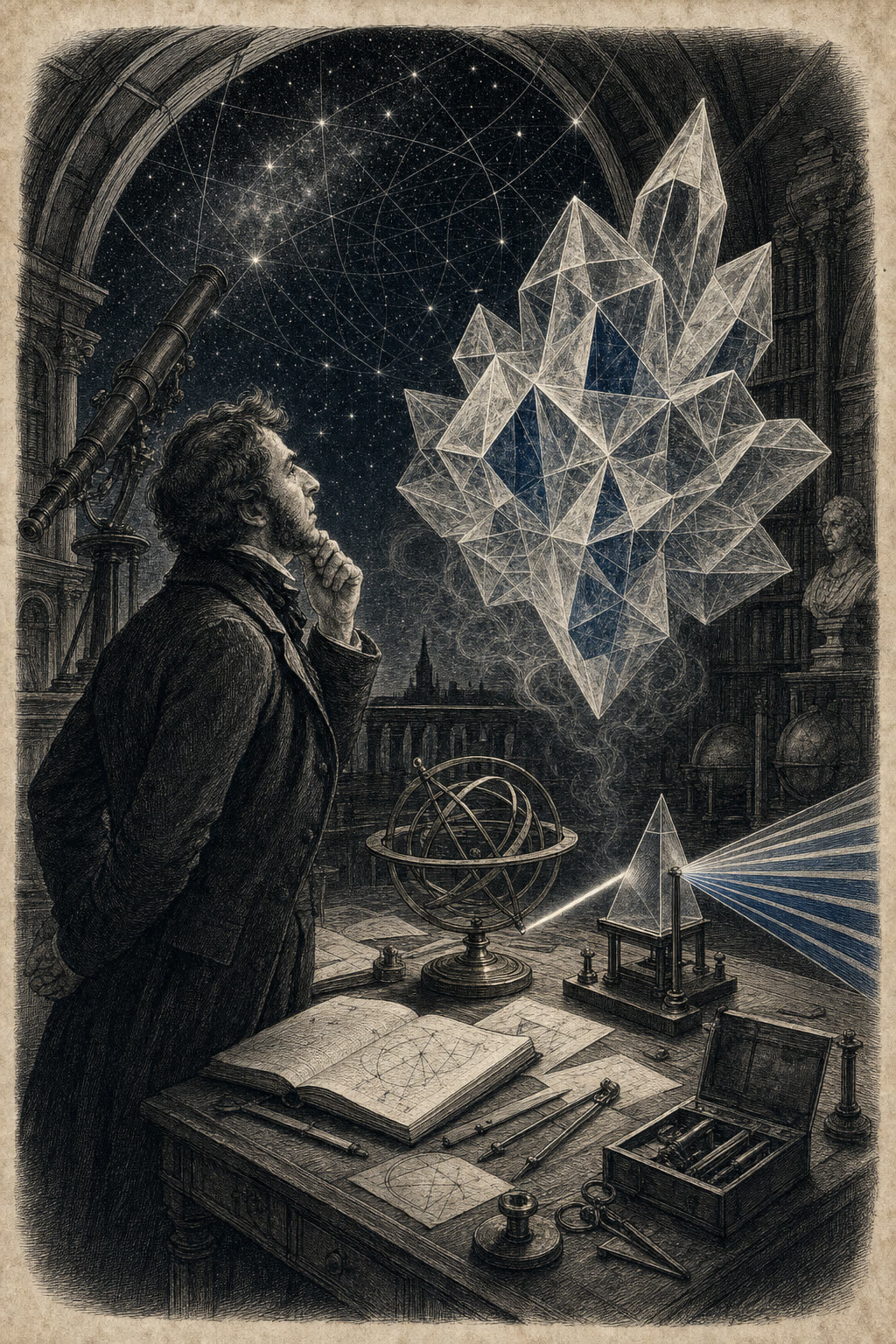
The 7D framework of Jacobus van Merksteijn does not propose to replace established physics, but to embed it within a richer structure. The familiar 4D laws remain fully valid — but as a projection of a deeper ordering with seven dimensions: x, y, z, t, G, W and N.
Central thesis: Reality is fundamentally hierarchical. Each higher dimension modulates the lower ones. The 4D spacetime we observe is a stable — but not complete — projection of a seven-dimensional structure.
Part I — Theoretical Framework
The Three Extra Dimensions: G, W and N
What are they, how do they work, and which physics puzzles do they explain? An exposition of the conceptual framework as developed in the foundational academic work.
The Hierarchical Structure of Seven Dimensions
The first four dimensions are familiar. What distinguishes the 7D framework from conventional extra-dimension theories is its hierarchical logic: each higher dimension modulates the lower ones, rather than simply existing alongside them as an additional direction.
The central intuition: whereas t is already the dimension in which spatial configurations can evolve, the leap to G — a dimension in which timescale, growth scale and mass appearance can vary — is less arbitrary than it may seem at first glance. The logic of dimensional hierarchy justifies the extension.
G: Vacuum Structure, Scale and Effective Mass
Vacuum structure
Determines how 4D spacetime appears at different scales. Variation in G modulates the effective mass of objects and the rate at which phenomena unfold.
Matter sectors
Ordering principle for matter-antimatter polarity. Describes which sector of the double-well potential our universe occupies.
Internal information
Ordering or indexing of parallel universes. Each universe has its own G and W background values. N represents the most speculative layer.
The G dimension is one of the most original elements of the model. It is conceived as a dimension of size, growth, scale and effective mass formation. Whereas t describes change over time, G describes change in the scale of that change.
The core formula reads:
The effective measured mass is the projection of a base mass, multiplied by a scale function that depends on the position in G, W and N. Mass is not an absolute primitive quantity, but the projection of a deeper scale structure.
This has three direct implications:
- Scale modulation: The same 4D structure can appear differently at different scales — depending on the G coordinate. This opens explanations for cosmological phenomena in which scale differences have hitherto been treated in an ad hoc manner.
- Effective mass: The observed mass of objects is not solely an intrinsic 4D property, but may also depend on the dynamics in G. This is a working hypothesis that requires mathematical refinement.
- Process rate: The speed at which processes unfold can in this model be partly determined by the position in G — which opens new explanations for the effective timescales in extreme environments.
"The 7D framework poses a fundamentally different question: how do I design space itself?"
It is crucial to emphasise what the model does not claim: G is not a classical ether, not a new medium in the nineteenth-century sense. It is a dimensional ordering level within which the familiar 4D laws are fully preserved as a limiting case.
W: Matter Sectors and the Baryon Asymmetry
The dimension W is interpreted as a polarity field — a sector symmetry between matter and antimatter, and possibly more broadly between positive and negative orientations of physical state. Its range: −1 ≤ W ≤ +1.
The open question W seeks to address is one of the deepest in cosmology: why do we observe a universe so strongly dominated by matter? In standard physics this is treated via baryogenesis and CP violation in the early universe — but a fully satisfying explanation is still lacking.
The 7D framework offers an alternative ordering picture: our universe may simply be a positive W sector. The polarity potential describes this formally as:
A double-well potential in which the small term εW lightly breaks the symmetry. This is conceptually comparable to the Higgs mechanism — but applied to the W dimension as an ordering principle for matter-antimatter sectors.
The three W values at a glance:
- W = +1: Positive sector — our observable universe, dominated by matter
- W = 0: Symmetry point — theoretical equilibrium between matter and antimatter
- W = −1: Negative sector — a mirror universe dominated by antimatter
This is not a resolution of the baryon asymmetry problem, but an alternative ordering picture that must later be coupled to real physical mechanisms. The double-well potential shows that two sectors are in principle possible, but that one is energetically favoured by the small symmetry breaking εW.
The analogy with the Higgs mechanism is instructive but not identical: the Higgs field spontaneously breaks symmetry in the space of the electroweak force. W breaks symmetry in a higher-dimensional space that orders matter and antimatter realisations. The mathematical resemblance invites formal comparison — but the identification requires further elaboration.
N: Internal Information and Universe Indexing
The dimension N is the most speculative component of the framework. It represents the ordering, indexing or counting of parallel universes. In some interpretations, N can also be read as a label for different complete physical realisations — each with their own background values for G and W.
What distinguishes N from a simple collection of universes:
- N is not merely a label, but a formal dimension within the total 7D system — with the same structural role as G and W
- N connects to existing multiverse discussions insofar as they speak of collections of universes with different parameters — but formalises that discussion dimensionally
- N should not be presented as a directly observable spatial dimension: it is for now an ordering concept, useful as a theoretical upper layer
Caution required: N currently has no direct empirical confirmation. The model is candid about this limitation. The value of N lies in its ordering role — it gives the framework the structure to speak about fundamentally different physical realisations.
In the context of technological applications (see Part II), N acquires a second interpretation: not as a universe index but as the internal information content of a system — the hidden degrees of freedom that are not explicitly present in the 4D description but do determine system behaviour. This dual reading makes N particularly fruitful for quantum computing.
The 7D point in formal notation:
All observable 4D quantities are effective quantities that depend on higher-dimensional variables: Qeff = Q(x, y, z, t ; G, W, N). The general metric structure ds² = gAB(X) dXA dXB shows that the 7D space has its own geometry, of which 4D spacetime is a projection.
How the 7D Framework Reframes Physics Puzzles
The framework is not an escape from the facts, but an attempt to order them differently. Below is the comparison between the conventional formulation and the 7D formulation for four major open questions:
| Domain | Conventional approach | 7D approach |
|---|---|---|
| Dark matter | Search for a new particle (WIMP, axion, sterile neutrino); measure via direct detection | Dark matter as a projection effect of G/W/N configurations; measurable via residual deviations in nanophotonics experiments |
| Dark energy | Cosmological constant Λ as a free parameter; origin unexplained | G dimension varies on cosmic scale; Λ is not a free parameter but a projection of G dynamics |
| Baryon asymmetry | CP violation in the early universe via baryogenesis mechanisms | Our universe occupies the positive W sector; asymmetry is structural, not a process outcome |
| Mass hierarchy | Higgs mechanism gives mass; why such a large spread remains unexplained | Effective mass meff = m₀ · Γ(G,W,N); spread is G/W/N-dependent |
| Black holes | Singularity — breakdown of general relativity | Regime where causal structure changes so drastically that 4D intuition no longer suffices; describable in 7D without singularity |
| Multiverse | Ad hoc in inflation scenarios or string theory landscapes | N dimension formalises the indexing as a structural component of the framework |
A methodological caveat: the model acknowledges that these are reframing proposals, not proofs. Explanatory power increases only if the 7D approach yields unique, falsifiable predictions that diverge from the conventional approach. The nanophotonics path (chapter 12 of the foundational work) is the most concrete candidate.
Projection as the Central Explanatory Principle
The concept of projection is the pivot of the entire framework. Projection means in this context: a measured 4D law is not necessarily the whole of reality, but a stable manifestation of a richer 7D pattern.
The geometric analogy: a three-dimensional object casts multiple two-dimensional shadows. Those shadows are real — but not complete. They cease to convey information about the third dimension. So too with 4D spacetime: real and describable with extraordinary precision, but possibly not complete.
Our observable spacetime — real, but a projection
Extra dimensions G, W, N — hierarchically ordered
The complete structure — richer, yet inclusive of the 4D facts
The 7D framework must not be formulated as opposition to relativity or quantum theory. Almost every successful paradigm shift in physics has not destroyed the preceding framework, but absorbed it as a limiting case:
- Special relativity remains fully valid as a limiting case of the 7D framework under standard conditions
- Light bending, time dilation and geodesic structure are not denied but incorporated
- Quantum field theory for matter and antimatter remains valid within the 4D projection level
Methodological rule: Everything the 7D framework proposes must, under ordinary conditions, reduce to the known results of established physics. Only at boundary regions — extreme conditions, black holes, the early universe — can small residual effects occur.
Part II — Technological Applications
Beyond Physics: G, W and N in Practice
The 7D conceptual framework is not confined to theoretical physics. The same projection-based thinking can be applied to technological domains where we are running up against seemingly insurmountable limits: computing, nanotechnology, quantum computing and fusion energy.
The Universal Pattern: The Same Constraint, Across All Domains
Modern technology is stalling on problems that share a profound common feature. Millions of parameters in machine learning. Billions of configurations in materials design. Exponentially growing state spaces in quantum computing. We work in high-dimensional spaces — but treat them as flat.
"The bottleneck is not computational power, but conceptual framework."
These are projection problems. We work in a constrained subset of the full configuration space and miss crucial degrees of freedom outside our standard parameter set. Just as physicists treat dark matter as a "new particle" rather than as a W dimension effect, engineers treat problems as "better materials" rather than as geometry design in an extended space.
Computing: High-Dimensional Optimisation as a Geometry Problem
Modern algorithms — machine learning, optimisation, scientific simulations — operate in extremely high dimensions. Deep learning networks have millions to billions of parameters; combinatorial optimisation problems involve exponentially growing solution spaces. The higher the dimensionality, the harder it is to find optimal solutions.
The three G/W/N analogies in computing:
- G analogy (Metric of the space): The "stiffness" of the configuration space determines how difficult it is to move from one solution to another. Some directions are steep (high gradients), others flat. This is precisely what the G dimension describes: scale and process rate of change.
- W analogy (Solution sectors): Good solutions in "sector A" can be invisible if you search only in sector B — just as W bands in fundamental physics can couple weakly. Sector structure in the solution space is a real phenomenon in machine learning (mode collapse, local minima).
- N analogy (Implicit information content): Structure that is not explicitly in the features, but does determine optimality — symmetries, constraints, invariants hidden in the data geometry.
Remarkably, state-of-the-art methods already implement elements of 7D geometric thinking — albeit without that explicit conceptualisation:
- Natural Gradient Descent optimises in the space of probability distributions with their natural Riemannian metric — precisely G-based optimisation
- Manifold Learning uncovers lower-dimensional structure hidden in high-dimensional data — W sector identification in the language of machine learning
- Neural Architecture Search seeks not only parameters but the optimal network geometry itself — a direct application of N structure engineering
7D addition: Explicit G/W/N conceptualisation makes this systematic rather than ad hoc. The question becomes deliberate: "What is the right geometry for this problem?" — not merely "which algorithm works?"
Nanotechnology: Materials as G/W/N Configurations
In nanotechnology it has long been known that dimensionality dramatically alters physical properties. Yet the current approach — trial and error and computational screening — remains confined to existing material classes. Radically new functionality requires radically new design thinking.
The 7D perspective poses a fundamentally different question: "Which local G/W/N configuration produces the desired properties as a 4D projection — and how do we realise that configuration?"
Three concrete applications where the 7D perspective is already implicitly present:
- Topological materials & Quantum Computing: Topological insulators and qubits already implicitly use high-dimensional structure: momentum space as an extra dimension, Hilbert space for quantum information, coherence as N structure. Explicit 7D engineering makes systematic design possible.
- Metamaterials and Negative Properties: Negative refractive index, negative mass density and cloaking are achieved via nano-structured architectures that transform the effective metric — pure geometry engineering, precisely what the 7D framework advocates.
- Nanoscale Positioning via DNA Origami: Recent developments demonstrate nanoscale 3D positioning of quantum emitters with valence control. This technique already manipulates G, W and N — the next step is systematisation via 7D design principles.
Quantum Computing: Decoherence as N Leakage
Quantum computers suffer from decoherence: quantum information leaks into the environment, causing calculations to fail. Coherence times are microseconds to milliseconds. Error correction requires enormous overhead — thousands of physical qubits per logical qubit. The conventional approach: isolate qubits as thoroughly as possible via ultra-low temperatures and electromagnetic shielding. The fundamental limitation: complete isolation is physically impossible — the quantum system must always interact with control fields and measurement apparatus.
"Decoherence is not a loss — it is information leakage that we can direct."
The 7D reframing: in N language, decoherence is not "loss into the environment" but information leakage into the N dimension. Quantum information spreads across ever more degrees of freedom — N expansion. The information persists, but becomes inaccessible to our 4D measuring apparatus.
The strategic implication: instead of fighting decoherence through isolation — actively control how information leaks into N. Design the qubit-environment coupling so that the information flow into N remains reversible. Implement N recovery protocols to retrieve information before it is irretrievably lost.
Directing N Leakage: Three Steps
Design qubits with controlled topologies and defects that direct the N structure. Determine in advance which degrees of freedom serve as information carriers and which serve as N buffers.
Measure quantum state and N footprint via decoherence patterns. Use the signals of decoherence as information carriers rather than ignoring them.
Feedback-driven adjustment of N configuration during computation. Retrieve information from decoherence channels before it is irretrievably lost.
Expected breakthrough: Coherence times that scale with system size rather than declining exponentially — because N leakage is directed rather than blindly fought. This would fundamentally break the quantum computing impasse.
Fusion Energy and the G Configuration
"What if G is modular?"
If the vacuum structure itself is configurable, fusion can no longer be merely a matter of forcing extreme conditions — but of realising the right local geometry.
The 60-year fusion impasse — in which we pump ever more energy into plasma to achieve ever shorter confinement — illustrates the core problem of the conventional paradigm. We force extreme conditions within the existing laws of nature, rather than asking: which G configuration produces the desired conditions as a projection?
| Domain | Conventional approach | 7D approach |
|---|---|---|
| Fusion energy | Force extreme conditions within fixed natural laws via magnetic or inertial confinement | Modulate local G configuration so that the desired conditions appear as a 4D projection |
| Nano-engineering | Trial and error: synthesise and test thousands of materials | Systematically design and realise G/W/N configurations with targeted properties |
| Computing | Optimise parameters within a given feature space | Design the geometry of the configuration space itself |
| Quantum computing | Minimise decoherence via isolation | Actively steer entropy into the N dimension via controlled leakage |
The 7D paradigm brings the systematics of architecture to all technological domains: first specify the desired geometry, then determine the realisation strategy. This is the reverse order of conventional engineering thinking — and that is precisely the point.
Concrete Research Lines and Testability
A model without testable predictions is philosophy, not science. The 7D framework acknowledges this explicitly and formulates a phased research agenda. Not everything needs to be solved at once — but the sequence must be sound.
Operational definitions
Formulate operational definitions of G, W and N so that the model becomes testable. This is the most urgent priority — without it, all subsequent steps remain speculative.
Sample projections
Work out projections to 4D mathematically with concrete calculations. Show that the core formulas lead to predictions that diverge from the standard approach.
Nanophotonics experiment
Write a technical nanophotonic concept note as an experimental proposal. Conical nanostructures offer the most credible near-term path to testing.
Unique predictions
Formulate a small set of predictions that distinguish the model from standard physics. Additional phase shifts, travel time differences, scattering anomalies.
Academic feedback
Systematically collect and process the first academic feedback. The model is explicitly open to falsification — that is not a weakness but the correct scientific attitude.
Broader extrapolations
Only then further develop broader cosmological or fundamental extrapolations. Including: fusion energy, universe indexing, N leakage in quantum systems.
Experimentally testable predictions (nanophotonics path)
The most credible near-term path lies in sensitive, controlled nanophotonics experiments. Conical metal nanostructures with controlled surface architecture can produce strong local field enhancement and phase-sensitive propagation. Four observables against which the model is tested:
- Additional phase shift along the cone — deviations from the expected phase propagation that are not explained by standard models
- Travel time differences of pulses relative to control samples — residual after full modelling
- Polarisation response — unexpected response not explained by the known geometry of the nanostructure
- Scattering anomalies — the most direct indication of a 7D correction
Across all technological domains, the 7D approach makes concrete, falsifiable predictions: unexpected optima (configurations that appear conventionally sub-optimal but are superior via 7D geometry), scaling anomalies (performance that scales better than predicted) and cross-domain correlations (successful strategies in ML that transfer to materials design because they employ the same G/W/N principles).
A Paradigm Shift and an Appeal: Taking Off the Blinkers
The 60-year fusion impasse, the plateauing progress in nano-materials, the persistent decoherence in quantum computing and the curse of dimensionality in machine learning are not independent problems. They are all manifestations of the same fundamental constraint: we optimise within configuration spaces that are too narrow because we do not see the full geometry.
The 7D framework proposes three steps — applicable in physics as much as in technology:
Three steps toward a 7D approach
- Recognise the projection — Identify that your problem is a projection of a higher-dimensional structure. Ask yourself: which degrees of freedom are absent from my current parameter description?
- Identify the extra dimensions — Seek the relevant G, W and N analogies in your technological domain. What is the metric of your configuration space? Which sectors exist? What is the implicit information content?
- Design and realise — Sculpt the desired geometry in the extended space and realise it with available 4D techniques. First specify the desired geometry, then determine the realisation strategy.
The unifying power of this paradigm is its most surprising property: domains that now appear separate — computing, materials science, quantum computing, fundamental physics — become aspects of the same design principle. The shared language is geometric thinking.
"The question is not whether 7D technology is possible — but whether we are bold enough to think outside our familiar 4D box."
The 7D framework is at its best a serious speculation under discipline. It does not ask for belief, but for careful formulation, critical testing and a willingness to be falsified. A model that is prepared to be bounded, refined and if necessary refuted has the right scientific attitude.
A model that is attractive only as long as it goes unexamined has no future. This is a coherent first attempt to translate a broad intuition about the structure of reality into a discussable academic research programme — and from that programme, into concrete technological breakthroughs.
Invitation: Academic discussion, mathematical sharpening and experimental evaluation as the next step. Responses and criticism are essential — that is how serious science begins.