Your Thermostat Is Smarter Than Your Minister
That's not a joke. That's math.
Door Jacobus van Merksteijn · 12 min read · 27 June 2026
The Calculation
Twenty thousand euros are stolen. Solving it costs 73,000.
You know within three seconds what to do: nothing. Leave it. Get on with your life. Anyone who's ever balanced a household budget understands this.
The government doesn't. The government sets up a committee. Hires consultants. Writes a protocol. Holds a press conference. Spends 73,000 euros to recover 20,000 — and calls that decisive action.
53,000 euros in extra losses. Your money. My money. Burned as fuel for a press moment.
And you pay. Every month. For people who can't do the math but get to run the country.
What a Thermostat Understands
Pick up your thermostat. The dumbest device in your house. No degree, no cabinet, no advisory board. And still smarter than the entire Dutch parliament.
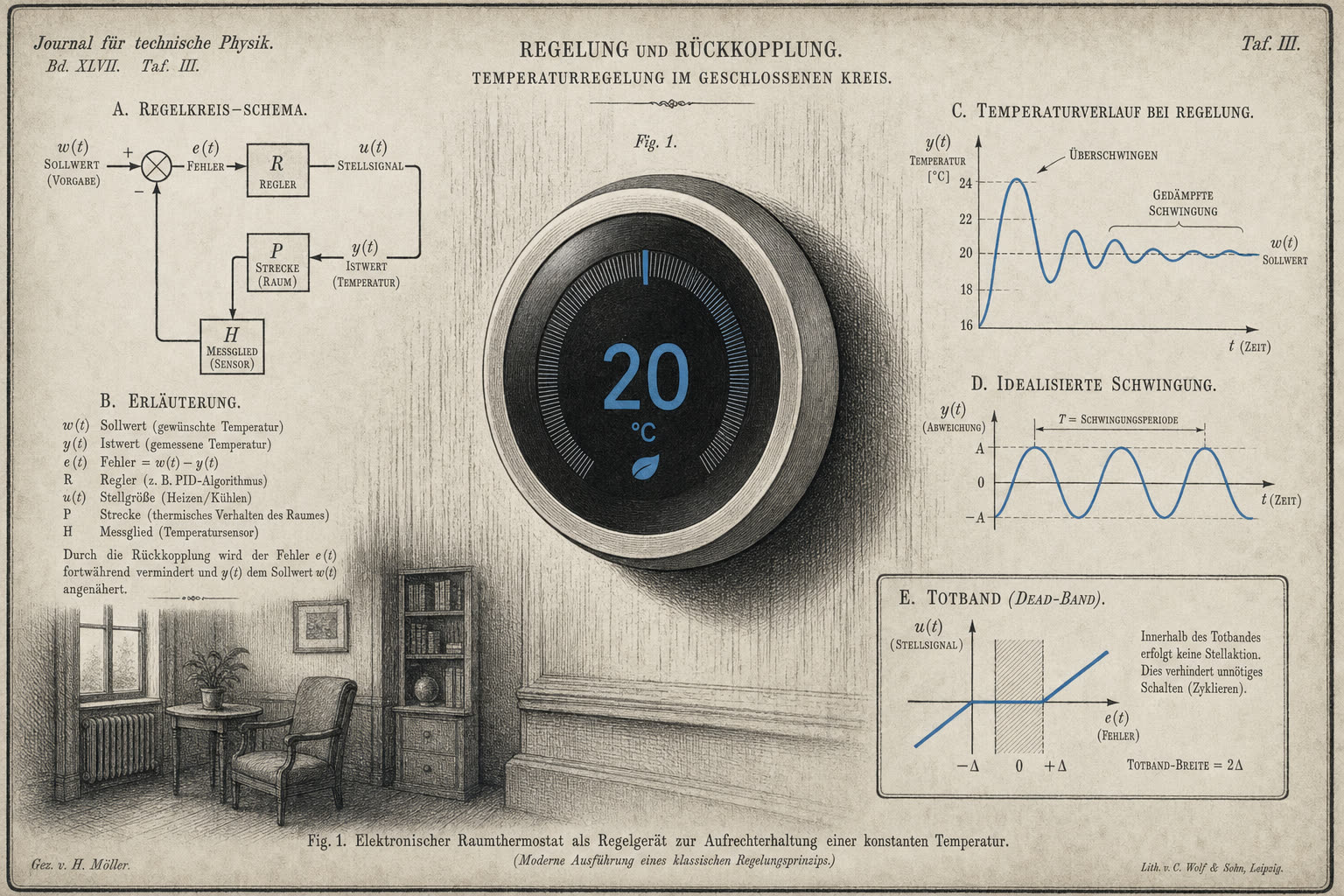
It has something called a dead band. You set it to 20 degrees. At 19.9 it does nothing. At 20.1 it does nothing. It only steps in when it's truly necessary.
Why? Because a thermostat that reacts to every 0.1 degree is broken within a week. It switches itself into the ground. Every engineer knows this. First-year control engineering students learn it in week one. It's not an opinion. It's a law of nature.
Every controller in every factory works this way. Every aircraft. Every car. Every pacemaker. A control system without a dead band oscillates itself to death. Full stop.
The Dutch government has no dead band. And that's exactly what we've been watching for thirty years. We just call it "policy."
The Benefits Scandal Was Not an Accident
We filed the benefits scandal — the Toeslagenaffaire — under "incident." Under "institutional failure." Under "bias." Under a system that "went off the rails."
Nonsense.
The benefits scandal was the logical outcome of a government that hunts single mothers for a few hundred euros using an enforcement apparatus that costs tens of thousands per case. That's not going off the rails. That's exactly what a control system without a dead band does: destroy itself on minor deviations, and drag the people it's aimed at down with it.
The enforcers weren't monsters. They did their jobs. The job was the monster.
And you know what the worst part is? The system hasn't changed. We said sorry. We paid out some money. We replaced a few people. And the engine keeps running — just a little more careful about who it grinds up this time.
The next benefits scandal is already on its way. Nobody just knows yet which group is next.
It's Everywhere. Just Look.
The freelancer with no staff, no customer data, who still has to maintain a GDPR compliance file. Protected: nobody. Wasted: a week of her life. Per year.
The entrepreneur who applies for 5,000 euros in subsidies and has to pay 3,000 to an accountant to prove she actually spent it. The accountant laughs. The state frowns. The entrepreneur has lost 60% of her subsidy before doing a single thing.
The playground that gets shut down because the safety inspection costs more than the equipment. The kids don't play outside anymore. But the inspection authority has a lovely annual report.
The neighbor who can no longer prune his tree without a permit. Two months' wait. Three forms. Five hundred euros. For a two-meter branch.
Each rule on its own sounds reasonable. Every official who invented it had a good story. A nice moment in a conference room. A sustained smile.
Add them up and you get a country strangling itself. And the people pulling the strangling cord get promoted every four years.
Why This Keeps Happening
Because the system rewards people who intervene — and punishes those who don't.
A minister who "takes firm action" makes the news. A minister who calculates that acting costs more than the problem, and therefore does nothing — also makes the news. As someone who looks away. As someone who fails to act. As "a person who ignores wrongdoing."
Write a new rule: you get credit and a commendation. Scrap an old rule: you get six lobby groups against you, a lawsuit, and an article in a major newspaper insinuating you're dangerous.
The math is simple: the regulatory system always grows. Every law gets added. Almost no law gets removed. Thirty years later you're living in a country where you can't exist without a permit — and nobody can explain to you why anymore.
This isn't a conspiracy. It's laziness plus incentives. And it is deliberately kept in place by everyone who profits from it — and that is an army.
One Rule. That's It.
I'm proposing one rule. One. No subcategories, no exceptions, no panels of wise men who get to "interpret" the rule because that's become their profession.
Every law, inspection, or enforcement action must demonstrate that its implementation costs less than the harm it prevents. If not: leave it.
Done. That's all.
No ethics. No politics. No "but what about the signal." A number against a number. Problem cost on top, solution cost on the bottom, dividing line. Above 1: don't do it. Below 1: do it. A five-euro calculator can handle it.
And that's exactly why it will be fought. Because every official, every consultant, every enforcer, every regulator currently making their living from corrections that cost more than they recover — they're out of a job.
Good. Let them go do something else. Something useful, maybe.
What Gets Left Alone — and Why That's Not Weakness but Maturity
With this rule, some problems go unsolved. Minor fraud. Marginal violations. Symbolic incidents that get a full column in the paper today, and that nobody remembers a week later.
That's not failure. That's a society growing up.
Every day we accept that people die on the roads because we don't set the speed limit to 30. We accept that some people eat unhealthy food because we don't ban sugar. We accept a hundred risks that are statistically far larger than anything in a welfare file.
But the moment it involves money — fraud, subsidies, a euro here or there — every deviation suddenly becomes unbearable. That's not consistency. That's a moral cramp. A reflex that costs us money and destroys people.
If you try to fight everything, you mostly fight yourself. And your neighbors. And your children. And your future.
The Counterargument — and Why It's Cowardly
"But then we're accepting injustice. We're sending the wrong signal."
Give me a break.
We're accepting injustice right now. We're just hiding it. Every euro spent enforcing a hundred-euro mistake doesn't go to the child who can't get glasses. Not to the nurse with burnout. Not to the waiting list for youth services. Not to the neighbor who actually needs help.
The injustice we don't see isn't smaller. It's just quieter. And a minister who only responds to noise isn't a minister. That's a weathervane with a chain of office.
If you oppose this principle, explain one thing to me: why is it better to spend 73,000 chasing a theft of 20,000? Give me the number. Give me the calculation. Not the sentiment.
I'm waiting.
To Close
We demand that pilots weigh things rationally. Same for doctors. Same for engineers, accountants, captains, and crane operators. All professionals who every day must decide which risks are worth reducing and which are not.
From our politicians we expect the opposite. That they tackle every problem regardless of cost. And if someone suggests doing otherwise, they're told they're heartless.
Heartless is not the person who does the math. Heartless is the person who, without doing any math, wastes other people's money on their own moral exhibitionism.
A government with a dead band is not an indifferent government. It's a mature government. One that accepts its resources are finite, that its corrections cause harm of their own, and that doing nothing is sometimes the most civilized choice available.
Not every deviation is worth correcting.
And it's long past time we demanded from our politicians what we've long taken for granted from a forty-euro thermostat.
Otherwise we might as well just appoint the thermostat as prime minister. It would at least be cheaper.