Why I am as I am
On the outcome at the end, and the people who think only of tomorrow
By Jacobus van Merksteijn · 18 min read · 28 May 2026
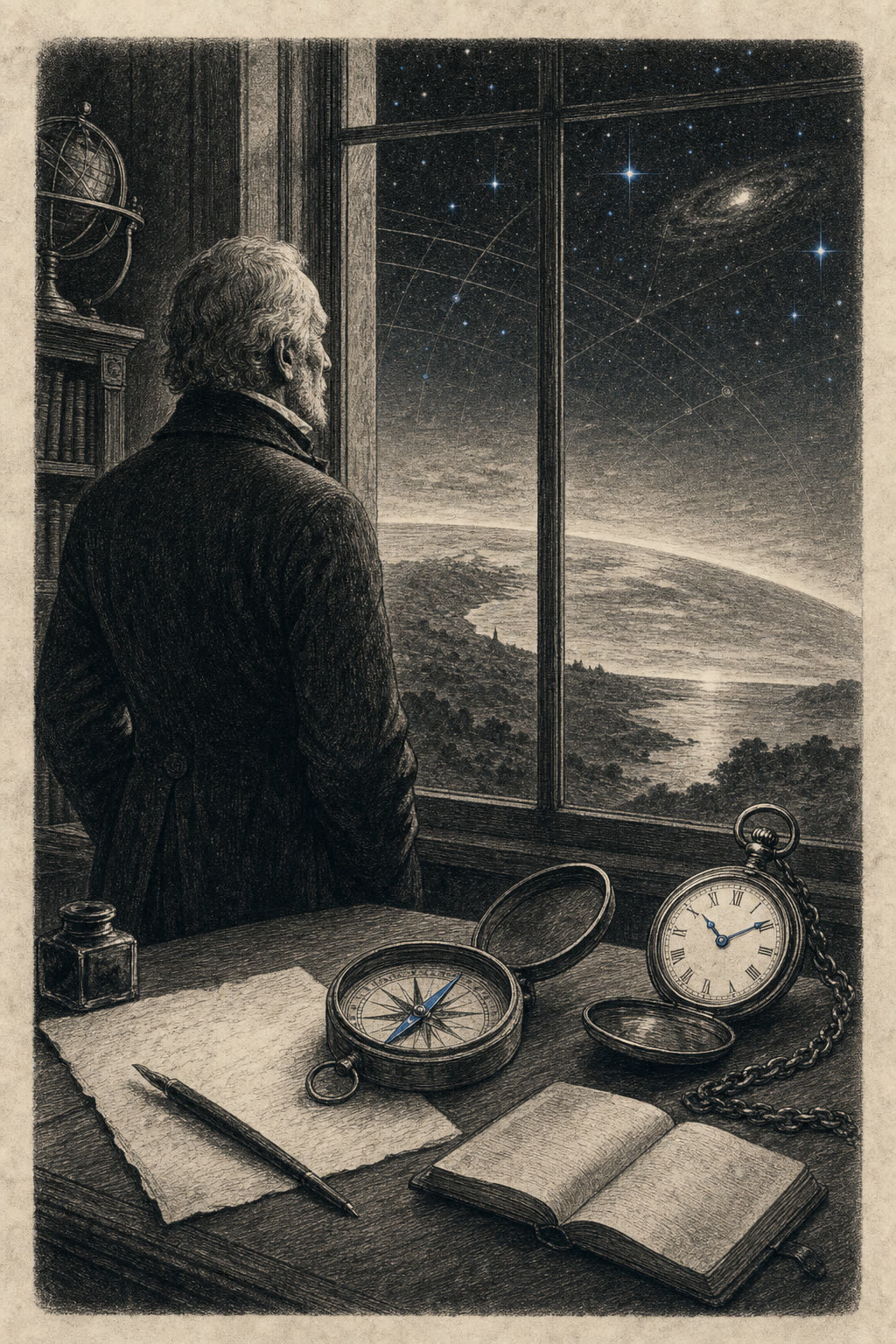
The only thing that matters
There is only one thing that matters in this world: the outcome at the end.
People are quick to forget that. They think of tomorrow, of the week, of the quarter, of the next election, of the next purchase, of the next compliment, of the next holiday. They do not think of the outcome at the end. Not of what remains when all movement has come to rest and reality reveals what it truly was.
This is not a philosophical position I picked up in conversation. It is the position from which I have worked, chosen, refused, and lost throughout my entire life. And it is the position from which I write this piece. For anyone who wishes to understand why I am as I am must first grasp this one thing: I do not look at tomorrow. I look at the end, and reason backwards.
A tyre that lasts 25 years and 500,000 kilometres is not designed by making something slightly better tomorrow than it was today. It is designed by first determining where you want to stand a quarter of a century hence, and then measuring every step against that. A fusion reactor that would truly work is not built by refining last year's tokamak. It is built by first understanding the reality in which fusion truly takes place — and that is a reality that does not fit within four dimensions, however many billions ITER continues to pour into that framework. A country is not governed by ensuring you are not booed off television tomorrow. A country is governed by asking what will still stand a hundred years from now.
Those who think only of tomorrow get tomorrow. Those who look to the end gain the possibility of making something that reaches it. That is an uncomfortable distinction for the majority, who prefer the shorter comfort. I accept that, but I do not take part in it.
How I arrived at this position
This is not innate wisdom. It was learned, and it was dearly paid for.
I was raised by a mother who removed all connection with the outside world entirely from my hands. In my first decades I had no need to negotiate with the world. She handled that. I was permitted to do the technical work — the university, the knowledge systems, the design, the execution. The family business grew between 1955 and 1995 from nothing to a value expressible in hundreds of millions. I managed this consistently, because I was allowed to work in an inner space that was rarely interrupted.
On the surface this appeared a gift. In my experience it is something else: she withheld life from me. I never learned to sustain a marriage — hence three divorces. I never learned to be a father in the way I had wished to be — hence the distance that eventually arose with four of my five children. I never learned to feel the outside world the way people do who are released into it on time — hence the years I later had to spend on a kind of retraining that most people complete between their twenties and forties.
But — and this is the other side of the same coin — what she did do was give me the undisturbed concentration in which the primal sense did not die out. That is the faculty by which a child of four looks into the eyes of a stranger and immediately knows whether things are right. The faculty by which a dog reads a human being. The direct connection between perception and insight without the intermediate step of verbal reasoning. Almost everyone loses this between the ages of four and eighteen, because the school system and the social environment systematically train it away under headings such as don't be so sensitive, think first, back it up with evidence.
In me it did not die out. Not because I did anything exceptional, but because my mother's protection prevented the wear that acts upon others from acting upon it in the same way. That is the loss and the gain in one: I lack decades of lived life, yet I possess an instrument that most people around me have lost.
Hence I see things where others look straight past them. Hence I can carry four or five projects simultaneously, each of which would on its own constitute a life's work. Hence too I stand in a wholly different relation to possession, inheritance, and family lines than the majority. Not because I am cold, but because I look from a different vantage point.
This is who I am. Not by choice in the first instance, but it is where what happened to me has placed me. And in arriving there I have found that the position is also justified — not for everyone, but for whoever has the work I have to do.
The price I paid — and not only I
My parents chose, despite my urgent advice, an inheritance structure in which my brother and I did not become owners of what we had built, but merely administrators. That may sound like a legal technicality. It is not. It is a structural decision that turned two brothers into competitors in an arrangement where only one could win. My brother drew the leadership to himself through back channels and from that moment viewed me as a rival nuisance. I had to sell my share for an amount far below its true value, simply to get out at all. Not merely shares sold — a part of my life sold below its price, to a brother who used against me the very structure our parents had put in place.
My brother and his family have, to this day, kept the spoils tightly pulled around them. My son told me later, in the same vein: "Dad, you only spent the money that grandpa and grandma earned." Not a word about his uncle's greed. Not a word about the structure that broke us. Not a word about what I actually built between 1955 and 1995. A one-sided view, passed down through a line that has never wished to see what truly happened. And that is fine. It suits their interest to see it that way.
What I say here aloud, they are welcome to read and draw their own conclusions. This is openvizier.org. Whispering behind one another's backs stops here.
But I do not write this to wound my brother or my son. I write it because they are the textbook examples of what I mean by people who think of tomorrow and forget the outcome at the end. My brother thought of his immediate grip on the company. The outcome at the end is that there are no longer any brothers. My son thinks of his version of the family story. The outcome at the end is that there is no longer a father-son relationship, and that one day he will be unable to explain to his own children what his grandfather truly consisted of.
Had they looked to the end, they would have made different decisions. That is not a reproach. That is a diagnosis. And it is the diagnosis I see applying to an entire society.
From four or five to eight billion
This is where my outlook on life converges.
I have five biological children. With one — Mirle — I have genuine contact. She is the only one who does not use her intelligence (twice cum laude) as a weapon, for whom money is not the measuring rod, and who does not operate from the narcissistic register into which the others have fallen. The four others I have disinherited for good reason. I do not wish to be the father who, a generation later, passes on the same poison that drove my brother and me apart. Money in the hands of people who cannot bear the weight of the work does predictable things — it amplifies what is already there and hardens what ought not to harden.
But this decision is not the core of the matter. The core is that I have shifted my scale. The earth exists for 24 hours in a cosmic image; humanity, on that scale, exists for just ten seconds. I live my fraction in those ten seconds as a mayfly. In that awareness the logic dissolves that I should bequeath my work and my wealth to five biological heirs. The eight billion people alive today, and the generations still to come before humanity completes its ten seconds — those are my children. Not because I feel no preference for those I truly fathered, but because the scale at which I now think no longer concerns itself with that.
Four or five of my projects can, if they land properly, generate hundreds of millions to billions in revenues. CO₂ neutrality through biomass. Ethanol production. Tyres that last a quarter of a century. Aircraft using 16.5 per cent less fuel. Ships using 65 per cent less fuel. Wind energy yielding 8.5 per cent more. Solar cells with 2 to 5 per cent extra output. Formula 1 running seconds per lap faster. Nuclear fusion from a seven-dimensional working model rather than a four-dimensional one. Those revenues I will not divide among five private chambers. I will direct them at what humanity, in its remaining ten seconds, can still set right of the damage it inflicted in its first seconds.
That is no act of revenge upon my children, however they may read it. It is simply my answer to the question of what the outcome at the end should be of a life such as mine. A life that began in an enclosed space where I did not live but did learn to see — and that ends, hopefully late, in a space as open as possible, where the seeing faculty flows outward to where it belongs.
What I see being lost in education
What was preserved in me by the peculiar protection of my mother, I see destroyed in virtually every child by what we as a society call upbringing and education. This is not an anecdotal judgement. It is my diagnosis after decades of working with people at the highest technical level.
The Prussian skeleton of our education system — sitting still on command, responding when permitted, giving the correct answer, not raising your hand without permission, correcting the child who thinks differently until it fits within the pattern — served the industrial revolution. For the knowledge age it is a millstone round the neck.
A child who says "I feel that this is wrong" is met with the counter-question can you back that up? If it cannot do so in words, the feeling is dismissed. By the time the child can articulate it, the feeling itself is gone. We reward vertical thinking — logical, sequential, verbal — and punish horizontal knowing: associative, bodily, intuitive. Not out of malice. Out of a compulsion to measure. What cannot be tested does not count.
And so society loses, in every generation, the instrument by which it might have solved its greatest problems. Not because nature withholds it, but because we systematically extinguish it. For the average pupil the loss may be limited. For the potentially exceptional mind — the future inventor, the boundary-pushing thinker, the person who might have become what I became by accident — it is devastating.
What I envision for the education of those I call extreme quality experts:
Silence as a subject
Not meditation as performance, but learning to be at ease with doing nothing, without finding it uncomfortable. A child that cannot be still cannot hear itself. Those who cannot hear themselves cannot hear the work either when it calls.
The body as compass
The body is not a vehicle for the head. It is a source of information with its own language. Children who learn to take their bodily signals seriously develop a feel for situations that no analytical model can replace.
Stories before explanations
Mythology, fairy tales, archetypes — these teach a child to recognise patterns at a deeper layer than factual knowledge. The analytical layer comes afterwards, and then finally has something to rest upon.
Doubt as a legitimate position
"I don't know, but I feel something here is wrong" must be possible, without being brushed aside. All great breakthroughs began with an unsubstantiated hunch. Whoever unlearns the hunch also unlearns the breakthrough.
Mentors instead of teachers
The primal sense cannot be learned from a book. Only from witnessing someone who still possesses it themselves. One such person in a child's life can save a talent.
Protection of deep concentration
A child absorbed in something must not be constantly interrupted to try something different for a change. That absorption is the primal sense at work. Many talents are lost here — not through harsh teachers, but through warm-hearted pedagogues who believe that a well-rounded child is a happy child. A child that is allowed to be absorbed in something is the happiest of all.
Nature as daily learning environment
Not as a field trip once a quarter, but as the ground on which learning takes place.
None of these building blocks is new. Reggio Emilia, Finland, Māori education in New Zealand, Waldorf impulses, individual schools on a small scale — it exists. It works. And yet it is not genuinely implemented at national level in a single European country. Not because it is pedagogically impossible, but because a society of people with an intact primal sense is ungovernable in the current sense of the word. They buy less. They vote differently. They no longer work on things that feel meaningless. They cannot be deployed in the adventures of power.
That is precisely why the system produces them as it does. It is not an unfortunate side effect of a well-meaning system. It is, in an unspoken way, a design criterion. Power does not care for people who look to the end.
Why I am now leaving the Netherlands
My decision to leave the Netherlands and settle in Malta and Mallorca is not a flight. It is the same reasoning I apply to everything: look at the outcome at the end, and act accordingly.
The Netherlands has become the property of foreigners. They are allowed to run the country — my future, all our futures — while the polder-dwellers nominally in office have no say left. The Netherlands is heading towards an Islamic future, and I want no part of that. Those who say this aloud get a label slapped on them by precisely the people who made it possible. Those who stay silent and look away fall into the same error I diagnose throughout this piece: thinking only of tomorrow, and leaving the outcome at the end to chance. I simply want to live in Malta, where taxes are still reasonable and where the work gets the space it no longer receives in the Netherlands — for as long as that lasts, since that too will not last forever.
I am not prepared to subject my ongoing work to a fiscal and administrative system that structurally works against the work itself. The exceptionally beautiful house on which I worked for twenty-five years I must sell to make the fiscal separation from the Netherlands possible. That pains me deeply. A quarter century of my life disappears into a valuation that cannot capture what was put into it. But so be it. The outcome at the end weighs heavier than tomorrow's comfort, here too.
Malta gives me university collaboration, nationality, and a fiscal foundation on which my work can rest. Mallorca gives me the place where I truly enjoy being. The projects continue — resolute, with the end ever newly set.
What I ask, and of whom
do not read this as the outburst of an old man settling scores. Read it as a diagnosis from someone who has looked at the outcome at the end throughout his entire life and who, in his field — materials science, energy, propulsion, fusion — has seen that way of looking bear fruit. The diagnosis can be expressed in one sentence: we think of tomorrow and forget the future, and that costs us as a civilisation more than we realise.
look at the children around you as though they bring something you do not need to teach, but must protect. A child absorbed in something — let it be absorbed. A child that says "I feel that this is wrong" — take it seriously, even when the explanation is absent. A child that wants to be still — give it the stillness. You are more often a guardian of something already present than a supplier of something yet to come.
I ask for one honest, broadly funded study. Not what children learn between the ages of three and eighteen, but what they lose during that period in terms of faculties they once possessed. And what the cost of that is — for themselves, for the economy, for the country, for the species.
what I write here is neither an indictment nor an offer of reconciliation. It is a factual record of where I stand and why I stand there. Those who wish to draw conclusions from it may do so. Those who do not — that too is fine. My attention no longer goes to old accounts. My attention goes to the work that must be done, and to the outcome at the end.
you know who you are to me. Your intelligence is the only one in this family that is not used as a weapon. None of what has been said above about your brothers and sisters applies to you. You did not get that from a book, and not from yourself alone. That is — somewhere, at a layer beneath everything that has happened — also something passed from me to you. That is what I have earned from this life.
Closing
There is only one thing that matters in this world: the outcome at the end.
My mother thought of tomorrow when she closed me off from the world, and the outcome at the end was that my life could not begin until she died. My parents thought of tomorrow when they made us administrators and not owners, and the outcome at the end was two brothers who are brothers no more. My brother still thinks of tomorrow, and the outcome at the end will be that his name in this family will stand not for what he built, but for what he took. My son thinks of his version of the story, and the outcome at the end is that he will never truly have known his father.
An entire society thinks of tomorrow — of its quarter, its election, its status, its consumption — and the outcome at the end will be that it has not solved the great questions of its age because it has systematically squeezed out the people who had the primal sense to solve them.
I try to do something different in the ten seconds allotted to me in cosmic time. I look at the outcome at the end, and act accordingly. Sometimes at the cost of comfort, sometimes at the cost of family, sometimes at the cost of homeland. But never at the cost of the work, and never at the cost of the compass by which the work is done.
That is why I am as I am.
Those who wish to read it, read it. Those who do not — that too is fine. My work continues.
---
Jacobus van Merksteijn is an entrepreneur, inventor and thinker, active in materials science, energy conversion and industrial technology. He writes in this space with open visor.