What we do to children
The systematic squeezing-out
Polemic · 14 min read
By Jacobus van Merksteijn
A three-year-old sits on the floor. Playing. Building something with blocks — a tower, or what in the child's imagination is a tower. The child is completely present in what it is doing. There is no past and no future in that concentration. There is only the tower, the hand, the block, the now. That is the primal feeling in full operation.
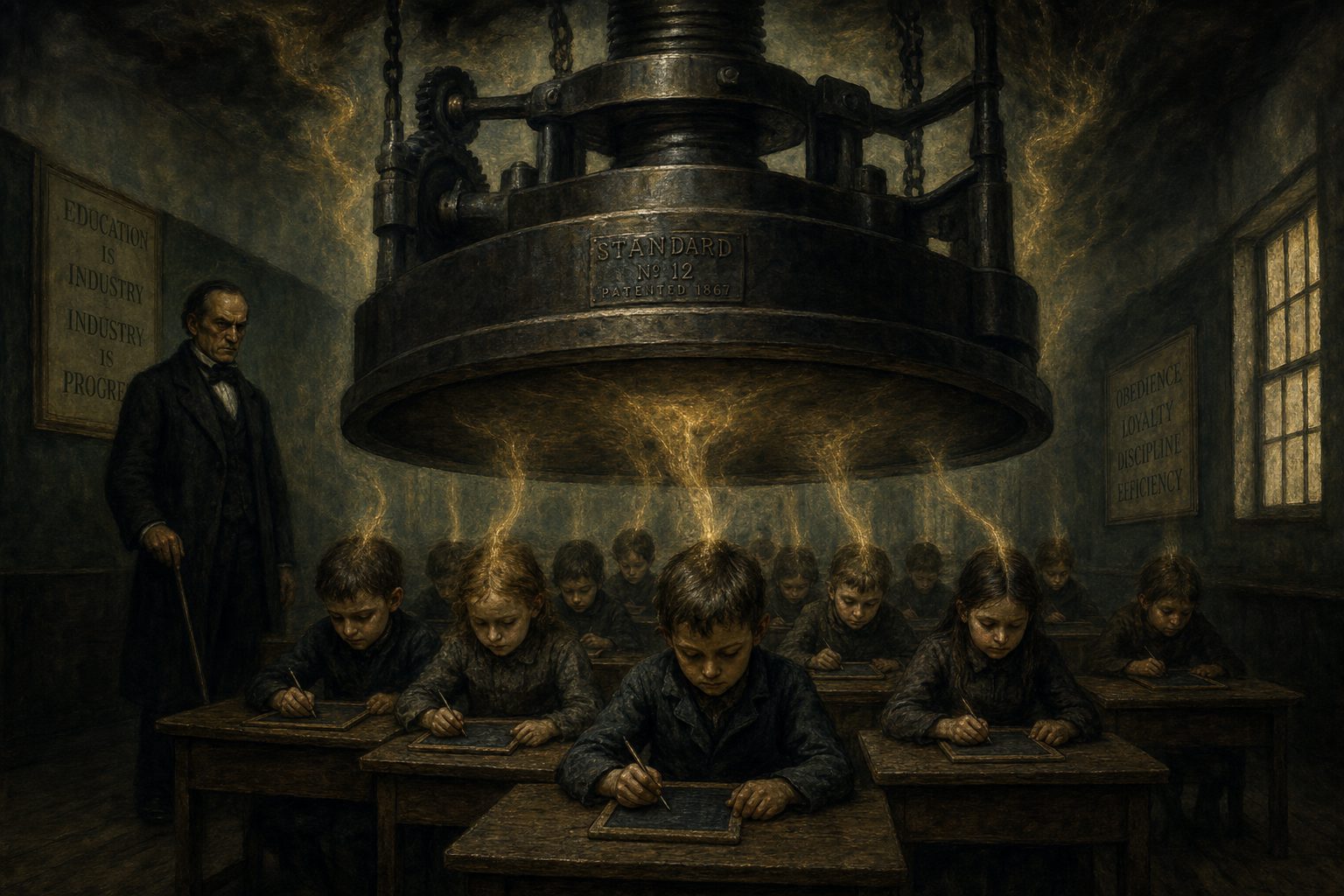
Then the bell rings. The daycare has a schedule. It's time for circle time. The child has to stop. The child cries, or negotiates, or is already learning early on to fall silent and comply.
That moment is not dramatic. It is simply the schedule. But it is also the moment when a child learns for the first time that what it feels from within — the concentration, the absorption, the complete presence — is subordinate to an external structure it did not choose and does not understand. It learns this, and it does not forget.
That is what we do to our children. Not out of malice. Out of scheduling logic. But the child pays the price.
Seven dimensions, one at a time
Article 2 of this edition described the 7-dimensional feeling model: the three spatial dimensions, the time dimension, the G-axis (love/hate, appreciation/rejection), the W-axis (real/unreal), and the N-axis (the individual position). Seven dimensions that together describe the human inner life.
A child from zero to six years old is naturally at home in the first three: the spatial dimensions of the body, movement, and immediate surroundings. It lives in its body. It lives in the now. It is an expert at sensing atmospheres, people, and situations. It has a sleep pattern that maximally uses the nighttime stream — young children sleep a lot and dream a lot, and that is not coincidental. REM sleep is proportionally longest in early childhood; the brain processes the enormous amount of new information through precisely the mechanism described in article 3.
What do we do then? We start early. Sometimes as early as six weeks old, when the child goes to daycare. We introduce the time dimension: schedules, timetables, Monday and Tuesday, juice and biscuits at half past ten. We introduce the moral dimension — the G-axis in its heavenly form: be nice to others, wait your turn, don't hit, participate in rules that presuppose the child is a moral subject capable of consciously controlling its impulses. A three-year-old is not. The prefrontal cortex — the seat of moral reasoning and impulse control — is not fully mature until around age twenty-five. We are asking a three-year-old to function as a twenty-five-year-old moral subject.
We introduce self-definition: "What do you like? What do you want to be? What is your favourite colour?" Questions that spring from the N-axis, from explicit self-awareness. But the N-axis is not yet operational as an individualised structure in a four-year-old. The child cannot answer that question from within itself. It guesses — and guessing is exactly what it does, not from the inside, but from the expectation embedded in the question.
It guesses — and guessing is exactly what it does, not from the inside, but from the expectation embedded in the question.
We introduce the W-axis: the distinction between real and unreal, actual and imaginary. "That doesn't really exist." "That's just a fairy tale." "Monsters don't exist." But the W-axis in its abstract cognitive form is only manageable for a child around its tenth or twelfth year. Before that age, a child lives in a world where the boundary between reality and imagination is fluid — and that is not a fault but a developmental phase. The monster under the bed is as real as the bed. Denying it does not cut off the fear but the capacity for symbolic thinking.
All those dimensions at once, too early, on a brain that is not yet ready for them.
What too much too fast destroys
Let's be concrete.
Introducing the time dimension too early — schedules and timetables before the age of six — produces children who learn to live in the rhythm of an external clock rather than their own biological rhythm. The biorhythm, the individual pace of processing, the cycle of concentration and recovery — all of it locks up. What takes its place is a reflex to the bell. That is not learning. That is conditioning.
Introducing the moral dimension before age twelve in its abstract heavenly form — "that is good," "that is wrong" as abstract ethical categories — produces children who learn to distrust their own sense of justice. Because their sense of justice is situational and direct: this doesn't feel right. But the abstract moral rule states what always applies, regardless of the situation. The child learns: my direct feeling is less reliable than the rule. That is precisely the opposite of what the child needs.
Moreover: the G-axis in its heavenly form places love above and hate below, and teaches the child that the good goes upward and the bad goes downward. But a child also has an earthly G-axis — the sense that love can also be what carries and nourishes and grounds, not only what points heavenward. By offering only the heavenly G-axis, a child learns to distrust its own earthly sense. The mother who feeds is less sacred than the heaven that promises. That is a deep psychological problem that presents its bill later in life.
That is a deep psychological problem that presents its bill later in life.
Introducing the W-axis too early in its abstract cognitive form — the distinction between real and unreal as a test for the legitimacy of one's own experiences — produces children who learn to see their imagination as a problem. The child who says "I see a monster" and is told "that doesn't exist" does not learn that monsters don't exist — it figures that out later on its own. It learns that its direct perception of something threatening is not legitimate if it has no name in the catalogue of the above-world-approved. That is the core of what the learned empty-function produces: the feeling is there, but the child learns that it is not allowed to be.
Forcing N-self-definition too early — "what do you think?", "who are you?" — produces children who build a verbal self-concept before there is a felt self to build on. It is like a house on sand — the walls stand, but there is no foundation. Later in life this shows up as the question people experience as a crisis in their forties: who am I, really? That crisis is not a sign of ripening. It is a sign that the self-understanding built at a young age was not grounded in the primal feeling.
Phased introduction: the four phases
There is an alternative that is not utopian but concrete. It is not about abolishing everything that exists, but about adjusting the sequence.
The first phase runs from zero to six years. In this phase the child is at home in the three spatial dimensions: above and below, left and right, in front and behind. It lives in its body and in the immediate space around it. The primal feeling is at its strongest in this phase, precisely because the higher dimensions have not yet been activated as a system.
What education and upbringing must do in this phase: protect the primal feeling. Not cultivate it in the sense of directing it — it is already there. Protect in the sense of not overloading it, not overwriting it, not introducing abstraction too early that replaces direct experience. No abstract sense of time. No formal numerical assessments. No schedules that override the child's biological rhythm. What is needed: lots of movement, lots of time outdoors, lots of stories, lots of play with others, and the undisturbed concentration that every child naturally has.
The second phase runs from six to twelve years. In this period the time dimension gradually becomes manageable, but still concretely: the rhythm of the seasons, the return of summer, the difference between yesterday and tomorrow. The W-axis can be introduced in its most concrete form: the distinction between real and imaginary, not as a cognitive framework but as discovery through fairy tales and mythology. Children from six to twelve are naturally interested in precisely that boundary. But the cognitive "that doesn't really exist" is still destructive in this phase — the distinction must be offered through story, through play, through discovery, not as a test for the legitimacy of one's own perceptions.
Formal moral judgements do not belong in this phase. The child has a fine sense for justice in the immediate situation — that sense is the primal core of the G-axis and must be trusted, not overridden by abstract rules. Formal numerical assessments do not belong here either. Feedback can be rich and concrete without being reduced to a number that places the child on a ranking.
The child has a fine sense for justice in the immediate situation — that sense is the primal core of the G-axis and must be trusted, not overridden by abstract rules.
The third phase runs from twelve to eighteen years. Only in early adolescence are the higher dimensions ripe for explicit introduction. The time dimension in its abstract form — planning as systematic future-thinking — becomes manageable when identity is sufficiently established to carry a relationship with the future. The G-axis in its moral abstract form — ethical questions about good and evil in society, the individual versus the system — becomes manageable when the child also has the cognitive capacity to hold multiple perspectives simultaneously. And the N-axis in its explicit self-definition form — "who am I?", "what are my values?" — becomes manageable in mid and late adolescence. Not earlier.
The question the adolescent can handle and needs is not "what do you want to be?" but "what moves you?" Not "who are you?" but "when do you feel most like yourself?" The first type of question forces the construction of an abstract self-concept. The second type of question points toward direct felt sense.
The fourth phase begins at eighteen and continues for life. Only in early adulthood, when all dimensions have been introduced through life and the nighttime stream has had the chance to sediment them further year after year, is a person able to use all seven dimensions in an integrated way. That integration is only possible when the primal feeling has been left intact during the years when it was vulnerable. Whoever arrives at eighteen with an extinguished primal feeling has no foundation on which the integration can rest. He has knowledge but no compass.
The cost of the current approach
I don't want to be soft about this. The cost of the current system is concrete and broadly visible.
Burn-out does not only affect adults after decades of work — it begins with adolescents who are already exhausted from performing at age fourteen. Anxiety and depressive disorders are epidemic among young people in all Western countries. Attachment problems on a massive scale. A loneliness epidemic that equals the health costs of smoking. A population that doesn't know what it feels, that doesn't hear its own body, that doesn't trust its direct perceptions.
These are not side effects of an otherwise successful system. These are the symptoms of a system that systematically removes its most precious product — the primal feeling as a functioning compass — at the age when it is most vulnerable.
A child that has all seven dimensions imposed on it at once, too early, loses its direct access to itself. It loses the ability to be still. It loses its sense of others. It loses its natural rhythm. It loses its capacity for deep concentration.
And with all those losses, society loses precisely the people it needs most in the twenty-first century: people who can read reality directly, who dare to act from a felt sense, who cannot be manipulated by good arguments pointing in the wrong direction.
The system was already bad for the twentieth century. For the twenty-first it is a disaster.
For further reading: the complete elaboration of the four developmental phases and the phased introduction of the seven dimensions is in the Manifest voor onderwijs en opvoeding. The theoretical underpinning — why the seven dimensions ripen in this sequence, and what role the nighttime stream plays in this — is in the work Denkbasis voor een 7-dimensionaal gevoelsmodel. Both are available for download on openvizier.org.
What We Do to Our Children
A three-year-old builds a tower, completely present in the now. That is the primal feeling in full operation. Then the bell rings. Circle time. The child has to stop.
"That is what we do to our children. Not out of malice. Out of scheduling logic. But the child pays the price."
Seven dimensions, all at once
A child from zero to six is naturally at home in the three spatial dimensions — body, movement, immediate surroundings. What do we do? We start early. We introduce the time dimension: schedules, Monday and Tuesday. We introduce the moral dimension, asking a three-year-old to behave as a twenty-five-year-old moral subject — when the prefrontal cortex isn't mature until around twenty-five. We force self-definition before the N-axis is operational. We impose the real/unreal distinction before age ten or twelve, when the monster under the bed is as real as the bed.
All those dimensions at once, too early, on a brain not yet ready for them.
What too much too fast destroys
Time too early produces children who live by an external clock instead of their own rhythm — conditioning, not learning. Abstract morality before twelve teaches the child to distrust its own situational sense of justice: my direct feeling is less reliable than the rule. The W-axis too early teaches the child to see its imagination as a problem. Forced self-definition builds a verbal self-concept with no felt self beneath it — a house on sand, which presents its bill as the midlife crisis at forty.
The four phases
The alternative is concrete: adjust the sequence. Zero to six — protect the primal feeling; movement, outdoors, stories, play, undisturbed concentration; no abstract time, no schedules overriding biology. Six to twelve — time as seasons, real and imaginary through fairy tales and myth, not as a cognitive test. Twelve to eighteen — the higher dimensions ripen for explicit introduction. Eighteen onward — integration of all seven, but only if the primal feeling was left intact while it was vulnerable.
Not "what do you want to be?" but "what moves you?" Not "who are you?" but "when do you feel most like yourself?" The first forces an abstract self-concept. The second points toward direct felt sense.
Close
The cost is concrete and visible. Burn-out beginning with fourteen-year-olds already exhausted from performing. Anxiety and depression epidemic among the young. A loneliness epidemic that equals the health cost of smoking. A population that doesn't know what it feels. These are not side effects of a successful system — they are the symptoms of a system that removes its most precious product at the age it is most vulnerable.
"The system was already bad for the twentieth century. For the twenty-first it is a disaster."