The success formula we have unlearned
Japan, Korea and China overtook us because they embraced the instrument we threw away.
Opening · 11 min read
Before I explain the principle of ranking in this edition, I must first demonstrate something that the Dutch reader will probably not find surprising — but will rarely have seen laid out in quite this form. The three countries that have overtaken us economically did not do so despite the discipline of weighted Pareto, Ishikawa and the fishbone method. They did it because they introduced that discipline systematically. We believed we could manage better without it, and that is precisely what we achieved: falling behind economically, with a sense of moral superiority as the only consolation.
A few numbers.
Japan between 1955 and 1973
Japanese Gross National Product grew at an average of just over ten per cent per year in the period 1957–1973. Between 1965 and 1980 nominal GNP rose from 91 billion dollars to more than a trillion — a twelvefold increase in fifteen years. The average monthly consumption of urban households doubled between 1955 and 1970. This is what economists came to call the Japanese economic miracle. The figures sit in every economics library.
But the miracle was no miracle. It was the outcome of a deliberate methodological choice.
In 1950 Japanese industry laboured under the reputational damage of the war years and of its own product quality; Made in Japan was synonymous with cheap and fragile. That same year the Japanese Union of Scientists and Engineers (JUSE) hosted a series of lectures by the American statistician W. Edwards Deming, who had spent the preceding years going unheard in the United States. American industry believed it had no need of quality discipline — it thought the tailwind of its wartime output sufficient. Japan thought differently.
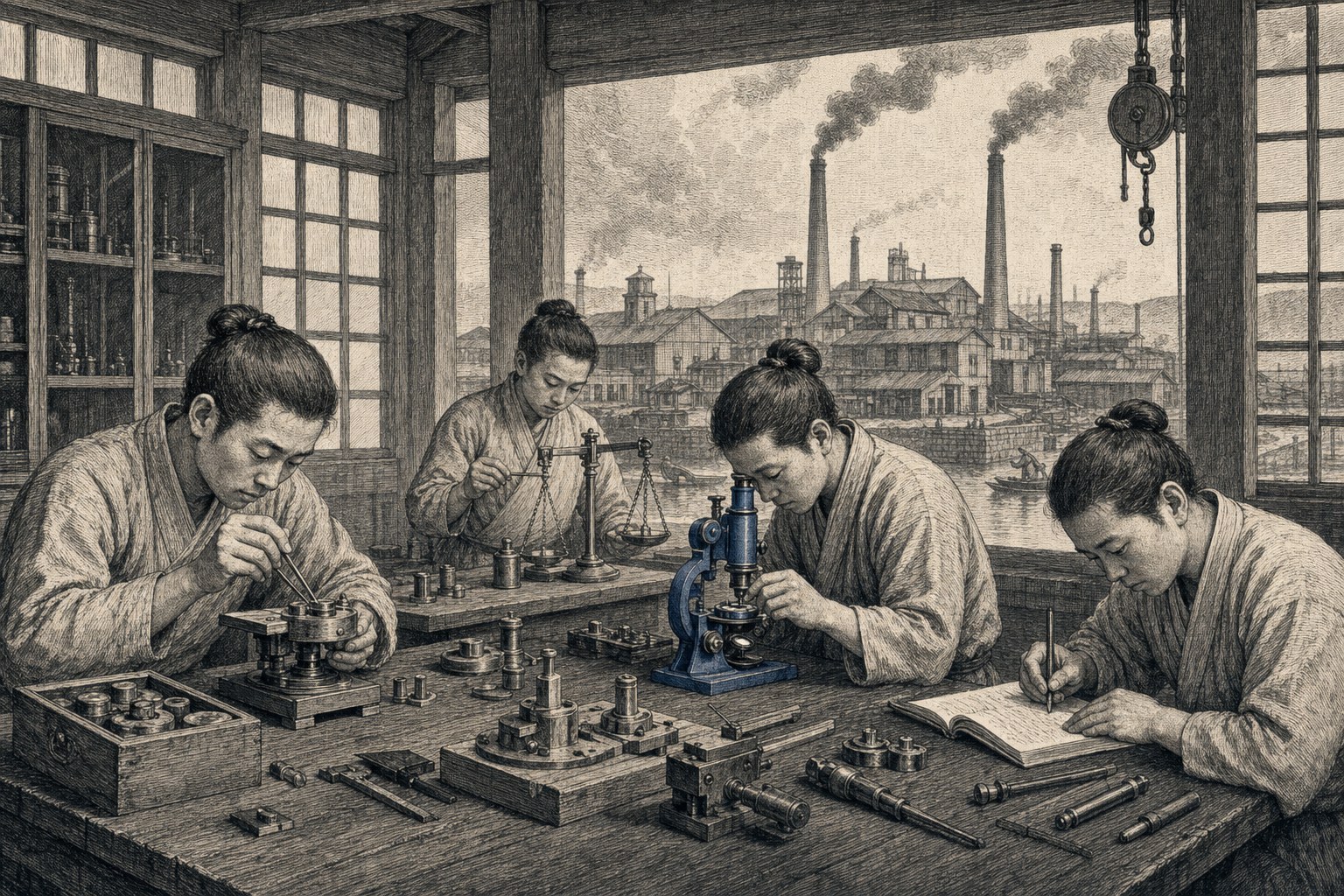
Kaoru Ishikawa took Deming's principles, translated them into shop-floor instruments, and in 1968 published his Guide to Quality Control. The seven instruments — Pareto chart, control chart, histogram, scatter diagram, stratification, checklist, and fishbone analysis — became compulsory equipment for every Japanese production unit. Hundreds of thousands of QC-circles — quality circles of workers — applied them each week on their own shop floor. Toyota, Honda, Sony, Canon, Nikon, and hundreds of less well-known companies had a Pareto analysis as routine in every production process by 1975.
The results were measurable. Between 1960 and 1980, Japan transformed itself from a post-war reconstruction economy into the world's second largest economic power.
Korea between 1963 and 1997
Korea followed a different path but with the same methodological foundation. GDP per capita grew at an average of seven per cent per year between 1963 and 1997 — three and a half decades in succession. A rate of growth that had nowhere in human history been sustained on this scale before that period.
The chaebols — Samsung, Hyundai, LG, SK, Daewoo — adopted the Japanese model of quality circles almost directly. By the late 1980s Samsung had its own Six Sigma programme, built on Ishikawa's instruments. Hyundai applied fishbone analysis in its welding shops before it exported its first car to Europe. Korea exported the equivalent of three per cent of its GDP in 1960; by 1981 that figure was thirty-seven per cent. Between those two numbers lies a methodological revolution that the Netherlands never experienced.
China after 1979
China made the leap more sharply still. Between 1979 and 2008, four-fifths of the growth in output per worker derived from improvement in Total Factor Productivity — the term economists use to capture what the Japanese called Kaizen (continuous improvement) and what the Koreans adopted as Bisangieong (flying upward). It is in essence the practice of breaking down every productive act into its Pareto components and improving precisely where the heaviest effect lies.
A World Bank study from 2020 records the finding: between 1979 and 2008, productivity improvement accounted for more than eighty per cent of the growth in output per worker. Eighty per cent. The remainder — investment, expansion of the labour force, economies of scale — was less than twenty per cent. A country of a billion people lifted itself out of poverty in thirty years, and the principal factor is precisely the instrument that our own society has declared superfluous.
What we believed we could manage without
In the Netherlands, and across Europe, a widely held conviction has existed since the 1980s that the Japanese, Korean and Chinese method belongs to "factories" — to material production. For services, for government, for healthcare, for education and for policy a different toolkit would be needed: softer, more dialogical, less hard-numerically inclined.
The opposite is true. It is precisely in the soft sectors — where the human and political consequences weigh heaviest — that the absence of ranking discipline exacts its highest cost. The Toeslagenaffaire (the Dutch childcare-benefits scandal) is a textbook example of a service that never examined its own process productivity using Ishikawa's instruments. The nitrogen policy is a textbook example of a dossier to which no Pareto analysis was ever applied. Healthcare, education, housing — sectors in which the Dutch government has performed less per euro almost without interruption since 1990, and in which the answer has invariably been more rules and more controls rather than fewer but better-targeted interventions.
We believe we can manage better without weighted Pareto. Real-world examples — Japan, Korea, China, together with domestic sectors where the method is in use, such as Dutch water management and petrochemicals — show precisely the opposite. That is not an ideological verdict. It is a measurable fact, as hard as the structural-load calculation of a steel construction.
A single figure captures the discrepancy. Three countries that embraced the instrument and multiplied their economies in thirty years; one country — our country — that rejected it and has since declined on most measures in relative terms.
This is the first reason why the rest of this edition exists. What I demonstrate in the following articles across three dossiers is not a Dutch problem alone. It is a Dutch problem that we walked into with our heads held high, while three nations showed us that it could be otherwise — and that the outcome of that otherwise has lifted hundreds of millions of people out of poverty.
Sources: Wikipedia, Japanese economic miracle; Brookings, Japan and the Asian Economies; OUP Academic, Chaebols and firm dynamics in Korea; World Bank, China's Productivity Slowdown and Future Growth Potential; Kaoru Ishikawa, Guide to Quality Control (Asian Productivity Organization, 1968).
Before I explain the principle of ranking in this edition, I must first demonstrate something that the Dutch reader will probably not find surprising — but will rarely have seen laid out in quite this form. The three countries that have overtaken us economically did not do so despite the discipline of weighted Pareto, Ishikawa and the fishbone method. They did it because they introduced that discipline systematically. We believed we could manage better without it, and that is precisely what we achieved: falling behind economically, with a sense of moral superiority as the only consolation.
A few numbers.
Japan between 1955 and 1973
Japanese Gross National Product grew at an average of just over ten per cent per year in the period 1957–1973. Between 1965 and 1980 nominal GNP rose from 91 billion dollars to more than a trillion — a twelvefold increase in fifteen years. The average monthly consumption of urban households doubled between 1955 and 1970. This is what economists came to call the Japanese economic miracle. The figures sit in every economics library.
But the miracle was no miracle. It was the outcome of a deliberate methodological choice.
In 1950 Japanese industry laboured under the reputational damage of the war years and of its own product quality; Made in Japan was synonymous with cheap and fragile. That same year the Japanese Union of Scientists and Engineers (JUSE) hosted a series of lectures by the American statistician W. Edwards Deming, who had spent the preceding years going unheard in the United States. American industry believed it had no need of quality discipline — it thought the tailwind of its wartime output sufficient. Japan thought differently.
Kaoru Ishikawa took Deming's principles, translated them into shop-floor instruments, and in 1968 published his Guide to Quality Control. The seven instruments — Pareto chart, control chart, histogram, scatter diagram, stratification, checklist, and fishbone analysis — became compulsory equipment for every Japanese production unit. Hundreds of thousands of QC-circles — quality circles of workers — applied them each week on their own shop floor. Toyota, Honda, Sony, Canon, Nikon, and hundreds of less well-known companies had a Pareto analysis as routine in every production process by 1975.
The results were measurable. Between 1960 and 1980, Japan transformed itself from a post-war reconstruction economy into the world's second largest economic power.
Korea between 1963 and 1997
Korea followed a different path but with the same methodological foundation. GDP per capita grew at an average of seven per cent per year between 1963 and 1997 — three and a half decades in succession. A rate of growth that had nowhere in human history been sustained on this scale before that period.
The chaebols — Samsung, Hyundai, LG, SK, Daewoo — adopted the Japanese model of quality circles almost directly. By the late 1980s Samsung had its own Six Sigma programme, built on Ishikawa's instruments. Hyundai applied fishbone analysis in its welding shops before it exported its first car to Europe. Korea exported the equivalent of three per cent of its GDP in 1960; by 1981 that figure was thirty-seven per cent. Between those two numbers lies a methodological revolution that the Netherlands never experienced.
China after 1979
China made the leap more sharply still. Between 1979 and 2008, four-fifths of the growth in output per worker derived from improvement in Total Factor Productivity — the term economists use to capture what the Japanese called Kaizen (continuous improvement) and what the Koreans adopted as Bisangieong (flying upward). It is in essence the practice of breaking down every productive act into its Pareto components and improving precisely where the heaviest effect lies.
A World Bank study from 2020 records the finding: between 1979 and 2008, productivity improvement accounted for more than eighty per cent of the growth in output per worker. Eighty per cent. The remainder — investment, expansion of the labour force, economies of scale — was less than twenty per cent. A country of a billion people lifted itself out of poverty in thirty years, and the principal factor is precisely the instrument that our own society has declared superfluous.
What we believed we could manage without
In the Netherlands, and across Europe, a widely held conviction has existed since the 1980s that the Japanese, Korean and Chinese method belongs to "factories" — to material production. For services, for government, for healthcare, for education and for policy a different toolkit would be needed: softer, more dialogical, less hard-numerically inclined.
The opposite is true. It is precisely in the soft sectors — where the human and political consequences weigh heaviest — that the absence of ranking discipline exacts its highest cost. The Toeslagenaffaire (the Dutch childcare-benefits scandal) is a textbook example of a service that never examined its own process productivity using Ishikawa's instruments. The nitrogen policy is a textbook example of a dossier to which no Pareto analysis was ever applied. Healthcare, education, housing — sectors in which the Dutch government has performed less per euro almost without interruption since 1990, and in which the answer has invariably been more rules and more controls rather than fewer but better-targeted interventions.
We believe we can manage better without weighted Pareto. Real-world examples — Japan, Korea, China, together with domestic sectors where the method is in use, such as Dutch water management and petrochemicals — show precisely the opposite. That is not an ideological verdict. It is a measurable fact, as hard as the structural-load calculation of a steel construction.
A single figure captures the discrepancy. Three countries that embraced the instrument and multiplied their economies in thirty years; one country — our country — that rejected it and has since declined on most measures in relative terms.
This is the first reason why the rest of this edition exists. What I demonstrate in the following articles across three dossiers is not a Dutch problem alone. It is a Dutch problem that we walked into with our heads held high, while three nations showed us that it could be otherwise — and that the outcome of that otherwise has lifted hundreds of millions of people out of poverty.
Sources: Wikipedia, Japanese economic miracle; Brookings, Japan and the Asian Economies; OUP Academic, Chaebols and firm dynamics in Korea; World Bank, China's Productivity Slowdown and Future Growth Potential; Kaoru Ishikawa, Guide to Quality Control (Asian Productivity Organization, 1968).