The Methane Misdirection
Three FD pieces in one week, three inversions of weight, four demands on the press.
Diagnosis · 14 min read
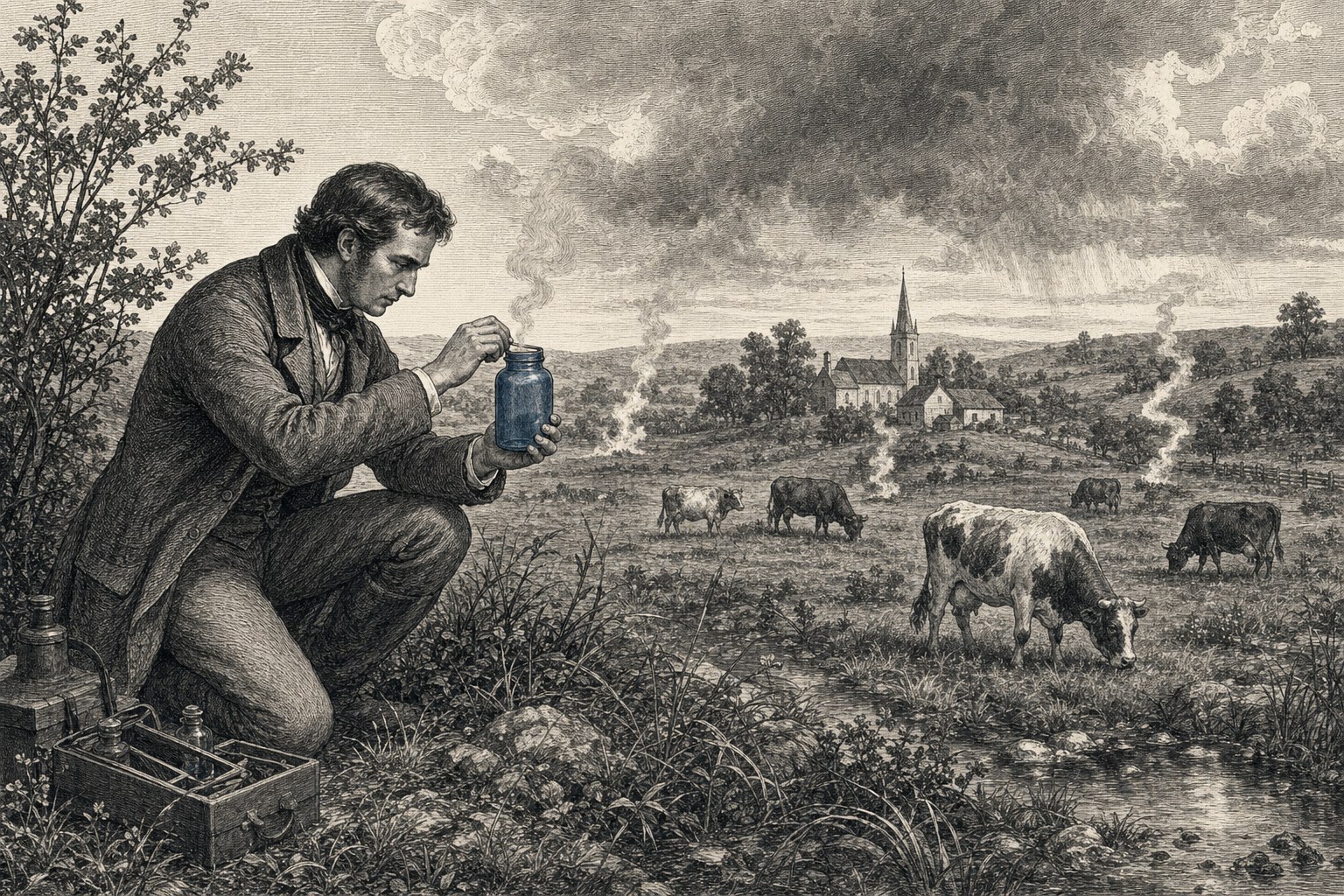
On Wednesday 20 May 2026 the Financieele Dagblad ran the headline: United States warns Europe about methane regulations. Three days later, on Saturday 23 May, a second piece appeared under the names of Bette de Koning and Eva Rooijers: Methane rules promise enormous climate gains, but gas companies say they threaten Dutch gas extraction. Three days later again, on Tuesday 26 May, TNO published a quick scan for the Ministry of Climate and Green Growth showing that 78 percent of Dutch methane emissions come from livestock farming, and only 2.7 percent from the energy sector.
Three publications in six days. Three meticulously correct percentages. Three different authors. And together they constitute a ranking error of textbook quality. What the reader retains at the end of that week is that the farmer is the problem and the gas company is relatively clean. The inverted reality has entered his mind, and he does not even know it has happened.
The Molecule
Start with the molecule. Methane forms, lives ten to twelve years in the atmosphere, and breaks down into carbon dioxide and water via reaction with the hydroxyl radical. That is not an opinion. It is chemistry. The lifespan has been established by the IPCC at an average of 11.8 years with an uncertainty margin of one and a half years.
Over those eleven years, methane is roughly 22 to 23 times more potent as a greenhouse gas than CO₂. This figure has been used for decades in Dutch and international engineering practice; it comes from IPCC AR2 and AR4. At the moment of emission the instantaneous forcing is higher — more than one hundred times — but that peak dissipates quickly. What remains, mathematically integrated over one hundred years, is a factor of 28 to 30. That is the figure that has appeared in policy documents since AR5 and AR6.
The IPCC itself explicitly distinguishes two types of methane. Fossil methane: released during oil and gas extraction, transport, coal mines. Global warming potential over one hundred years: 29.8. Non-fossil methane: released from livestock, rice cultivation, wetlands. Global warming potential over one hundred years: 27.0. The difference of nearly three units is not an arithmetic error. It stems from the fact that fossil methane adds carbon to the atmosphere that has not been there for millions of years; biogenic methane recycles carbon that was extracted from that same atmosphere by the plant a short time before. The IPCC acknowledges this distinction in its tables. The Dutch press in these three publications does not.
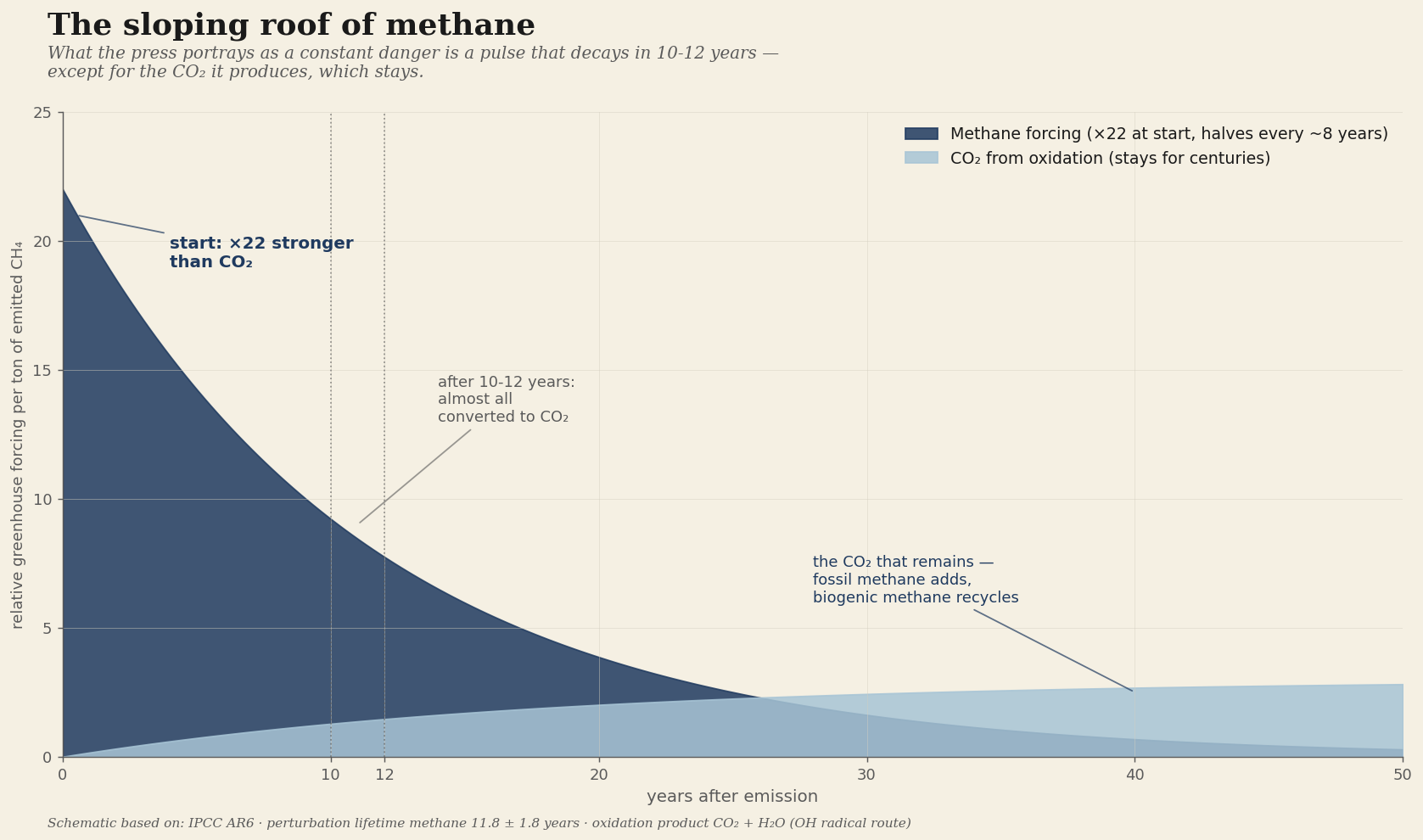
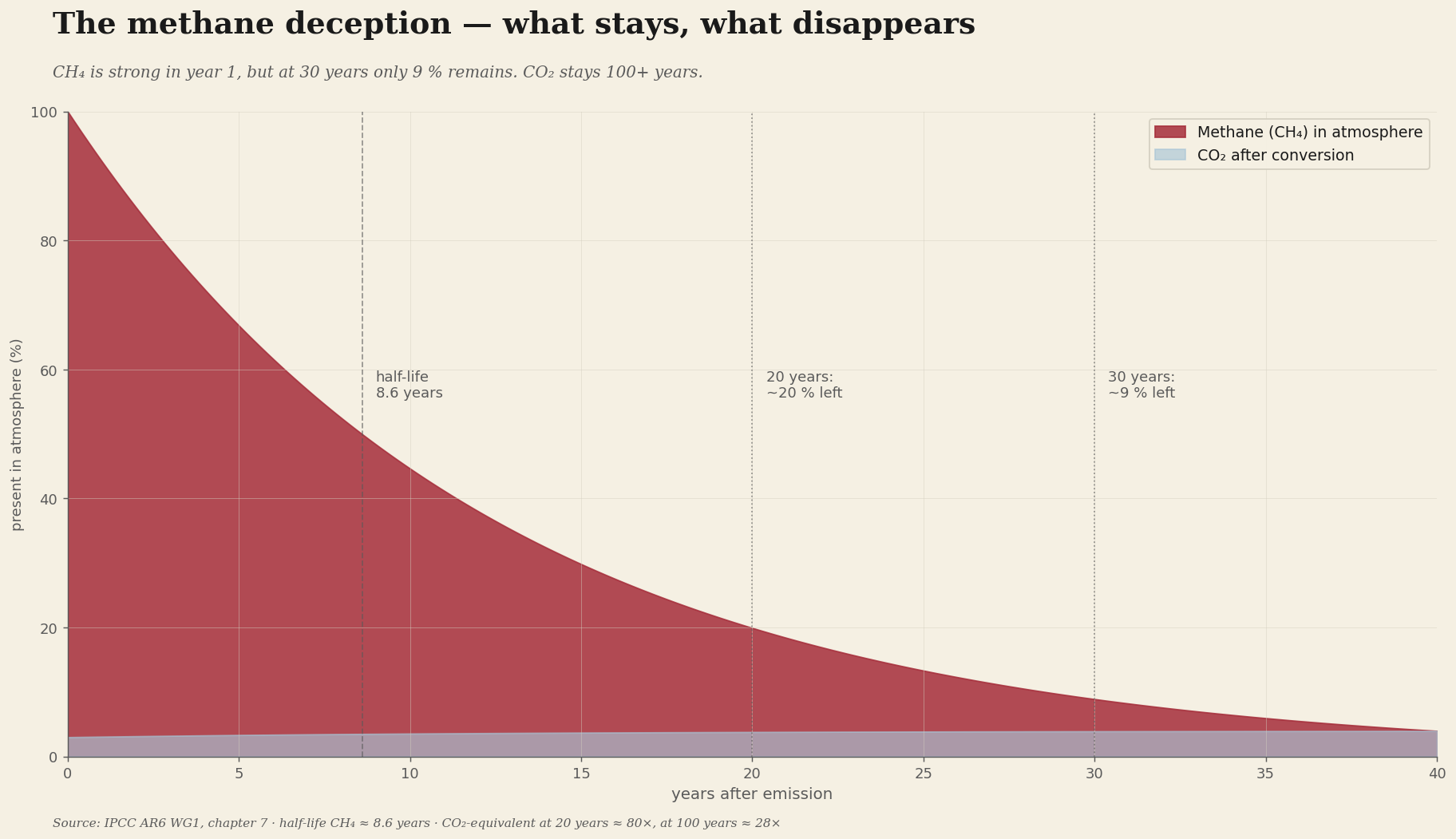
One figure tells the whole story. Methane peaks at emission, halves every eight years, and has largely disappeared after twenty-five years. What remains is the CO₂ from the oxidation. For fossil methane that CO₂ is a net addition to the carbon cycle. For biogenic methane from a stable livestock herd it is the closure of a short cycle that the plant opened ten years earlier. The plant breathed in CO₂, the animal ate the grass, the animal emitted methane, the methane oxidised back to CO₂, and the next plant breathed in the same carbon again. Climatically, a stable livestock herd is net neutral.
A gas leak is not net neutral. A drilled well extracts carbon from a layer that the sun of fifty million years ago locked away. That carbon is new to the atmosphere. It remains there, in the form into which it is converted, for centuries.
The Three Inversions
Seen this way, the three FD pieces together contain three separate ranking errors, which reinforce each other.
The first inversion is the time horizon. Whoever uses the 20-year figure for methane — factor 81 — paints the substance more dramatically than the physics allows for long-term policy. Whoever uses the 100-year figure — factor 28 — frames the matter more realistically. Which do you choose? In the FD pieces this choice is not made explicit. The figures appear as though they were natural constants. They are not. They are editorial choices dressed up as physics.
The second inversion is biogenic versus fossil. The TNO quick scan presents 78 percent livestock and 2.7 percent energy sector without drawing that distinction. But the lasting climate contribution of fossil methane per tonne is fundamentally different from that of biogenic methane per tonne. The reading public sees "78 percent" and thinks "the farmer is the chief culprit". The reading public sees "2.7 percent" and thinks "gas is a side issue". The figures are correct; the conclusion runs contrary to the physics.
The third inversion is scale. The Dutch share of global methane emissions amounts to roughly 0.3 percent. The large sources of fossil methane are in Russia, the United States, Turkmenistan, Iran. Halving the Dutch livestock herd affects a fraction of a fraction. Making American shale-gas infrastructure leak-free affects orders of magnitude more. Yet the FD editorial writes as though the Netherlands solves the problem in its own fields. The Ministry of Climate and Green Growth reports in the same tone. Both actors place the first-order problem somewhere other than where the physics locates it.
What an Engineer Would Do Here
If I received this as a construction assignment, I would do two things.
First I would make the time horizon explicit. For what purpose are you measuring? For meeting the 2030 target the 20-year factor weighs most heavily — methane is then indeed a lever. For meeting the 2100 target the 100-year factor applies — methane then recedes through its own decay and CO₂ becomes the primary factor. Without making that choice explicit, every percentage is a political statement.
Then I would separate fossil and biogenic in every calculation. Not as a statistical footnote, but as the primary column in every table. Whoever does not make this separation is not delivering science but a cultural statement: they are saying that the farmer and the gas company weigh the same, while the physics says they do not.
Finally I would identify the global context as the first-order factor. What does Dutch nitrogen and climate policy amount to in the global picture? An honest answer transforms the entire debate. The Dutch farmer is not innocent. He is also not the primary culprit for climate change. He is a third-order factor who, through his national visibility in the media debate, has been promoted to first-order factor.
Four Requirements for the Press
This cannot continue. A press that discusses warming without distinguishing the first order from the third delivers not journalism but a fog screen with which political decisions are rendered indefensible. I therefore address myself today directly to the editorial board of the Financieele Dagblad and, by extension, to every Dutch editorial team that publishes on climate.
From the next article about greenhouse gases onwards, I expect your editorial team to meet four requirements.
One. State the time horizon of every GWP value used. Twenty years or one hundred years. Not "methane is x times more potent than CO₂", but "methane is over twenty years x times more potent, over one hundred years y times". Otherwise what you are claiming is not measurable.
Two. Distinguish between biogenic and fossil methane in every piece in which you discuss both. The IPCC does so itself in its tables. A journalist who does not is presenting a claim that contradicts their own source.
Three. Place Dutch figures in global context. A national percentage without a global ratio is a confession, not an observation.
Four. Have every greenhouse gas article read by a physicist or environmental chemist before publication. Not by a policy analyst. The subject matter is exact, the consequences are societal, and the margin for error is narrow.
None of these four requirements is contested in science. None of the four is applied by your editorial team today. The difference between those two sentences is the real threat to climate policy in this country.
On Wednesday 20 May 2026 the Financieele Dagblad ran the headline: United States warns Europe about methane regulations. Three days later, on Saturday 23 May, a second piece appeared under the names of Bette de Koning and Eva Rooijers: Methane rules promise enormous climate gains, but gas companies say they threaten Dutch gas extraction. Three days later again, on Tuesday 26 May, TNO published a quick scan for the Ministry of Climate and Green Growth showing that 78 percent of Dutch methane emissions come from livestock farming, and only 2.7 percent from the energy sector.
Three publications in six days. Three meticulously correct percentages. Three different authors. And together they constitute a ranking error of textbook quality. What the reader retains at the end of that week is that the farmer is the problem and the gas company is relatively clean. The inverted reality has entered his mind, and he does not even know it has happened.
The Molecule
Start with the molecule. Methane forms, lives ten to twelve years in the atmosphere, and breaks down into carbon dioxide and water via reaction with the hydroxyl radical. That is not an opinion. It is chemistry. The lifespan has been established by the IPCC at an average of 11.8 years with an uncertainty margin of one and a half years.
Over those eleven years, methane is roughly 22 to 23 times more potent as a greenhouse gas than CO₂. This figure has been used for decades in Dutch and international engineering practice; it comes from IPCC AR2 and AR4. At the moment of emission the instantaneous forcing is higher — more than one hundred times — but that peak dissipates quickly. What remains, mathematically integrated over one hundred years, is a factor of 28 to 30. That is the figure that has appeared in policy documents since AR5 and AR6.
The IPCC itself explicitly distinguishes two types of methane. Fossil methane: released during oil and gas extraction, transport, coal mines. Global warming potential over one hundred years: 29.8. Non-fossil methane: released from livestock, rice cultivation, wetlands. Global warming potential over one hundred years: 27.0. The difference of nearly three units is not an arithmetic error. It stems from the fact that fossil methane adds carbon to the atmosphere that has not been there for millions of years; biogenic methane recycles carbon that was extracted from that same atmosphere by the plant a short time before. The IPCC acknowledges this distinction in its tables. The Dutch press in these three publications does not.
One figure tells the whole story. Methane peaks at emission, halves every eight years, and has largely disappeared after twenty-five years. What remains is the CO₂ from the oxidation. For fossil methane that CO₂ is a net addition to the carbon cycle. For biogenic methane from a stable livestock herd it is the closure of a short cycle that the plant opened ten years earlier. The plant breathed in CO₂, the animal ate the grass, the animal emitted methane, the methane oxidised back to CO₂, and the next plant breathed in the same carbon again. Climatically, a stable livestock herd is net neutral.
A gas leak is not net neutral. A drilled well extracts carbon from a layer that the sun of fifty million years ago locked away. That carbon is new to the atmosphere. It remains there, in the form into which it is converted, for centuries.
The Three Inversions
Seen this way, the three FD pieces together contain three separate ranking errors, which reinforce each other.
The first inversion is the time horizon. Whoever uses the 20-year figure for methane — factor 81 — paints the substance more dramatically than the physics allows for long-term policy. Whoever uses the 100-year figure — factor 28 — frames the matter more realistically. Which do you choose? In the FD pieces this choice is not made explicit. The figures appear as though they were natural constants. They are not. They are editorial choices dressed up as physics.
The second inversion is biogenic versus fossil. The TNO quick scan presents 78 percent livestock and 2.7 percent energy sector without drawing that distinction. But the lasting climate contribution of fossil methane per tonne is fundamentally different from that of biogenic methane per tonne. The reading public sees "78 percent" and thinks "the farmer is the chief culprit". The reading public sees "2.7 percent" and thinks "gas is a side issue". The figures are correct; the conclusion runs contrary to the physics.
The third inversion is scale. The Dutch share of global methane emissions amounts to roughly 0.3 percent. The large sources of fossil methane are in Russia, the United States, Turkmenistan, Iran. Halving the Dutch livestock herd affects a fraction of a fraction. Making American shale-gas infrastructure leak-free affects orders of magnitude more. Yet the FD editorial writes as though the Netherlands solves the problem in its own fields. The Ministry of Climate and Green Growth reports in the same tone. Both actors place the first-order problem somewhere other than where the physics locates it.
What an Engineer Would Do Here
If I received this as a construction assignment, I would do two things.
First I would make the time horizon explicit. For what purpose are you measuring? For meeting the 2030 target the 20-year factor weighs most heavily — methane is then indeed a lever. For meeting the 2100 target the 100-year factor applies — methane then recedes through its own decay and CO₂ becomes the primary factor. Without making that choice explicit, every percentage is a political statement.
Then I would separate fossil and biogenic in every calculation. Not as a statistical footnote, but as the primary column in every table. Whoever does not make this separation is not delivering science but a cultural statement: they are saying that the farmer and the gas company weigh the same, while the physics says they do not.
Finally I would identify the global context as the first-order factor. What does Dutch nitrogen and climate policy amount to in the global picture? An honest answer transforms the entire debate. The Dutch farmer is not innocent. He is also not the primary culprit for climate change. He is a third-order factor who, through his national visibility in the media debate, has been promoted to first-order factor.
Four Requirements for the Press
This cannot continue. A press that discusses warming without distinguishing the first order from the third delivers not journalism but a fog screen with which political decisions are rendered indefensible. I therefore address myself today directly to the editorial board of the Financieele Dagblad and, by extension, to every Dutch editorial team that publishes on climate.
From the next article about greenhouse gases onwards, I expect your editorial team to meet four requirements.
One. State the time horizon of every GWP value used. Twenty years or one hundred years. Not "methane is x times more potent than CO₂", but "methane is over twenty years x times more potent, over one hundred years y times". Otherwise what you are claiming is not measurable.
Two. Distinguish between biogenic and fossil methane in every piece in which you discuss both. The IPCC does so itself in its tables. A journalist who does not is presenting a claim that contradicts their own source.
Three. Place Dutch figures in global context. A national percentage without a global ratio is a confession, not an observation.
Four. Have every greenhouse gas article read by a physicist or environmental chemist before publication. Not by a policy analyst. The subject matter is exact, the consequences are societal, and the margin for error is narrow.
None of these four requirements is contested in science. None of the four is applied by your editorial team today. The difference between those two sentences is the real threat to climate policy in this country.