The Plant That Moves
Nitrogen, drought, climate shift, fragmentation — and the policy that sees only one of the four.
Diagnosis · 12 min read
A similar error lurks in another dossier, where the stakes are even more personal. The nitrogen dossier has determined Dutch rural politics since 2019. A Council of State ruling in May of that year set aside the Programma Aanpak Stikstof [Programme Approach Nitrogen, PAS]; since then a cabinet has fallen, tens of thousands of farmers have been bought out or threatened with compulsory purchase, and the political landscape has shifted through one party that built its entire raison d'être on this single issue.
The dossier is presented as though there is one primary cause: excessive nitrogen deposition on vulnerable nature. That is correct as one factor. It is misleading as a first-order factor. Because in the heathland and calcareous grasslands where this nature lives, at least three other factors are operating simultaneously, each contributing a comparable or heavier share to the actual vegetation loss.
The Four Factors
The first factor — nitrogen deposition from agriculture and traffic — is the one that policy identifies exclusively. I estimate its contribution to vegetation loss in these areas at roughly thirty percent. That is a substantial contribution. It is not sole dominance.
The second factor is desiccation. The groundwater level in the Dutch sandy soils has been falling for decades. Through drainage, through paved urbanisation that runs off rainwater instead of letting it infiltrate, through deep drinking-water extraction. When the root zone dries out, the mineralisation of organic matter in the soil accelerates. That breakdown releases nitrogen and phosphate — from the soil itself. The system chokes itself, even without a single ammonia molecule from a cow. STOWA names this explicitly in its delta fact on terrestrial nature: desiccation thereby also leads to eutrophication. I estimate the contribution of this factor at roughly twenty-eight percent. Nearly equal to the first.
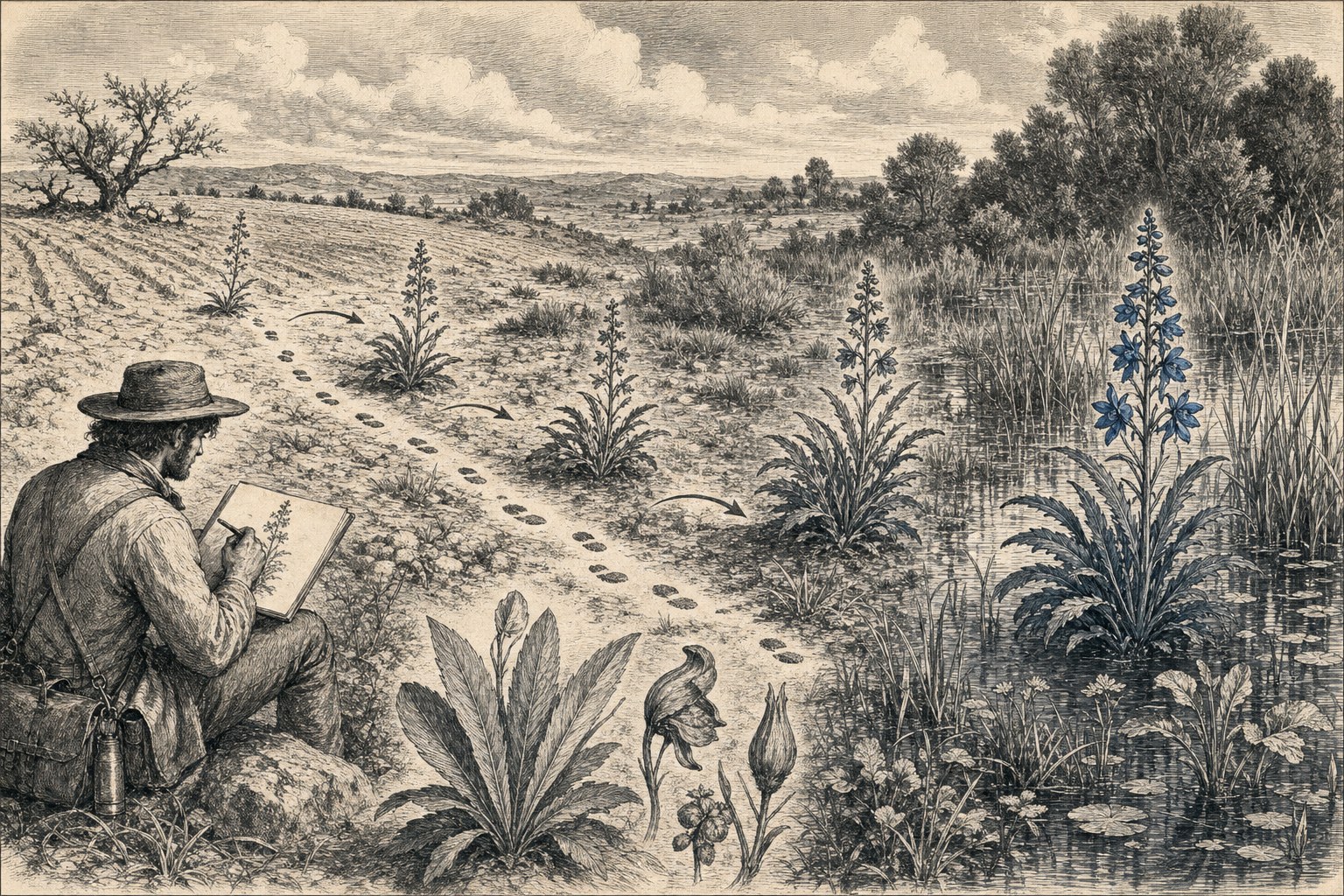
The third factor is climate shift. Species distribution studies in Europe indicate that plant and animal species are shifting northward at an average of seventeen kilometres per decade. The vegetation we wish to conserve in our Natura 2000 sites may simply no longer be capable of growing here by 2050 — not because of nitrogen, but because a climate that has moved the species optimum to Scandinavia. The European Commission acknowledged this on 25 March 2026 in new guidance for Natura 2000: area boundaries and conservation targets must be able to move with the climate. Brussels says it. The Hague is deaf. I estimate this factor at twenty-two percent.
The fourth factor is historical habitat fragmentation. Roads, canals, urbanisation, intensive land use between nature areas — everything that prevents species from finding or reaching their habitat. A species that disappears from the Veluwe can no longer migrate to the Drents-Friese Wold as it did in the nineteenth century. This factor contributes an estimated eighteen percent to vegetation loss. Not the largest, but a persistent one.
Together these four factors account for roughly one hundred percent. In policy, only the first appears. Three first-order factors are treated as footnotes — when they appear at all — while one is inflated into the sole cause.
The Static Model
The problem is conceptual. Dutch nature conservation operates from a static model: here are areas, here are species, here are targets, and policy must maintain the species in the designated areas as they were recorded in 1990 or 2000. That model is well-intentioned. It is also fundamentally untenable in a changing climate.
A dynamic nature policy would look different. It would accept that some species will disappear here and appear elsewhere. It would not spend resources solely on nitrogen reduction on the Veluwe, but also on corridor construction towards Germany, on reserve expansion in cooler areas, on acceptance of changing vegetation where change is unavoidable. It would put less energy into preventing what cannot be prevented, and more into enabling what is inevitably shifting.
That is precisely what Brussels prescribed in March 2026. It was not to be found on any Dutch newspaper front page.
What This Does to the Farmer
Here the order inversion reaches the human scale. Thirty-five thousand Dutch farmers have in the past five years faced regulations that threatened or ended their business, motivated by one of the four factors in this diagram. For the other three factors — desiccation, climate shift, fragmentation — no comparable policy effort has been made. Agriculture was held almost solely responsible for vegetation loss of which, at best, it delivers one third.
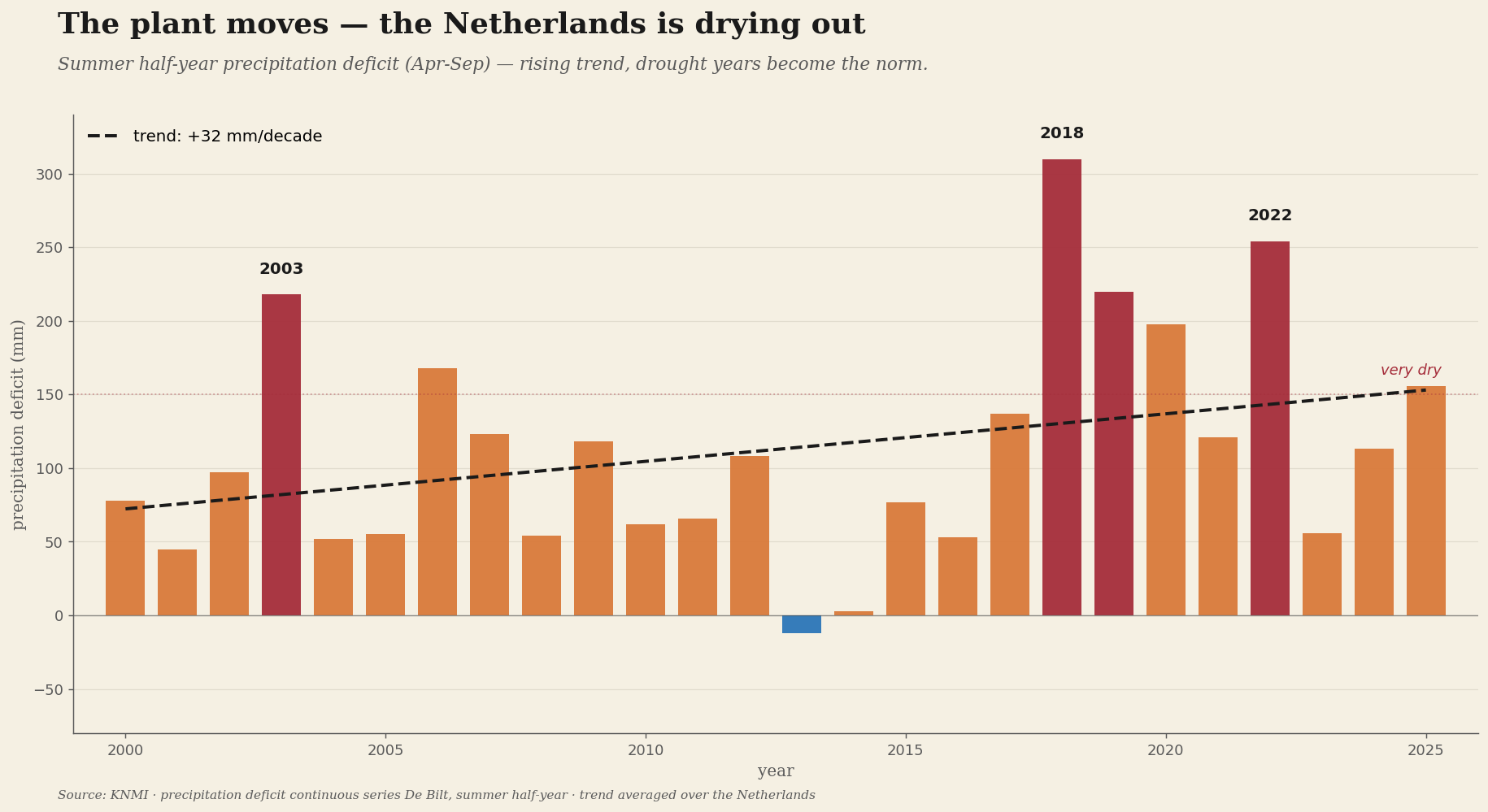
The figures from KNMI [the Royal Netherlands Meteorological Institute] confirm what the plants themselves are already showing: the precipitation deficit in the summer half-year has increased by roughly a third over twenty-five years. The drought years of 2018, 2019, 2020, and 2022 were not incidents. They constitute the trend. A plant that for the past twenty years grew at a given location now finds less water there than before — and that drought has a greater effect on vegetation than an extra kilogram of nitrogen per hectare. Whoever combats the one factor while ignoring the other is fighting the wrong thing.
This is not a plea to abolish nitrogen policy. That would be the opposite order inversion — treating a third-order factor as zero. It is a plea to conduct policy proportionally. Whoever bears thirty percent of the cause bears thirty percent of the burden. Not one hundred. And the other seventy percent calls for instruments we are not developing today, because our gaze is fixed on one variable.
A judge in May 2019 saw this, in a certain sense. The Council of State set aside the Programma Aanpak Stikstof because it was insufficiently controlling nitrogen as one factor. That was legally correct. It was incomplete in terms of ranking. Since then the debate has remained stuck within that one factor, while three others roll on without regulation. The judge worked with the law before him. Policy should have recognised that the law itself was built on a first-order error.
A similar error lurks in another dossier, where the stakes are even more personal. The nitrogen dossier has determined Dutch rural politics since 2019. A Council of State ruling in May of that year set aside the Programma Aanpak Stikstof [Programme Approach Nitrogen, PAS]; since then a cabinet has fallen, tens of thousands of farmers have been bought out or threatened with compulsory purchase, and the political landscape has shifted through one party that built its entire raison d'être on this single issue.
The dossier is presented as though there is one primary cause: excessive nitrogen deposition on vulnerable nature. That is correct as one factor. It is misleading as a first-order factor. Because in the heathland and calcareous grasslands where this nature lives, at least three other factors are operating simultaneously, each contributing a comparable or heavier share to the actual vegetation loss.
The Four Factors
The first factor — nitrogen deposition from agriculture and traffic — is the one that policy identifies exclusively. I estimate its contribution to vegetation loss in these areas at roughly thirty percent. That is a substantial contribution. It is not sole dominance.
The second factor is desiccation. The groundwater level in the Dutch sandy soils has been falling for decades. Through drainage, through paved urbanisation that runs off rainwater instead of letting it infiltrate, through deep drinking-water extraction. When the root zone dries out, the mineralisation of organic matter in the soil accelerates. That breakdown releases nitrogen and phosphate — from the soil itself. The system chokes itself, even without a single ammonia molecule from a cow. STOWA names this explicitly in its delta fact on terrestrial nature: desiccation thereby also leads to eutrophication. I estimate the contribution of this factor at roughly twenty-eight percent. Nearly equal to the first.
The third factor is climate shift. Species distribution studies in Europe indicate that plant and animal species are shifting northward at an average of seventeen kilometres per decade. The vegetation we wish to conserve in our Natura 2000 sites may simply no longer be capable of growing here by 2050 — not because of nitrogen, but because a climate that has moved the species optimum to Scandinavia. The European Commission acknowledged this on 25 March 2026 in new guidance for Natura 2000: area boundaries and conservation targets must be able to move with the climate. Brussels says it. The Hague is deaf. I estimate this factor at twenty-two percent.
The fourth factor is historical habitat fragmentation. Roads, canals, urbanisation, intensive land use between nature areas — everything that prevents species from finding or reaching their habitat. A species that disappears from the Veluwe can no longer migrate to the Drents-Friese Wold as it did in the nineteenth century. This factor contributes an estimated eighteen percent to vegetation loss. Not the largest, but a persistent one.
Together these four factors account for roughly one hundred percent. In policy, only the first appears. Three first-order factors are treated as footnotes — when they appear at all — while one is inflated into the sole cause.
The Static Model
The problem is conceptual. Dutch nature conservation operates from a static model: here are areas, here are species, here are targets, and policy must maintain the species in the designated areas as they were recorded in 1990 or 2000. That model is well-intentioned. It is also fundamentally untenable in a changing climate.
A dynamic nature policy would look different. It would accept that some species will disappear here and appear elsewhere. It would not spend resources solely on nitrogen reduction on the Veluwe, but also on corridor construction towards Germany, on reserve expansion in cooler areas, on acceptance of changing vegetation where change is unavoidable. It would put less energy into preventing what cannot be prevented, and more into enabling what is inevitably shifting.
That is precisely what Brussels prescribed in March 2026. It was not to be found on any Dutch newspaper front page.
What This Does to the Farmer
Here the order inversion reaches the human scale. Thirty-five thousand Dutch farmers have in the past five years faced regulations that threatened or ended their business, motivated by one of the four factors in this diagram. For the other three factors — desiccation, climate shift, fragmentation — no comparable policy effort has been made. Agriculture was held almost solely responsible for vegetation loss of which, at best, it delivers one third.
The figures from KNMI [the Royal Netherlands Meteorological Institute] confirm what the plants themselves are already showing: the precipitation deficit in the summer half-year has increased by roughly a third over twenty-five years. The drought years of 2018, 2019, 2020, and 2022 were not incidents. They constitute the trend. A plant that for the past twenty years grew at a given location now finds less water there than before — and that drought has a greater effect on vegetation than an extra kilogram of nitrogen per hectare. Whoever combats the one factor while ignoring the other is fighting the wrong thing.
This is not a plea to abolish nitrogen policy. That would be the opposite order inversion — treating a third-order factor as zero. It is a plea to conduct policy proportionally. Whoever bears thirty percent of the cause bears thirty percent of the burden. Not one hundred. And the other seventy percent calls for instruments we are not developing today, because our gaze is fixed on one variable.
A judge in May 2019 saw this, in a certain sense. The Council of State set aside the Programma Aanpak Stikstof because it was insufficiently controlling nitrogen as one factor. That was legally correct. It was incomplete in terms of ranking. Since then the debate has remained stuck within that one factor, while three others roll on without regulation. The judge worked with the law before him. Policy should have recognised that the law itself was built on a first-order error.