The dissidents
Sandra Palmen-Schlangen, Eva González Pérez, Ad Bos — three verified compass-bearers.
Profiles · 15 min read
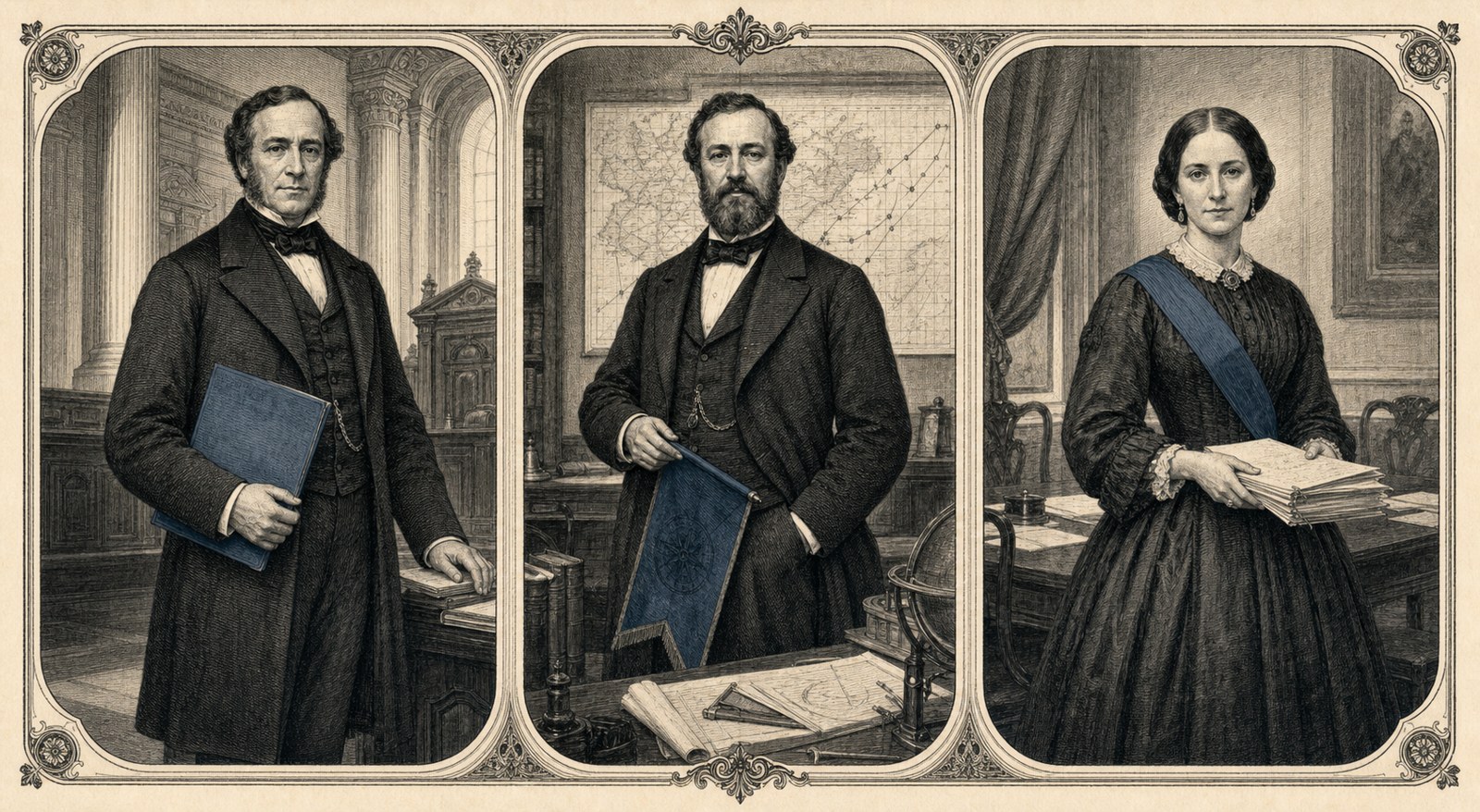
What the previous two dossiers show is a systematic inversion of gravity in the press and in government. The question, then, is this: are there people who, amid that inversion, nevertheless continued to distinguish the first order? The answer is yes. They are rare, they are usually not famous, and when they do become famous, it is because the system has tried to break them.
Here are three of them. Not as heroes. As the keepers of a lost compass.
Sandra Palmen-Schlangen — the memo that vanished
In March 2017, Sandra Palmen-Schlangen, at the time the highest-ranking legal official in the Tax Administration’s Benefits Division, wrote an internal advisory. Her supervisor had asked her to examine the CAF-11 case file — a group of parents whose childcare benefits had been collectively halted. The Council of State had already ruled that the Service had failed to comply with the law.
Palmen’s conclusion was stark: the suspension was based on an incorrect legal basis, parents had been denied the legal protection guaranteed to them by law, and the Service had acted culpably. Her advice: stop pursuing the case through the courts and offer compensation through a settlement agreement.
What she saw was first order. What the system held up before her was third order dressed up as procedure. The law, as it was applied, denied people what the law formally granted them. Collective anti-fraud enforcement based on risk models was legally covered — in reality, it violated the rule of law.
Her memo was discussed and rejected in two official meetings. Shortly afterward, Palmen was transferred from Benefits to Customs. The memo vanished into the organization — so thoroughly that eight separate investigations were needed to find it again. The accountancy firm PwC concluded in October 2021 that the disappearance of the memo remained unresolved. When the memo finally resurfaced in 2020 — Palmen still had it on her laptop — it became a key document in the parliamentary inquiry into childcare benefits. Three senior civil servants turned out to have known about the memo while testifying under oath that they knew nothing. The National Criminal Investigation Department opened a perjury investigation.
In 2024, Palmen was appointed State Secretary for Benefits Recovery. “Now I’m allowed to close the circle,” she said at her hearing in the House of Representatives, “from warning about injustice at the beginning of the benefits scandal to working on its conclusion.” Seven years between writing the memo and its acknowledgment. For the twenty thousand families for whom she had called for compensation at the time, seven years too late.
Sources: Tweedekamer.nl, Palmen memo dossier (research overview); NPO Radio 1 interview, 15 December 2022; Accountancy van Morgen, PwC report on the Palmen memo, 28 October 2021; Rijksoverheid, government ministers and state secretaries page.
Eva González Pérez — the lawyer in Helmond
Eva González Pérez discovered the benefits scandal not through a tip, but through her husband’s mailbox. He ran a childminding agency; his clients received letters from the Tax Administration informing them that their benefits were being stopped. González Pérez, a lawyer in Helmond, took on the first case in 2014. She thought: send everything in, and it will be resolved quickly. It wasn’t.
What she saw was once again first order. The Tax Administration treated childcare benefits as a mass process; applications were assessed collectively using risk models; when suspicion arose, benefits were stopped across entire groups and the recipient had to prove their entitlement to payment — not the other way around. Legally, this appeared to be covered by the Fraud Act. In reality, it was a reversal of the burden of proof that the rule of law does not permit.
In 2016, she discovered the so-called inclusion and exclusion lists — databases containing more than two hundred and sixty thousand names that the Service used internally and shared with other government agencies. She established that selection was based on nationality. A third-order criterion, dual nationality, had been turned into a first-order reason for exclusion. A textbook-quality inversion of hierarchy, the same inversion described throughout this edition, but in a case file where families were destroyed instead of headlines.
For years, González Pérez lost more cases than she won. She worked from a small office, on fees out of all proportion to the hours involved. “It was shocking and demoralizing to discover that a government institution itself was violating the law,” she later said at Utrecht University.
On 16 November 2020, she was the first witness heard by the parliamentary inquiry committee on childcare benefits. Her work contributed directly to the conclusion that “the fundamental principles of the rule of law” had been violated. The Rutte III cabinet resigned in January 2021. González Pérez received the Golden Hourglass in 2021, a royal decoration in 2022, and in 2024 handed the work over to the approximately three hundred lawyers by then involved in its resolution.
What distinguishes her from the professional average is neither talent nor courage. It is persistence in a hierarchy that no one around her took seriously. For ten years, she endured what her colleagues had dismissed as procedural triviality. At the end of those ten years, the procedural triviality turned out to be a first-order violation of the rule of law.
Sources: Utrecht University, alumni profile; Advocatie.nl interview, 10 September 2024; Wikipedia, Parliamentary inquiry into childcare benefits.
Ad Bos — the accounts left at the front door
In 1998, Ad Bos, former technical director of the Groningen construction company Koop Tjuchem, found two garbage bags outside his front door. Inside was the company’s shadow accounting — records showing how Dutch construction firms settled costs among themselves as part of prohibited price-fixing agreements. He initially followed the official route: reporting the matter to several authorities, including the Public Prosecution Service. In July 2001, he received a letter from the Public Prosecution Service stating that nothing would be done with the case. He then gave Zembla the green light. The broadcast aired on 9 November 2001.
What he saw was first order. A system of price-fixing agreements that had been maintained for ten years with the knowledge of senior civil servants and commissioning authorities — including Rijkswaterstaat. On average, clients were charged 8.8 percent too much, costing the Dutch state hundreds of millions of euros. Six hundred companies turned out to be involved. The parliamentary inquiry that began in August 2002 concluded that there had been large-scale fraud, cartel-like structures, and completely failed oversight. Minister Benk Korthals resigned.
Bos lost almost everything. Persona non grata in the construction world, no more work in his field, his villa sold, three years living with his wife in a camper van. Meanwhile, he was the one prosecuted. In 2005, he was given a suspended prison sentence for bribing a civil servant — an offense for which, as a director, he bore joint responsibility, but which was now being used against him. On appeal in 2008, the Public Prosecution Service was declared inadmissible because he had not received a fair trial. After a settlement in 2009, the state continued to litigate against him. “The dark side of the government has carried on litigating against us,” Bos said in 2023. More than two decades after his report, he is still fighting for recognition.
The 2022 private member’s bill on whistleblower protection cites Bos as a cautionary example of what can go wrong when a system punishes its own exposure. What his case means for this edition is more brutal than that: even those who correctly identify the first order can be ground down by the system because the procedural machine has no entry point for the message that it itself is built on the third order. Bos was not a civil servant who was permitted to deviate; he was an outsider who forced the system to look at itself. The price was, and remains, his life.
Sources: BNNVARA, interview with Ad Bos 25 years after the construction fraud, 15 May 2023; Transparency International, 20 years after the construction fraud, 20 November 2021; Tweedekamer.nl, 2022 private member’s bill on whistleblowers; Wikipedia, Parliamentary inquiry into construction fraud.
What they have in common
None of these three calls themselves brave. Ask them and you get variations on the same answer: I had no choice. That sounds like modesty, but it is exact. For those who can still see the first order, looking away is a mutilating act. Not mutilating is not heroism — it is self-preservation. What should astonish us most is not that some people act this way, but that so few do.
Their shared characteristic is neither courage, political conviction, nor ideology. It is that, at the decisive moment, they were able to detach their gaze from the paper before them and look at what the procedure concealed. A hierarchy instinct that our society broadly possessed in the twentieth century, and has systematically unlearned in the twenty-first.
That is why Edition 5 is not merely a diagnosis. It is also a tribute. To people who, in an order-inverted world, nevertheless took the trouble to see the first order.
They couldn’t care less about this tribute. That is precisely why they receive it.
What the previous two dossiers show is a systematic inversion of gravity in the press and in government. The question, then, is this: are there people who, amid that inversion, nevertheless continued to distinguish the first order? The answer is yes. They are rare, they are usually not famous, and when they do become famous, it is because the system has tried to break them.
Here are three of them. Not as heroes. As the keepers of a lost compass.
Sandra Palmen-Schlangen — the memo that vanished
In March 2017, Sandra Palmen-Schlangen, at the time the highest-ranking legal official in the Tax Administration’s Benefits Division, wrote an internal advisory. Her supervisor had asked her to examine the CAF-11 case file — a group of parents whose childcare benefits had been collectively halted. The Council of State had already ruled that the Service had failed to comply with the law.
Palmen’s conclusion was stark: the suspension was based on an incorrect legal basis, parents had been denied the legal protection guaranteed to them by law, and the Service had acted culpably. Her advice: stop pursuing the case through the courts and offer compensation through a settlement agreement.
What she saw was first order. What the system held up before her was third order dressed up as procedure. The law, as it was applied, denied people what the law formally granted them. Collective anti-fraud enforcement based on risk models was legally covered — in reality, it violated the rule of law.
Her memo was discussed and rejected in two official meetings. Shortly afterward, Palmen was transferred from Benefits to Customs. The memo vanished into the organization — so thoroughly that eight separate investigations were needed to find it again. The accountancy firm PwC concluded in October 2021 that the disappearance of the memo remained unresolved. When the memo finally resurfaced in 2020 — Palmen still had it on her laptop — it became a key document in the parliamentary inquiry into childcare benefits. Three senior civil servants turned out to have known about the memo while testifying under oath that they knew nothing. The National Criminal Investigation Department opened a perjury investigation.
In 2024, Palmen was appointed State Secretary for Benefits Recovery. “Now I’m allowed to close the circle,” she said at her hearing in the House of Representatives, “from warning about injustice at the beginning of the benefits scandal to working on its conclusion.” Seven years between writing the memo and its acknowledgment. For the twenty thousand families for whom she had called for compensation at the time, seven years too late.
Sources: Tweedekamer.nl, Palmen memo dossier (research overview); NPO Radio 1 interview, 15 December 2022; Accountancy van Morgen, PwC report on the Palmen memo, 28 October 2021; Rijksoverheid, government ministers and state secretaries page.
Eva González Pérez — the lawyer in Helmond
Eva González Pérez discovered the benefits scandal not through a tip, but through her husband’s mailbox. He ran a childminding agency; his clients received letters from the Tax Administration informing them that their benefits were being stopped. González Pérez, a lawyer in Helmond, took on the first case in 2014. She thought: send everything in, and it will be resolved quickly. It wasn’t.
What she saw was once again first order. The Tax Administration treated childcare benefits as a mass process; applications were assessed collectively using risk models; when suspicion arose, benefits were stopped across entire groups and the recipient had to prove their entitlement to payment — not the other way around. Legally, this appeared to be covered by the Fraud Act. In reality, it was a reversal of the burden of proof that the rule of law does not permit.
In 2016, she discovered the so-called inclusion and exclusion lists — databases containing more than two hundred and sixty thousand names that the Service used internally and shared with other government agencies. She established that selection was based on nationality. A third-order criterion, dual nationality, had been turned into a first-order reason for exclusion. A textbook-quality inversion of hierarchy, the same inversion described throughout this edition, but in a case file where families were destroyed instead of headlines.
For years, González Pérez lost more cases than she won. She worked from a small office, on fees out of all proportion to the hours involved. “It was shocking and demoralizing to discover that a government institution itself was violating the law,” she later said at Utrecht University.
On 16 November 2020, she was the first witness heard by the parliamentary inquiry committee on childcare benefits. Her work contributed directly to the conclusion that “the fundamental principles of the rule of law” had been violated. The Rutte III cabinet resigned in January 2021. González Pérez received the Golden Hourglass in 2021, a royal decoration in 2022, and in 2024 handed the work over to the approximately three hundred lawyers by then involved in its resolution.
What distinguishes her from the professional average is neither talent nor courage. It is persistence in a hierarchy that no one around her took seriously. For ten years, she endured what her colleagues had dismissed as procedural triviality. At the end of those ten years, the procedural triviality turned out to be a first-order violation of the rule of law.
Sources: Utrecht University, alumni profile; Advocatie.nl interview, 10 September 2024; Wikipedia, Parliamentary inquiry into childcare benefits.
Ad Bos — the accounts left at the front door
In 1998, Ad Bos, former technical director of the Groningen construction company Koop Tjuchem, found two garbage bags outside his front door. Inside was the company’s shadow accounting — records showing how Dutch construction firms settled costs among themselves as part of prohibited price-fixing agreements. He initially followed the official route: reporting the matter to several authorities, including the Public Prosecution Service. In July 2001, he received a letter from the Public Prosecution Service stating that nothing would be done with the case. He then gave Zembla the green light. The broadcast aired on 9 November 2001.
What he saw was first order. A system of price-fixing agreements that had been maintained for ten years with the knowledge of senior civil servants and commissioning authorities — including Rijkswaterstaat. On average, clients were charged 8.8 percent too much, costing the Dutch state hundreds of millions of euros. Six hundred companies turned out to be involved. The parliamentary inquiry that began in August 2002 concluded that there had been large-scale fraud, cartel-like structures, and completely failed oversight. Minister Benk Korthals resigned.
Bos lost almost everything. Persona non grata in the construction world, no more work in his field, his villa sold, three years living with his wife in a camper van. Meanwhile, he was the one prosecuted. In 2005, he was given a suspended prison sentence for bribing a civil servant — an offense for which, as a director, he bore joint responsibility, but which was now being used against him. On appeal in 2008, the Public Prosecution Service was declared inadmissible because he had not received a fair trial. After a settlement in 2009, the state continued to litigate against him. “The dark side of the government has carried on litigating against us,” Bos said in 2023. More than two decades after his report, he is still fighting for recognition.
The 2022 private member’s bill on whistleblower protection cites Bos as a cautionary example of what can go wrong when a system punishes its own exposure. What his case means for this edition is more brutal than that: even those who correctly identify the first order can be ground down by the system because the procedural machine has no entry point for the message that it itself is built on the third order. Bos was not a civil servant who was permitted to deviate; he was an outsider who forced the system to look at itself. The price was, and remains, his life.
Sources: BNNVARA, interview with Ad Bos 25 years after the construction fraud, 15 May 2023; Transparency International, 20 years after the construction fraud, 20 November 2021; Tweedekamer.nl, 2022 private member’s bill on whistleblowers; Wikipedia, Parliamentary inquiry into construction fraud.
What they have in common
None of these three calls themselves brave. Ask them and you get variations on the same answer: I had no choice. That sounds like modesty, but it is exact. For those who can still see the first order, looking away is a mutilating act. Not mutilating is not heroism — it is self-preservation. What should astonish us most is not that some people act this way, but that so few do.
Their shared characteristic is neither courage, political conviction, nor ideology. It is that, at the decisive moment, they were able to detach their gaze from the paper before them and look at what the procedure concealed. A hierarchy instinct that our society broadly possessed in the twentieth century, and has systematically unlearned in the twenty-first.
That is why Edition 5 is not merely a diagnosis. It is also a tribute. To people who, in an order-inverted world, nevertheless took the trouble to see the first order.
They couldn’t care less about this tribute. That is precisely why they receive it.