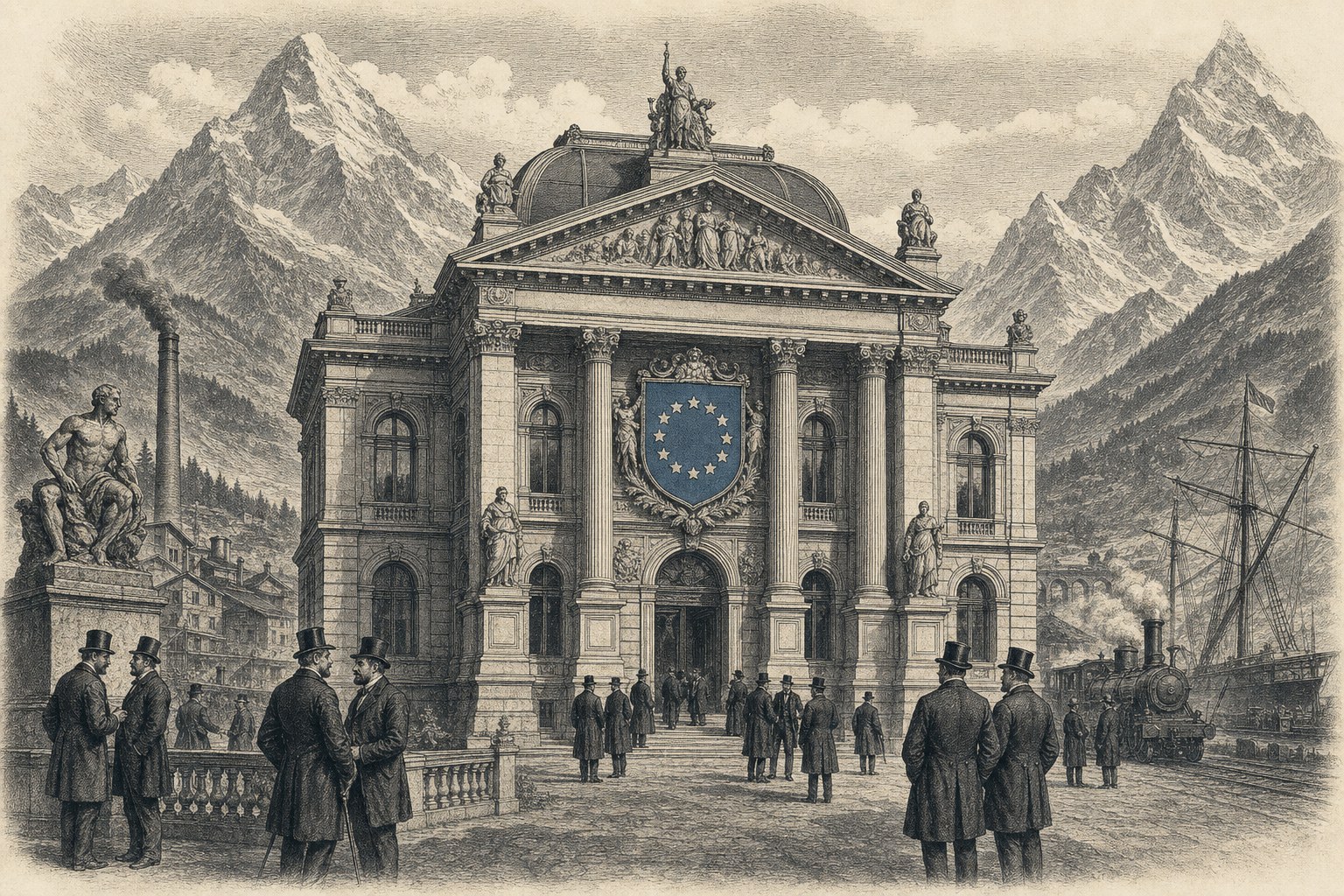
In episode zero, it was concluded that Brussels is a variable, not a constant. But a member state alone, however determined, is a light lever against a treaty system of twenty-seven. What is missing in the European field of forces is an organised antipode that is not tied to a member state, but to industry itself. A United European Industries Configuration, in this paper simply UEI, can fulfil that role — provided it is established outside EU jurisdiction. Switzerland is the obvious choice.
What already exists — and why it is not sufficient
Brussels knows two established business organisations. BusinessEurope represents, through forty-two national federations, twenty million companies from thirty-six countries — recognised as an official European social partner. The European Round Table for Industry, founded in nineteen eighty-eight, brings together forty-five industrial leaders and is described by commentators as “the driving force behind the European single market”. A former Commission President, Jacques Delors, publicly admitted that ERT was the catalyst.
These two organisations demonstrate that industry can direct Brussels — it is no utopia. But their agenda is consistent: lower taxes, less regulation, better competitiveness, and the free movement of goods and capital. Sovereignty of member states as an independent goal does not appear in their publications. Climate policy is softened, not returned to national parliaments. They are lobbyists within the Brussels frame, not redesigners of it.
UEI would make that difference. Not softer policies within the existing framework, but an institutional shift of power back to member states and companies. Not lobbying in the corridors of the Commission, but the public order classification of Brussels proposals — according to the same protocol as applies domestically in the Netherlands under Nova Democratia.
BusinessEurope and ERT lobby within the Brussels frame. UEI would call the frame itself into question.
Why Switzerland
Four reasons, in order of weight. Firstly: Switzerland stands outside EU jurisdiction. UEI can operate without the threat of Commission procedures or arbitral binding to EU law. What would be an institutional risk in Brussels or The Hague is an ordinary establishment in Zurich or Bern.
Secondly: in April twenty twenty-six, with the Bilateralen-III-akkoord, Switzerland publicly proved that it can force Brussels into procedural adjustment. A UEI established on that soil is institutionally based on a living precedent.
Thirdly: the Swiss legal form of Verein — a non-profit association — offers UEI the same flexibility with which international institutions such as FIFA, the International Olympic Committee, and the International Committee of the Red Cross were set up. No supervision by Brussels institutions, no shareholder pressure, no obligation to publish membership lists.
Fourthly: Switzerland has the highest incomes in Europe, a strong position in financial and legal services, and a tradition of neutrality that provides international credibility. A research staff and legal department of UEI will find the best in Europe here, without the wage ceiling from Brussels or a member state forming an obstacle.
What UEI does
Five functions, in order of urgency.
- Order classification of EU regulation. Every new EU directive, every new regulation, will receive a public classification judgment within three months according to the order method from episode four. First order, second order, third order, or fourth order. For members, a clear recommendation then applies: implement, evaluate, refuse, or test.
- Central compliance register. Companies that follow UEI recommendations gain a common defensive position in the event of Brussels procedures. A Brussels fine against one company becomes a procedure against the entire UEI cluster. This significantly raises the stakes for the Commission.
- Own legal service. Specialised in sovereignty defence, not in lobbying. The team conducts proceedings regarding the boundaries of EU competence, not the content of individual rules. The Swiss precedent regarding arbitration instead of Court adjudication is the legal blueprint here.
- Publication and media. Weekly public analyses of EU proposals, available in all EU languages, aimed at national parliaments and public opinion. Not for lobbyists in Brussels, but for democratic institutions in member states. This is a fundamental difference from current ERT practice.
- Research programme. Annual studies into the economic, social, and administrative effects of EU regulation, including counterfactual scenarios. Not an anti-European pamphlet, but hard numerical substantiation of where Brussels does and does not provide added value.
Membership and financing
Membership is open to companies from all European countries, EU member states and non-member states alike. Contributions are scaled to turnover, with a minimum that also allows medium-sized companies access. No exclusivity for large industry as with ERT — that would make UEI institutionally vulnerable to the accusation of being an elite club.
Financing follows the existing BusinessEurope model: contributions from members, no government subsidies, no Commission money. Independence from Brussels is institutionally anchored through the financing structure.
The Pareto position of UEI
In the heatmap from the previous episode, UEI is the only actor to score minus eight on phase zero. That is to say: actively pushing against Brussels, not just supporting Nova Democratia. No existing Dutch party, no existing union, and even no existing business federation scores negatively on that phase. UEI fills a void in the European field of forces that no other actor can close.
The total balance of UEI amounts to minus twenty-five — stronger than VNO-NCW and MKB-Nederland. This is no coincidence. UEI is designed for exactly the phases where Nova Democratia expects the most headwinds. Brussels classification (phase zero), KPI management (phase two), and sunset laws (phase four) are all fields where industry has natural interests that run parallel to the design of Nova Democratia.
UEI fills a void in the European field of forces that no other actor can close.
What this is not
UEI is not a Nexit preparation. It is not an anti-European organisation. It is not a business cartel that wants to revise regulation for softer implementation. It is a defender of sovereignty — institutional, legal, and publicist.
The parallel with the Swiss International Committee of the Red Cross is intentional. That institution is not a government, but it is recognised by all governments because it fulfils a function that no government can carry itself. UEI would fulfil the same role for industry — not by replacing governments, but by providing an institutional conservative force where no member state alone carries sufficient weight.
The question for the Netherlands
For the Netherlands, UEI is an external ally for position B from episode zero. The Netherlands imposes its own order classification on Brussels; UEI does the same on behalf of the companies. Two parallel channels, the same method. In such a constellation, it is much more difficult for Brussels to react selectively with punitive measures, because the combination of a member state and an institutional voice for industry carries too much economic and political weight.
The Pareto analysis from this newspaper series makes this step not only desirable but logical. Those who read the field of forces as it stands see that domestic inertia is concentrated in the unions, and abroad in Brussels. Both blocks can only be dismantled by simultaneous action within and outside the Netherlands. A national agreement with employers against the unions, and a European institute with employers against Brussels. The same partners at both tables.
That is not a coincidence. That is design.
Het Open Vizier · novademocratia.com · Working Material · Jacobus van Merksteijn · June 2026