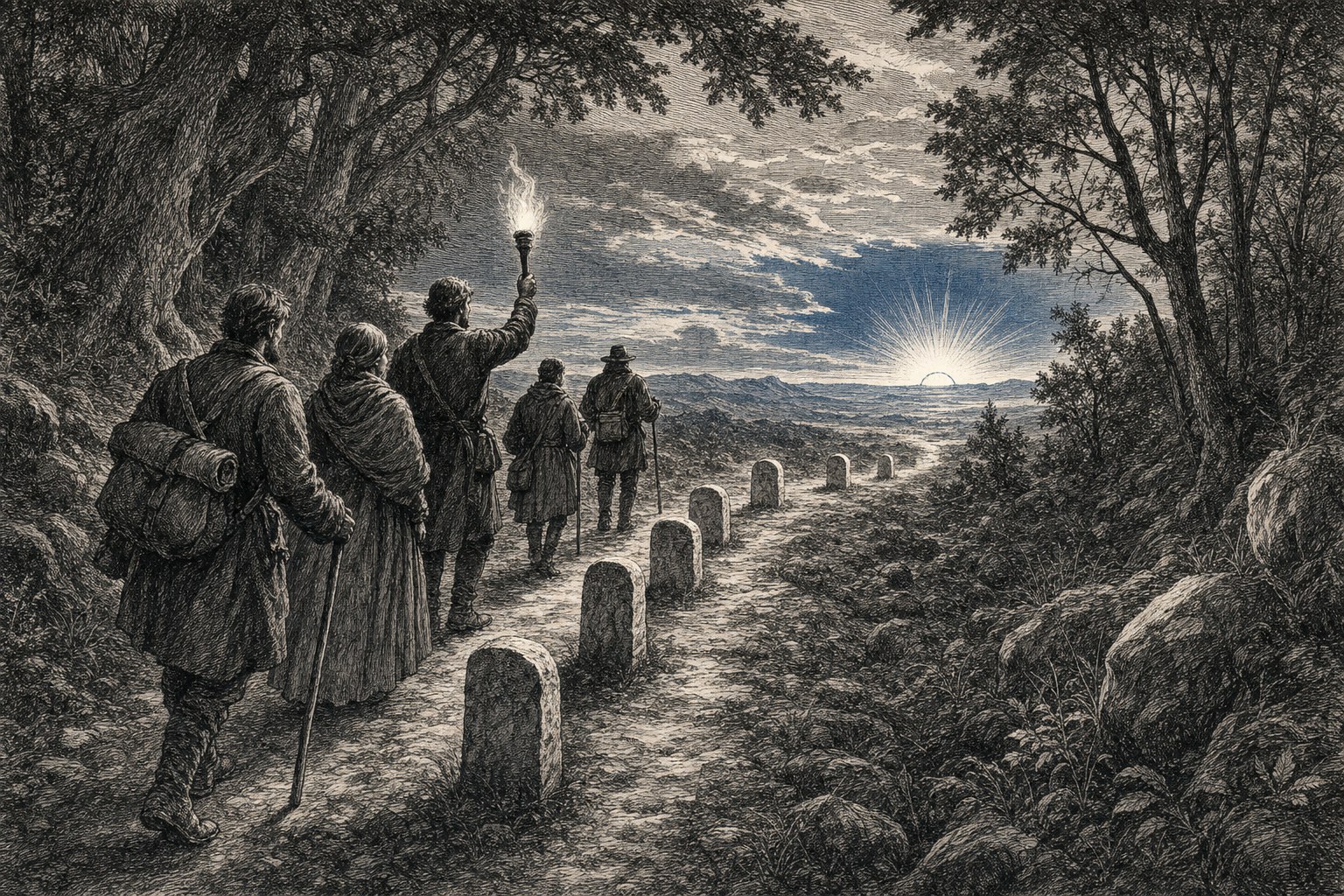
At the end of a series of eleven episodes, the question inevitably arises where the reader stands. Not the question of what he opines—that, the series has hopefully already shifted. The question of what he does. This episode offers no call and no pamphlet. It offers a playbook.
The playbook builds on everything that has been established in the ten preceding episodes. European treaty law is variable, not constant (episode zero). The phasing runs over ten years in six orders (episode one). Twelve groups together provide eighty per cent of the braking weight (episode two). The media are a strain gauge, not a wall (episode three). The objection itself must be weighed by order (episode four). Twenty concrete objections are already foreseeable today (episode five). The Swiss mirror shows what a collegial design does (episode six). The Canadian mirror shows what a federal distribution does (episode seven). The political parties lie in a recognisable field of forces (episode eight). Twenty-six actors distribute themselves according to phase and function (episode nine). One corporate institution can do in Brussels what no member state can do alone (episode ten).
What is missing is the coherence between those elements in one timeline with one discipline. That is what follows here.
Seven steps, one discipline
The discipline is singular and is applied consistently throughout the series: let no order vote on another order. First-order decisions—what is the factual functioning of the system—are taken by those who measure that functioning. Second-order decisions—what is the objective—are taken by those who bear the responsibility. Third-order decisions—how we govern between measurement and objective—are taken by those who hold the mandate. Fourth-order expressions—opinions about all three—are heard, but do not count as a vote.
Whoever applies this rule to the Dutch administrative structure sees immediately what is faltering. A trade union with a peer interest votes on a constitution. A professor with an opinion is quoted as an expert. A journalist with a framing model is heard as a witness. Each of those three is an order error—not in the person, but in the placement.
Let no order vote on another order.
With that discipline as a basis, there are seven steps for the coming ten years.
Step one — The baseline measurement (2026)
Publish in a public register the current Dutch inertia scores according to the method from episode two. Twelve groups, twelve figures, one line at eighty per cent. The baseline measurement does not need to be carried out by a government agency—that would show a conflict of interest at its first publication. A coalition of independent researchers, media-critical institutes, and business economists can deliver the measurement within three months. The method is set out in this series. The data are publicly available. What is missing is someone to do it.
Step two — The order classification to Brussels (2026-2027)
Assemble a Dutch delegation that does not negotiate in Brussels on content, but on method. The delegation presents to the European Commission the Dutch order classification of EU law, as described in episode zero. Brussels may provide objections. But every objection must itself be classified by order, publicly. The position of the Netherlands: we will not stop paying and we will not leave the union. We will publish what we count and what we do not, and act accordingly.
That is position B from episode zero, and it is what the Swiss precedent of April 2026 has opened up.
Step three — The objection register (2026-2028)
Open a public objection register according to the protocol from episode four. Every week, at least one new classified objection, with reasoning, with the name and function of the submitter, with order assignment, with an answer. The twenty foreseeable objections from episode five are the first twenty records. The register is public because publicity is the only sorting mechanism that forces the objector to reveal their order.
Step four — Constitutional vote first reading (2027-2028)
The three core articles—collegial cabinet as described in episode six, order classification of objection as described in episode four, and sunset limitation of legislation—can be submitted in first reading. Not as an integral package. Three separate proposals, each with its own question. That lowers the inertia score per proposal, and forces every link-with-inertia to explicitly express itself against each article separately.
Step five — Package deal with employers (2028-2030)
Conclude an agreement between employer organisations and the House of Representatives on the reform of labour market law, in exchange for support for the three constitutional articles. The package deal is operational: less regulation on flexibility, higher protection on first-order security (wages, health, education), lower protection on third-order friction (procedural complexity, long notice periods). The trade unions are not at the table—not by way of punishment, but because they are not a party that can sign for this package. Their voice returns in the labour market law itself, not in the constitutional route.
Step six — Second reading and first examination (2030-2034)
Second reading of the three constitutional articles according to regular procedure. In parallel: the establishment of an independent Dutch KPI bureau that measures and publishes administrative performance, with the same discipline as the Swiss Bundesamt für Statistik. The bureau has no mandate to change policy. It has solely the duty to show what works and what does not, based on measurements that were established in detail before the second reading.
Step seven — The first generation under the new system (2034-2036)
Education on performance—phase five from episode one—runs parallel with all preceding steps. The first cohort to graduate under a measurement-oriented school system will be seventeen years old in 2036. They are the first generation that does not need to explain why a third-order actor should not have a veto right. For them, that is a triviality. The entire heavy superstructure of this series—Pareto measurements, orders, objection registers, collegial cabinets—will one day be the ordinary way of thinking. That is what the entire exercise ultimately delivers.
What this is not
This playbook is not a revolution. Not a march. Not a party. It is not a call to withdraw from the European Union, not a demonstration against the sitting cabinet, not a plea to abolish the Senate or the House of Representatives. These are seven steps that fit within the existing constitution, existing law, and the existing European framework—provided the Netherlands dares to make its own weighing public.
It is also not a line that must necessarily be set out by a single party. Episodes eight and nine show why: three to four existing parties can each carry two to three of the seven steps. It does not require a majority to begin. It requires one coalition of willing actors—employers, researchers, journalists with a methodical conscience, two or three politicians—who together open the objection register and prepare the first reading.
The one question
At the end of every episode in this series was a final image. At the end of the playbook stands a question.
Which of the seven steps can you begin this month, without permission and without money? Step one—the baseline measurement—is the most obvious. Step three—the objection register—is the most directly executable. But perhaps the most important is step zero, which is not numbered: share this series with someone who currently thinks that a trade union ought to vote on a constitution.
Whoever enters into that one conversation has taken the first step that no law and no agency can replace. For the entire structure of Nova Democratia rests on one thing: a reader who recognises the order on which an argument stands, and acts accordingly.
With this episode, the Nova Democratia series concludes. The objection register opens next week.
Which of the seven steps can you begin this month, without permission and without money?