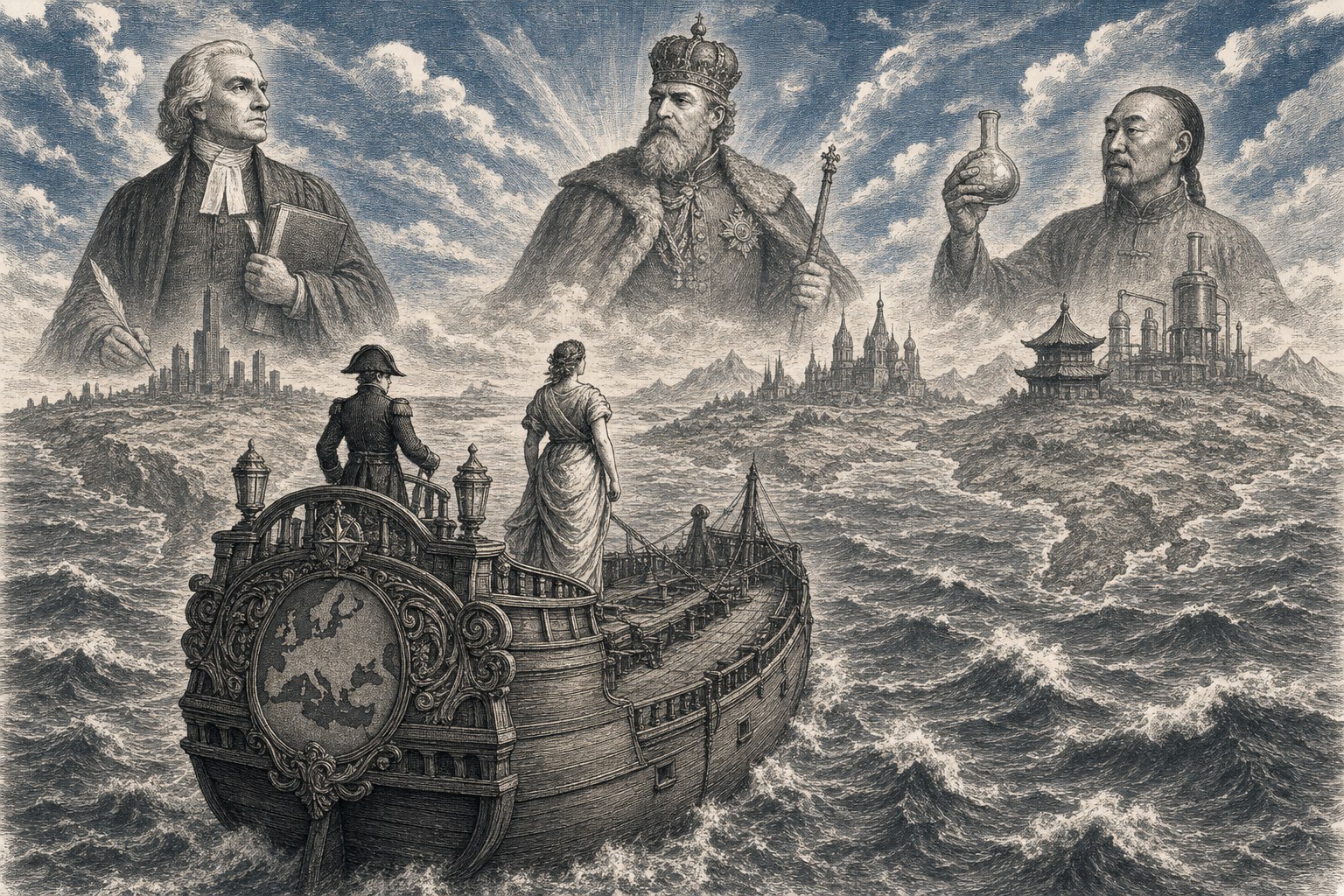
Whoever looks around in 2026 sees three global powers with one thing in common: they are led by individuals with a recognisable professional profile, and it shows in how they govern their states. Europe is the exception, and therein lies the problem.
Three powers, three designs
Vladimir Putin rules Russia as a personal autocrat. A double construction lies beneath: politically, a personalised, consolidated autocracy in which the president and his inner circle make all strategic decisions without accountability to legislative or judicial powers; economically, a kleptocratic state capitalism that, since 2014, has with increasing intensity expropriated private companies, redistributing them to Kremlin friends, and since February 2025 has been designing legislation to permanently confiscate frozen funds from foreign investors. The 2026 Bertelsmann Stiftung report on Russia describes the system as a "personalised, consolidated autocracy" — a tsar in modern form. Corporate ownership is a favour from the sovereign, not a right. Those who misbehave lose not only their company but potentially their freedom. The oligarchs function like the boyars of Tsar Nicholas: property held in fief, loyal or gone. Personal enrichment via the siloviki circle is estimated at three hundred billion dollars per year — a volume of capital equivalent to Denmark's that escapes the regular economy.
Donald Trump rules the United States with a cabinet full of legally trained advisors. Pam Bondi, former Attorney General of Florida, as Attorney General. Marco Rubio, a jurist-politician, as Secretary of State. The pattern is no coincidence. Trump's second term is explicitly described by academic economists, commentators, and former CEOs as an embrace of state capitalism: unprecedented control over companies, public attacks on executives who contradict him, forced resignations, and mandatory profit transfers to the federal government. Wikipedia's own article on state capitalism has, since 2025, included a new paragraph on the United States in which this is described as a systemic change. The legal character of the administration is not incidental — it is structural. Laws are deployed as weapons, contracts as leverage, and the Department of Justice as an instrument of personal campaigning. The design is clear: power through procedural coercion, not through constitutional balance.
Xi Jinping studied chemical engineering from nineteen seventy-five to nineteen seventy-nine at Tsinghua University in Beijing — ranked number one globally in that field according to US News & World Report. He rules China as if it were a factory. Data control over one billion and forty million people, a social credit system rolled out since 2014, a surveillance infrastructure that has no precedent in human history, and a Communist Party with seventy-nine million members laid over the population as a quality control layer. The governance design is that of a chemical engineer: measure, steer, and when an element misbehaves, remove it from the reactor. The population are neither voters nor citizens; they are material in a process. It works — for the Party. China's productivity is growing, technology is accelerating, and geopolitical power is increasing. The Chinese student graduating in 2030 lives in a country that is arithmetically stronger than the United States and politically and strategically more coherent than Europe.
Russia has a tsar, America jurists, China a chemist. Europe has commissioners who have not been elected and chancellors who no longer dare to address their own people.
Europe as yesterday
Opposing these three is Europe. A Union of twenty-seven member states, a Commission that lacks democratic legitimacy, a Parliament that possesses no legislative initiative, a Court that has placed itself above national jurisprudence, and in national capitals, a series of prime ministers and chancellors who no longer dare to address their own voters without first consulting the Commission and the press. In January 2025, the European Union released a Competitiveness Compass in which "competitiveness" was declared the overarching principle — the same Union that, since two thousand and thirteen, has not made a single part of its industrial policy more productive than its Chinese, American, or even Russian counterparts. The Carnegie Endowment published a survey of European strategists in December 2025 under the title Is the EU Too Weak to Be a Global Player? — the overwhelming answer was yes. The Vrije Universiteit Brussel report European Sovereignty or Decline? from November 2025 confirms it: Europe stands at the precipice of strategic irrelevance, with no plan to escape other than the hope that the other three will one day dismantle themselves.
Europe still believes that its democracy will defend itself. That the procedural certainties of Strasbourg and Luxembourg are self-sustaining. That a Franco-German axis, or a Polish-Italian froth of enthusiasm, or a new Commission President can do the work that a tsar, a cabinet of lawyers, and a chemist have been systematically doing for years. This is not the case. No autocracy in world history has ever retreated because it faced a democracy. Autocracies fall when their economies can no longer sustain them, when their populations lose the illusion, or when a rival overtakes them technologically. Europe is doing none of the three. It democratises within its own walls with growing inefficiency and, meanwhile, exports its industrial capacity to Czechia, Poland, and China. It no longer channels its youth into technical education but into social debates about identity. It is losing its farmers, its industry, its defence production, its pharmaceutical capacity, its chipmakers, its energy autonomy — almost in that order — while telling itself that it is successful through "values". Values are only worth something if they are supported by an economy that actually produces. The moment a European scholar goes to work at an American university because a Dutch university’s budget is cut by half, and a Belgian chip company emigrates to Taiwan because regulation is stifling, European values are nothing more than a museum.
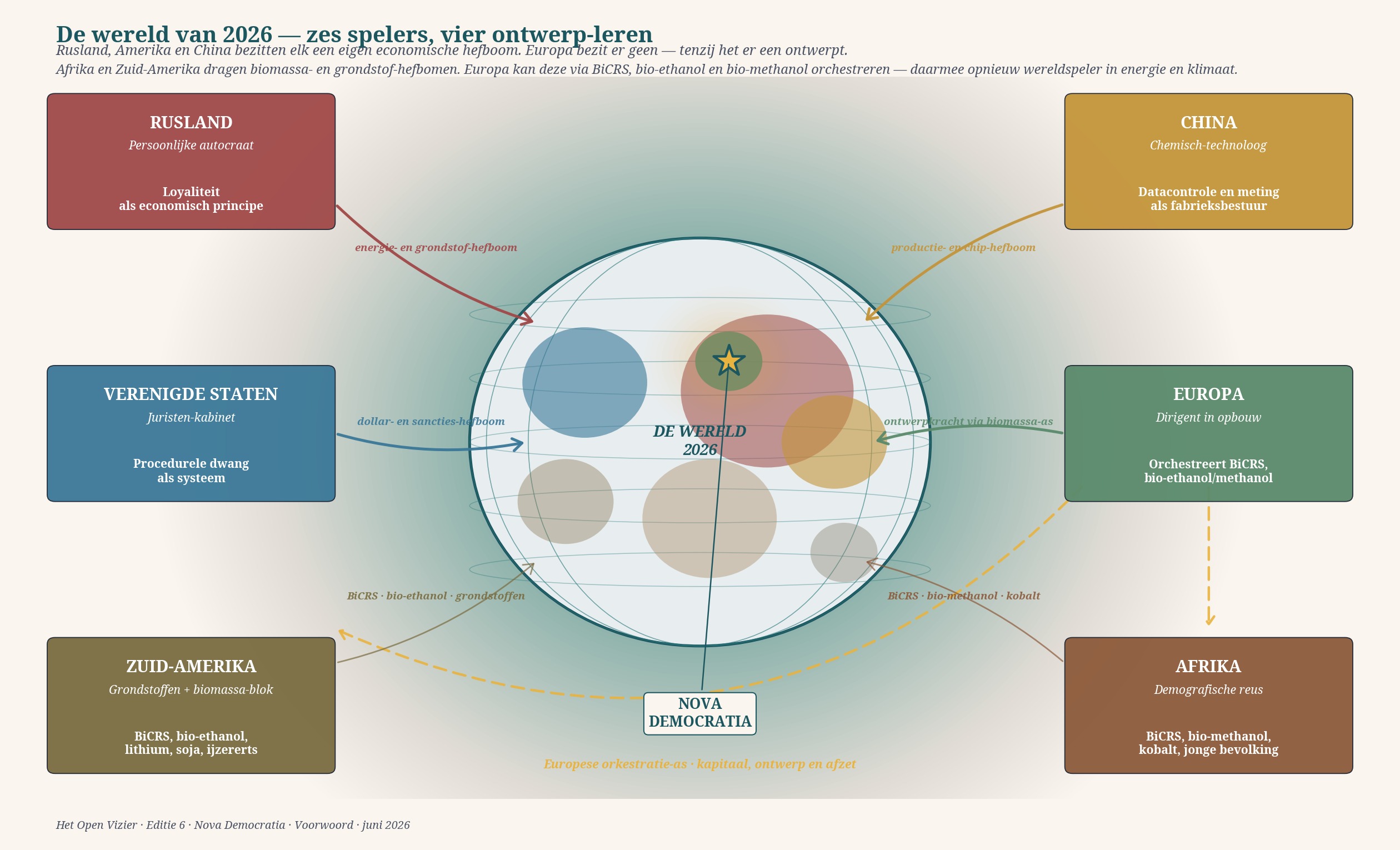
Two continents often remain out of sight in this analysis, wrongly so. South America and Africa do not only carry classic raw materials — lithium, cobalt, iron ore, soy — but also possess the two levers that will determine their weight in the technological order over the coming decade: BiCRS (a product of Carbon-Alert Ltd) (biomass carbon removal and storage) on an industrial scale, and the manufacture of bio-ethanol and bio-methanol from their own biomass. Brazil already produces more than thirty billion litres of bio-ethanol per year from sugar cane. Africa possesses the tropical-equatorial belt where biomass productivity is two to three times higher than in temperate zones. Whoever masters the chemical-physical routes of CO₂ sequestration and alcohol fuel will, in twenty thirty, master the cleanest link in the global chain — a link that neither Russia, nor America, nor China can geographically replicate.
The European lever that does not yet exist
Here lies the lever Europe seeks. Not in new regulations, not in a digital euro, not in another trade treaty. But in orchestrating the biomass axis: capital, design, standardisation, and sales that South America and Africa need to build their BiCRS installations and bio-fuel factories on an industrial scale, and which Europe itself needs to possess — for the first time since the nineteen eighties — its own energetic and climatological lever. This is not development aid and not a colonial relationship; it is a measured alliance between continents that need each other. South America and Africa have the biomass, the sun, and the demography. Europe has — still — the chemical engineering knowledge, the process capital, and market access to its own five hundred million wealthy consumers plus those of its trading partners. Whoever links these three continents in a measured way via BiCRS and bio-methanol/ethanol delivers something that neither Putin, nor Trump, nor Xi can replicate: an industrial climate axis that both sequesters CO₂ and produces high-quality fuel, with its geographical centre of gravity where the sun shines and its intellectual centre of gravity where the chemistry faculties stand.
Since two thousand and six, the European Union has published eleven consecutive industrial strategies without linking a single one of them to a continent outside Europe via a delivery mechanism. Dutch, German, and French chemistry faculties still produce leading publications on biomass-to-liquids conversion — but the installations are being built in Brazil, Indonesia, and Nigeria by Asian consortia. The fourth way requires that a European economic Bondsraad initiates a multi-year orchestration programme that brings these three elements — chemical design from Europe, biomass from South America and Africa, and off-take security via European legislation — together in one measured plan. Without such a plan, Europe remains the Waiting Room of yesterday. With such a plan, Europe becomes a global player once more — not on a military or monetary axis, but on the only axis that truly matters in twenty thirty and beyond: energy and climate control. How this lever becomes concrete — which crop, which installations, which time window — is the subject of Edition 7: the answer to the question this Edition poses.
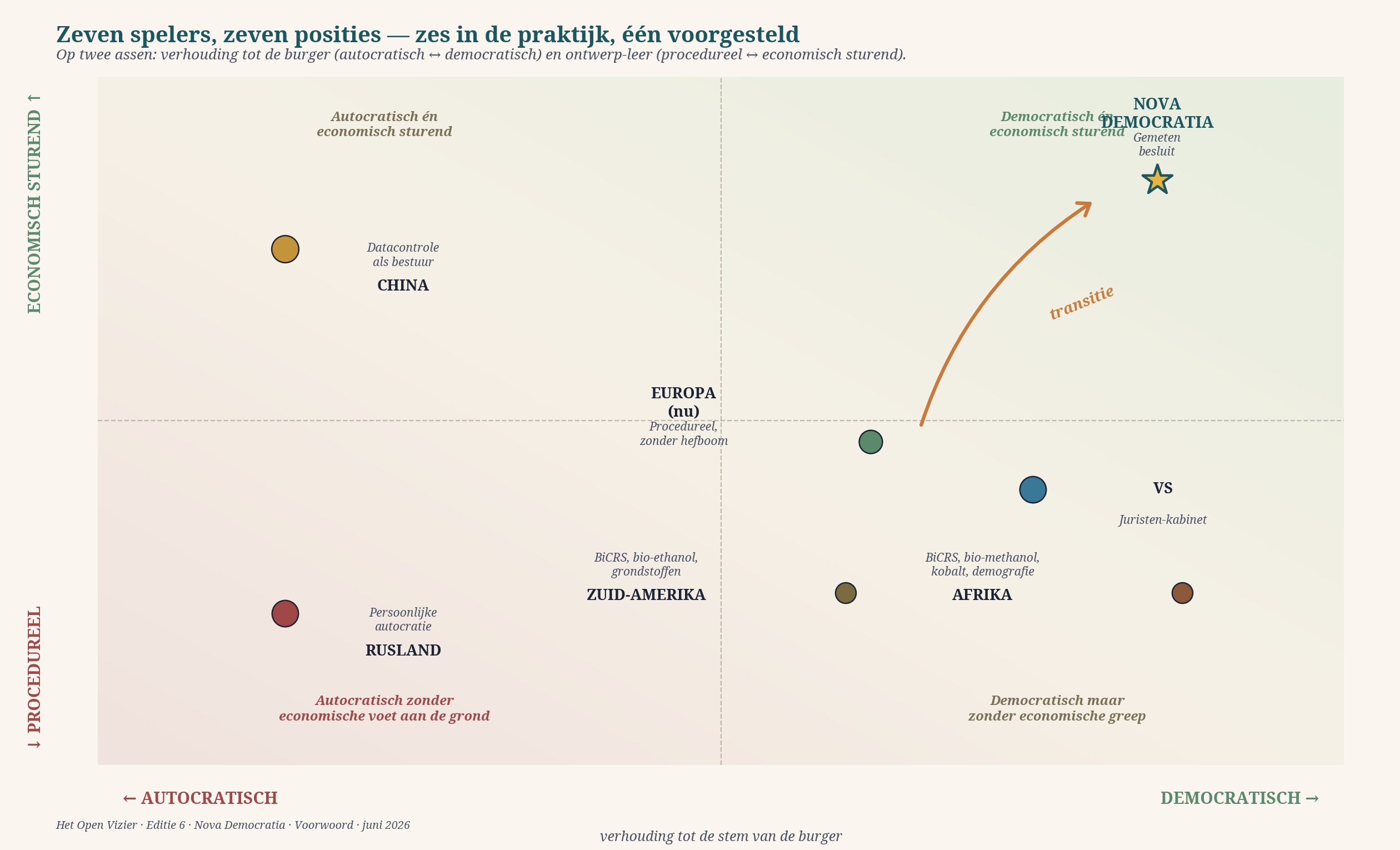
Their position on the positioning graph below — democratic but without a doctrine of design — is therefore not a permanent status. It is an invitation.
The consensus mode must go first — otherwise, the lever remains a drawing
Here lies the core of this entire chapter, and of this whole series. The European orchestration axis I describe above — BiCRS, bio-ethanol, bio-methanol, three continents together — is technically feasible, economically necessary, and strategically unprecedented. But it is institutionally impossible under the current European governance design. The Brussels form of governance, effectively a perfected polder model on a continental scale, cannot sustain such a plan. Not for lack of good people — they are plentiful — but because the design itself prioritises negotiation over decision, consensus over direction, and third-order procedure over first-order measurement. The consensus mode, which led to unprecedented prosperity in the Netherlands in the twentieth century, has in the twenty-first century degenerated into a ritual: everyone is heard, no decision is made, and what remains is an average that no one wanted but everyone accepts because contradiction is more expensive than concession.
That spirit views higher orders — long-term measurement, structural reconstruction, measured correction against the vote — not as solutions but as problems. Anyone who enters a Brussels meeting with figures on the decline in European productivity sees twenty-five heads nodding and then the discussion shifted to the next agenda item on inclusion or digital sovereignty. Anyone who proposes setting up a continental biomass axis in cooperation with Brazil and Nigeria immediately hears three objections — colonial past, human rights in the production chain, environmental effects of transport — each of which is legitimate in isolation but collectively results in a standstill from which only Asian competitors benefit. The consensus mode is not ill will; it is a design flaw. It treats every fourth-order objection as equivalent to every first-order fact, and because fourth-order objections are infinitely multipliable and first-order facts are finite, the objector always wins. The result: Europe negotiates but fails to help the world move forward.
The biomass axis can therefore only be built if Europe first renovates its governance design — not after. It is not that we first build the installations and then adjust the institution. It is exactly the other way around: as long as European governance remains in consensus mode, every industrial climate axis will remain stuck in a preliminary study, be parked in a working group, or be dismissed as "no longer a priority" after three commissioner terms. The institutional reconstruction described in the twelve episodes of this series — a measured Bondsraad, an independent first-order measurement body, a revised division of roles between orders one to four, a UEI layer that channels European counter-power — is not an alternative alongside the strategic lever. It is the prerequisite for it. Without that reconstruction, the European orchestration axis remains what it is today: a PowerPoint presentation at a Brussels strategic summit, where seven commissioners nod, two objections are recorded, and no one ever builds the installation.
This is the most important point of this chapter. The lever exists. The four design doctrines of the world are clear. Europe can choose between consensus mode and measured decision. With consensus mode, Europe continues to negotiate while Russia governs from personal authority, America from legal coercion, and China from chemical control. With measured decision — with the reconstruction described in this series — Europe builds the only global lever still available: CO₂ sequestration plus fuel, three continents together, its own design, measured results. The drawing on the wall. Or the installation in Brazil and Nigeria. Europe makes that choice now, or it will be made for Europe.
The fourth way
Conventional Western analysis says that Europe has a choice between three paths: more democracy (with more sluggish decision-making), a return to national sovereignty (with economic fragmentation), or surrender to one of the three global powers (America being the usual choice). None of the three is a way out. The first makes the problem worse. The second is a political fantasy as long as European companies need European markets. The third is not a solution but a submission.
There is a fourth way, and it is ripe for the taking in a country that has been a working example since eighteen forty-eight. Full democracy combined with economically competent leadership that is permitted to go against the vote when the measured reality requires it. Not as a monarchy, not as a technocracy, not as an autocracy. But as a design in which first-order measurement — economy, productivity, demography, defence capacity — takes precedence over the third-order vote of the electoral moment. The voice of the citizen remains sovereign over the direction; the measurement determines the feasibility. A leader who sees that public sector productivity has fallen by nine per cent in six years — a fact published by the CPB in 2023 — may decide to act against that trend, even if it wins him no subsequent election.
That is what Nova Democratia proposes: not the abolition of democracy, but its salvation by separating it from its self-destructive element. Old-fashioned democracy is the voice that cannot correct itself — that can vote itself blind on third-order friction while the first-order reality slips away. Nova Democratia adds a second layer: a collegial economic leadership that follows the actual functioning of the system, not the fashion of the campaign. Switzerland has put this into practice since eighteen forty-eight. The Swiss Bondsraad — seven equal members, annual rotation of the presidency, collegial decision-making — is not the most exciting form of government. But it is the most stable in all of Europe, and Swiss productivity per capita has been structurally higher than that of Germany, France, Britain, and the Netherlands since two thousand and seven.
Old-fashioned democracy is the voice that cannot correct itself. Nova Democratia adds a second layer: a collegial economic leadership that follows the actual functioning of the system, not the fashion of the campaign.
In Nova Democratia vocabulary: the third order — decisions on how we govern between measurement and goal — is taken by seven Bondsraden, elected by a United Federal Assembly that represents the various parties according to a fixed formula. The fourth order — opinions, campaigns, views — is heard but does not count as a vote in the same ranking. The first order — the measured facts about economy, productivity, demography, defence, climate — is established by an independent measurement body (CPB-style, planbureau, TNO). The second order — the objectives — remains with the citizen via referendum on concrete questions, not with an individual via a blank-cheque election of a charismatic leader.
This is no blueprint for a single country. It is the structural logic under which Europe could survive. A European design that is collegial, measured, and without a dominant voice can defend itself against a Russian tsar who drives everything on personal loyalty, against an American cabinet of jurists who base everything on procedural coercion, and against a Chinese chemist who organises everything on data control. Not by playing their game — they are better equipped for that — but by playing its own game, one that is slower, deeper, and corrective.
Where this series stands
The twelve remaining episodes of Nova Democratia show what that design looks like for the Netherlands, because without Europe, the Netherlands can be a test lab for what later becomes possible with Europe. Each episode covers one part of the design logic: the phasing, the Pareto of braking weight, the order classification, the mirrors in Switzerland and Canada, the field of actors, the European counter-power via UEI, the knowledge layer as an ally. At the end, in episode twelve, lies a concrete seven-step plan that a single Member of Parliament can start without any law, without any party, without any permission.
It is no revolution. It is an engineering approach to a political system that will collapse without renovation. And if the Netherlands can do it, Europe can do it. And if Europe does not do it, in twenty years it will no longer rule itself but will be ruled from Moscow, Washington, or Beijing.
Read further with episode zero: Brussels as a variable, not a constant. There begins the practical analysis of what the Netherlands can do as early as tomorrow.
Het Open Vizier · novademocratia.com · Working Material · Jacobus van Merksteijn · Malta · June 2026