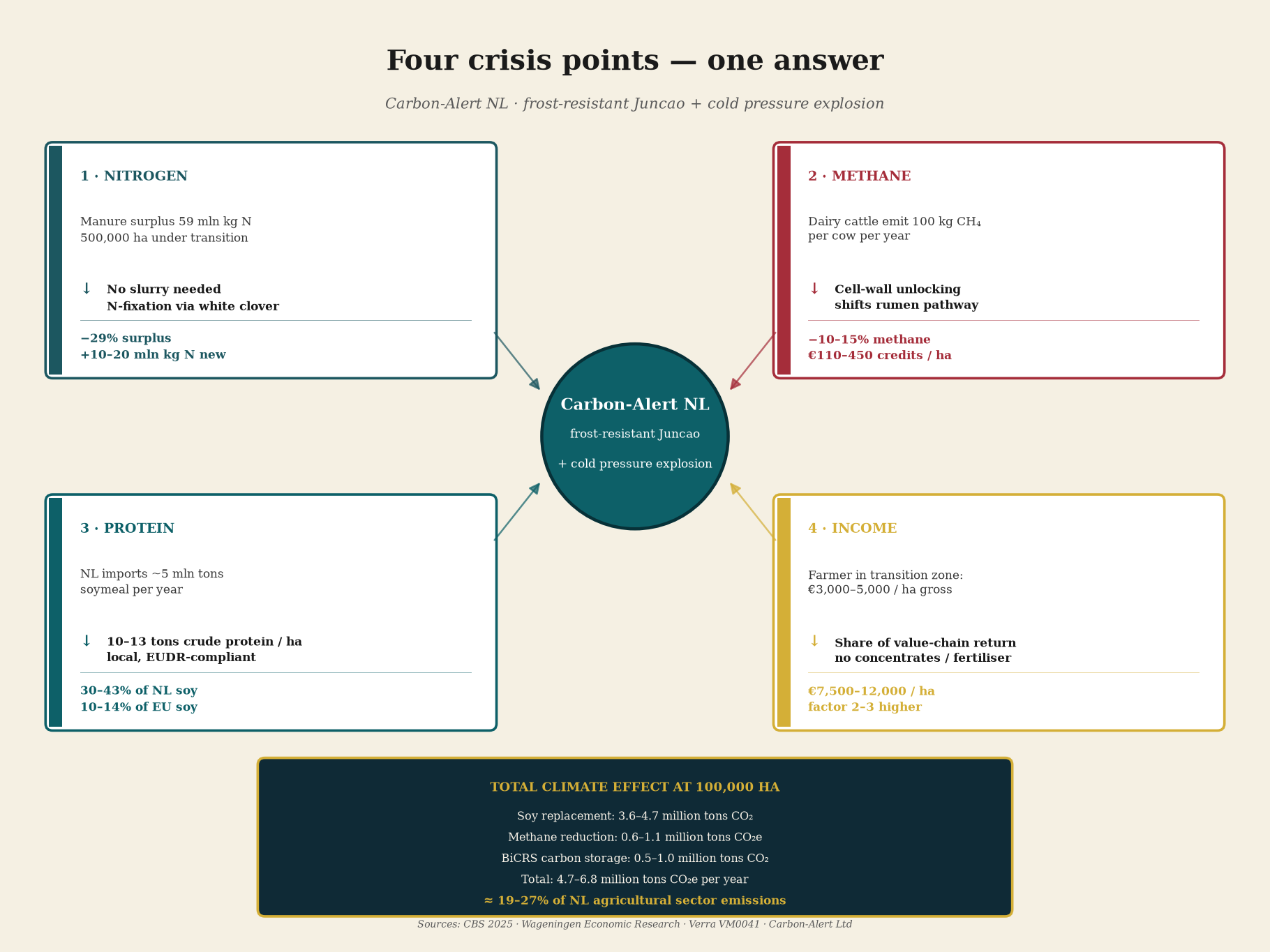
Three problems, one answer
and a fourth, forgotten winner
The Dutch nitrogen crisis, the methane problem and soy dependency are usually treated as three separate dossiers. They are one problem. With one answer. And one clearly forgotten winner: the farmer in the transition zone.
I · Three dossiers, one animal
The Hague treats nitrogen, methane and protein imports as three separate dossiers. Three ministries. Three committees. Three policy papers. And meanwhile, in the meadow stands one cow that causes all three simultaneously — and she is on the verge of disappearing because the three dossiers have each proved insoluble on their own.
That is not a plea for fewer cows. That is a diagnosis. Whoever treats three problems that stem from one source as separate solves none of the three. Whoever sees them together finds something that none of the three committees found.
Carbon-Alert Ltd has spent recent years developing a production architecture that happens to address all three simultaneously. Not as ideology. As the technical result of one biological insight: the plant cell wall, once unlocked, solves multiple problems that without that unlocking proved intractable.
II · What the cell wall unlocks
Plant-based biomass sits inside a chemical cage of cellulose, hemicellulose and lignin. A cow tears that cage open with its rumen microbes, but never completely. A considerable share of the crude protein, energy and minerals never passes the cell wall. It leaves the animal unused — as slurry, methane and ammonia.
Carbon-Alert changes that. Not via steam. Not via heating. But via cold pressure explosion followed by mechanical refinement. Fresh biomass is brought under pressure without thermal pretreatment, then suddenly decompressed. The cell walls rupture mechanically, the structure opens, fibre matrices fall apart, and in the subsequent fine-structuring stage the material is broken down further into a homogeneous digestive medium. The material changes chemically hardly at all — no heat means no Maillard reactions, no sugar degradation, no protein denaturation. But microbial accessibility changes fundamentally.
That distinction matters. Classical steam-explosion installations operate at temperatures of 180 to 220 °C and pressures up to 28 kg/cm². They lose a share of the high-value compounds along the way — bypass protein alters, free sugars caramelise, volatile compounds evaporate. Carbon-Alert's cold process avoids all those losses. The energy balance is also fundamentally better: no fuel for steam generation, no cooling to make the material workable again.
What the numbers say
International cell-wall unlocking studies (both classical steam-explosion and cold pressure-explosion) and Dutch field data (Grassa, Dairy Campus Wageningen) consistently show: dry-matter digestibility rises 24 to 47 per cent. Methane emissions from the cow fall 10 to 15 per cent. Nitrogen and phosphate excretion via slurry falls 30 per cent. With cold pressure-explosion the numbers sit at the upper end of the range — because no high-value compounds are lost to heat. This is no lab fantasy. These are the figures under Dutch conditions.
| Parameter | Untreated | After unlocking | Improvement |
|---|---|---|---|
| Dry-matter digestibility 24h | 19–34% | 35–43% | +24–47% |
| Dry-matter digestibility 48h | 29–37% | 37–47% | +17–29% |
| NDF fibre digestibility | 53–65% | 70–78% | +15–25% |
| Volatile fatty acids in rumen | baseline | +4–10% | more energy |
| Propionate share | lower | elevated | less methane |
III · What this means for the Dutch balance
In 2026 the Netherlands has a manure surplus of 59 million kilograms of nitrogen. The derogation has been phased out. The limit for animal manure has moved from 230 to 170 kilograms of nitrogen per hectare. Five hundred thousand hectares of dairy farming — a third of the total — faces direct transition pressure due to Natura 2000 buffer zones, peatland (-pastures) rewetting and vulnerable sandy soils.
This is not an abstract problem. This is a crisis with deadlines, ceilings and area boundaries. And Carbon-Alert NL — the Dutch implementation of the Carbon-Alert architecture, based on a frost-resistant Juncao variant with pressure-explosion cell-wall unlocking — fits precisely in the areas where no solution yet exists.
| Area type | Hectares | Pressure |
|---|---|---|
| Buffer zones around Natura 2000 | ~150,000 | Permit freeze |
| Peatland (-pastures) | ~270,000 | Rewetting + extensification |
| Vulnerable sandy soils | ~200,000 | Manure restriction |
| Stream valleys and seepage areas | ~80,000 | Nature-inclusive mandatory |
| Total under transition pressure | ~500,000 | Convert or quit |
IV · The fourth option
The farmer in a transition zone is currently offered three options: quit, switch to arable farming, or extensify to nature-inclusive with lower income. None of the three does justice to his business, his knowledge or his landscape. Quitting is a loss. Arable farming requires capital and expertise he does not have. Extensifying makes him subsidy-dependent.
There is a fourth option that rarely reaches the table. Not because it does not exist — because no one has brought it into the debate.
Option A
Quit
Cessation scheme. Destruction of future prospects. Farm gone.
Option B
Switch to arable farming
Requires new knowledge, machinery and sales channels. Not feasible for every farmer.
Option C
Extensify
Smaller herd, lower income, dependence on subsidies.
Option D · new
Carbon-Alert NL cultivation
Protein cash crop with preservation of grassland character. No slurry. €7,500–12,000 gross per hectare for the farmer.
Option D is not a subsidy construction. It is not an ideological project. It is a crop — a frost-resistant grass, supported by white clover for nitrogen fixation — that preserves the Dutch landscape, requires no slurry, and delivers a protein yield of 10 to 13 tonnes per hectare. That is twenty-two tonnes of soy equivalent per hectare. Those are figures the Dutch National Protein Strategy has been searching for since 2020.
V · What it yields the farmer
An average Dutch dairy farmer earns four to six thousand euros gross per hectare from grass silage rations. Under Option D — Carbon-Alert NL cultivation — a different figure appears on the gross account.
Important: this is not the farmer's isolated income. The total value the crop chain generates is significantly higher — the sale of premium hydrolysate brings in fifty-six to seventy-two thousand euros per hectare in a good year. But a substantial share of that revenue goes to the mobile Tier 1 unit (harvest, cold pressure explosion and mechanical refinement on the field), the regional Tier 2 processor (hydrolysate concentration and quality control), the cooperative (marketing, EUDR compliance, MRV), and chain financing. What actually reaches the farmer's bank account after these chain costs, Carbon-Alert estimates at a realistic maximum of twelve thousand euros per hectare per year.
| Component | Amount |
|---|---|
| Gross cultivation fee (farmer's share of chain return) | €6,000–10,000 |
| CAP eco-scheme (possible qualification) | €600–1,200 |
| Methane credits via offtaker | €110–450 |
| No concentrates costs any more | +€500–1,000 |
| No synthetic fertiliser costs any more | +€150–300 |
| Lower slurry disposal costs | +€200–500 |
| Realistic gross income farmer (ceiling) | €7,500–12,000 |
| For comparison: grass silage ration today | €4,000–6,000 |
That is a factor of two to three compared to the current grass silage ration. No tenfold increase — that would ignore what the chain itself costs to set up and run. But it is a real and steady step upward, on the same land, with the same farmer, and without him having to build capacity for processing, marketing or certification that he does not have today. The farmer in the transition zone comes out ahead through this switch. Not because we subsidise him. Because his product, once unlocked, has a genuine premium market, and he shares fairly in what that market generates.
VI · What it yields the Netherlands
An ambitious but realistic scenario: of the five hundred thousand hectares of transition area, twenty per cent — one hundred thousand hectares — switches to Carbon-Alert NL cultivation by 2035.
| Aspect | Effect |
|---|---|
| Soy meal equivalent produced | 1.8–2.6 million tonnes per year |
| Share of NL soy imports replaced | 30–43% |
| Share of EU soy imports replaced | 10–14% |
| Manure surplus resolved | ~29% of 59 mln kg N |
| Biological N fixation via clover | +10–20 million kg N new |
| Methane reduction dairy cattle | 0.6–1.1 million tonnes CO₂e |
| BiCRS carbon sequestration | 0.5–1.0 million tonnes CO₂ |
| Total climate effect | 4.7–6.8 million tonnes CO₂e per year |
| = share of NL agricultural-sector emissions | 19–27% |
One to three quarters of Dutch agricultural climate emissions solved on one architecture. With the same land. With the same farmer. Without forced buyout. With EUDR-compliant production, because everything is grown in the Netherlands and does not need to come from Brazil. The three dossiers — nitrogen, methane, soy — converge in one answer.
VII · What this is not
This is not a lobby against Dutch nitrogen policy. The cabinet states: a third of dairy farming must convert. We do not state: do not do that. We state: here is how. Not through forced buyout. Not through a mass arable transition that farmers lack the expertise for. Not through the loss of agricultural landscape. But through a new cash crop that solves all the problems and leaves the farmer better off.
This is not a plea to leave current dairy farming unchanged. This is an invitation to enter the transition along a track that works. A track that farmers embrace, because it doubles to triples their income on the same land without rebuilding their operation. A track that the cabinet can embrace, because it meets the nitrogen targets without a political war of attrition. A track that the dairy chain can embrace, because it resolves the scope-3 targets and EUDR requirements.
This is therefore not opposition. This is delivery. The concrete answer to the question that nitrogen policy leaves open.
VIII · The six steps that make it possible
Step 1 · Q3 2026
Feed value analysis of the two-hectare trial field via Eurofins Agro, with full DVE/OEB profiling.
Step 2 · Q4 2026
First meeting with the Ministry of LVVN on integrating Carbon-Alert NL into the National Protein Strategy.
Step 3 · Q1 2027
Pilot application with a province (Brabant or Gelderland) for 50 to 100 hectares in a concrete transition area.
Step 4 · Q2 2027
Set up cooperative structure for farmer ownership of the chain. The farmer remains owner of what he grows.
Step 5 · Q3 2027
Field trial with five to ten dairy farms for feed value validation and animal health testing.
Step 6 · 2028
First 500 to 1,000 hectares of commercial roll-out in selected transition areas.
IX · Who joins now
A transition of this scale requires partners with the power to set it in motion. Carbon-Alert NL is an invitation — not an ultimatum — to seven natural partners.
- Ministry of LVVN — on integrating into the National Protein Strategy and the nitrogen approach.
- Provinces of Brabant, Gelderland, Friesland — on the area-based approach and the first pilots.
- LTO Nederland — on the farm income model and collective conversion.
- FrieslandCampina, Vreugdenhil, Arla NL — on purchase guarantees for the hydrolysaat and scope-3 targets.
- Wageningen Livestock Research — on official inclusion of the feed values in the CVB tables.
- ZuivelNL and Eurofins Agro — on quality and safety protocols.
- Rabobank Agri and Invest-NL — on an investment package for scaling up.
X · Why this is a Dutch story
The frost-resistant Juncao variant that makes this entire chain possible was developed by Carbon-Alert, with IP position in the Netherlands. The architecture fits the specific Dutch combination of nitrogen crisis, soy dependency and climate targets. And the Dutch farmer in the transition zone benefits directly — no external solution imposed, but a way out of his own impasse.
This is not an import of a Brussels solution. It is not American technology. It is Dutch design for a Dutch problem. What is rarely allowed to be said — and therefore said here all the more sharply: at this scale and with this effect, this solution can come from no other European country.
The cow stands in the meadow. She emits methane, she produces slurry, and she eats soy that comes from Brazil. For years we have been asking her to solve all these problems simultaneously by becoming less of herself. That is a question the human cannot put to an animal.
We can put the question to what she eats. And the answer to that is already given — technically, biologically and economically. It only waits for a political decision to acknowledge it.
To every politician reading these lines: it is not a dream. It is a production architecture. With figures, with validated studies, with a trial field that is growing. It waits for you.
— Het Open Vizier · Nitrogen edition · June 2026