Brussels' anti-immune disease makes us poor
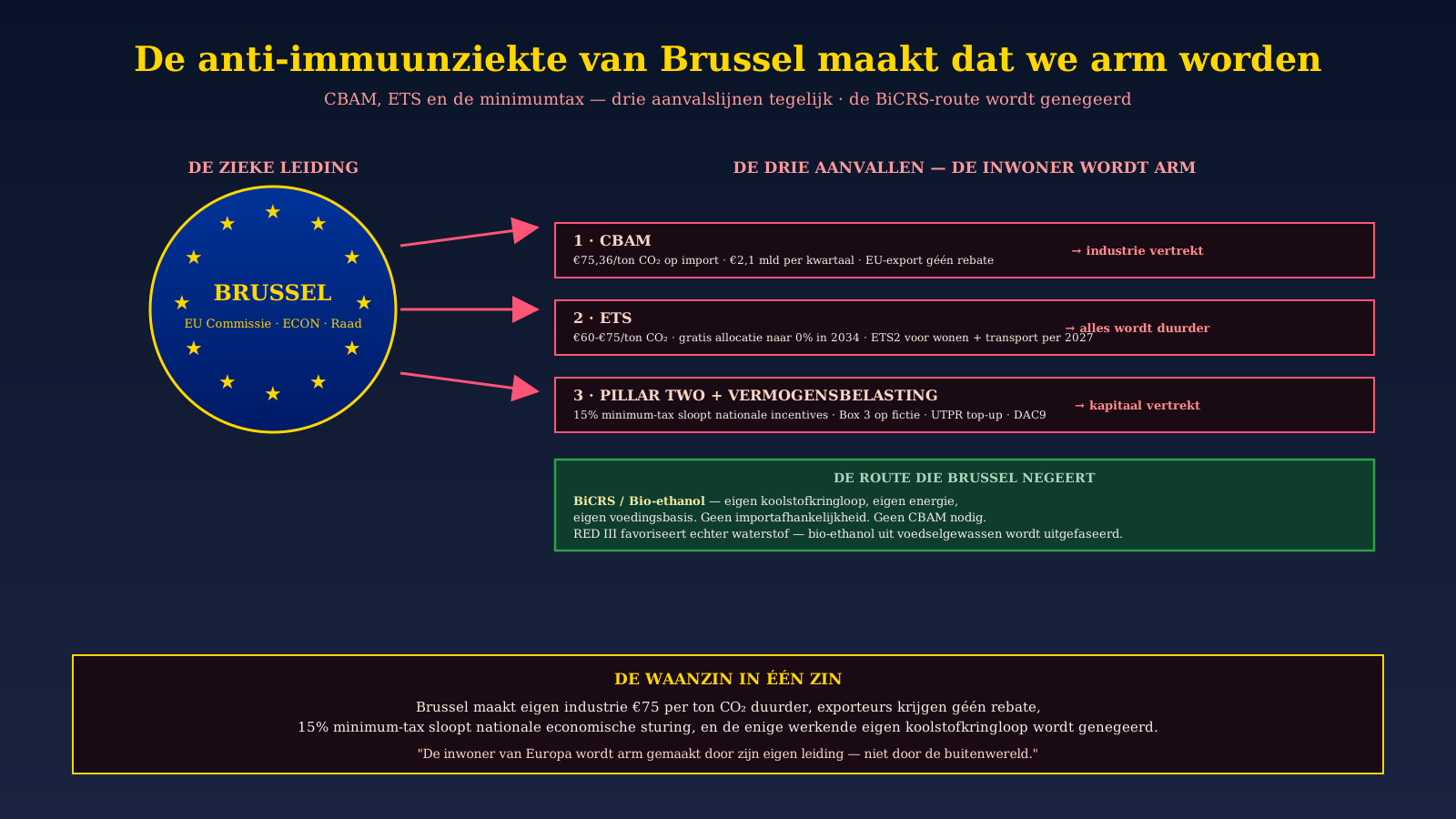
CBAM, ETS and Pillar Two — three attacks at once. The BiCRS/ethanol route is ignored. The inhabitant of Europe is being impoverished by his own leadership.
Jacobus van Merksteijn · 19 June 2026
Since 1 January 2026, Brussels has made its own industry €75 per tonne of CO₂ more expensive. No rebate for those who export. At the same time the minimum tax rolls out. At the same time fiscal space narrows. Three attacks on the productive tissue, simultaneously, from one leadership.
What is happening now:
CBAM entered its definitive phase on 1 January 2026. €75.36 per tonne of CO₂ on imports of steel, aluminium, cement, fertiliser, electricity and hydrogen. The European Commission estimates the costs at €2.1 billion per quarter. EU exporters to markets outside Europe receive no rebate — pure "reverse carbon leakage". The free ETS allocation is phased out from 97.5% (2026) to 0% (2034).
Sources: GoClimate, June 2026 · Green Calculus, June 2026
EU ETS stands at €60-€75 per tonne of CO₂. Shipping has been 100% in the system since 2026. ETS2 (buildings + transport fuel) is coming in 2027/2028. Every €10 increase makes gas €5-€8 more expensive for households. For energy-intensive industry — Tata, Nyrstar, chemicals, fertiliser — the calculation becomes untenable.
Source: SurgePV, May 2026
Pillar Two / minimum tax 15% has been in force since 2024. First GIR deadline: 30 June 2026. Multinationals with €750 million+ revenue must pay 15% effective tax in every jurisdiction. All national incentives — patent box, R&D deduction, investment facility — are effectively hollowed out via top-up. At the same time: in the Netherlands Box 3 on notional yield, in France PFU + CSG up, across Europe DAC7+DAC9 reporting. Everything gets more expensive.
Sources: Acclime, June 2026 · Global Law Experts, May 2026
RED III recognises hydrogen as future industrial infrastructure — Germany just set a 10% RFNBO quota for 2040. For BiCRS, bio-ethanol, circular carbon the framework becomes stricter: 70-80% GHG saving mandatory, third-party audit, and food and feed crops are being phased out. CropEnergies AG (European market leader in bio-ethanol) explicitly argues for recognition of crop-based biomass and CCU. Brussels rejects it.
Sources: Voice of Renewables, April 2026 · WABIO Technology, June 2026
That is the package. What it really is, in the same language as the The Hague article:
The anti-immune disease of Brussels is attacking the European productive tissue from at least three sides at once — while the only working European carbon cycle, BiCRS and bio-ethanol, is being systematically ignored in favour of imported hydrogen.
The madness in four numbers
€75.36. What Brussels imposes per tonne of CO₂ on its own industry — while American and Chinese competitors pay €0 on their home markets.
€2.1 billion. What one quarter of CBAM currently costs. For all of 2026 that means between €8 and €15 billion. All coughed up by European importers and their customers.
€0. What an EU exporter to third markets receives as rebate. He pays the ETS price inside Europe and then competes with parties who pay no carbon price elsewhere. Pure structural self-destruction.
15%. The minimum tax that neutralises every national economic steering instrument. Patent box in the Netherlands? Top-up. Investment deduction in Belgium? Top-up. Strategic-investment stabilisation in Greece? Top-up. National economic policy is by definition put out of operation.
Four numbers, one conclusion: the European inhabitant is being impoverished by his own leadership. Not by China, not by America, not by Russia. By Brussels.
The BiCRS blindness
What Brussels does not see — or does not want to see.
Europe has one productive route for its own energy and its own carbon cycle that can be scaled up now: BiCRS and bio-ethanol. Biomass from its own agriculture, fermentation to ethanol, carbon captured and returned to the soil. No import dependence on LNG or hydrogen from distant countries. No CBAM needed, because it is a closed European loop. No subsidy needed, because the market works.
Friesland has the living proof in the Agricycling cooperative: one year, one cooperative, 85,844 kg of nitrogen replaced via circular compost, €4.4 million in societal value, no subsidy. Scale this up to Europe via bio-ethanol and you have the end of import-dependent energy — and of the nitrogen surplus.
What does Brussels do? It chooses hydrogen. Germany received a 10% RFNBO quota in transport by 2040 in April 2026, plus "overriding public interest" status for hydrogen infrastructure until 2045. Bio-ethanol from food crops is phased out under RED III. CropEnergies AG wrote it in so many words in June 2026: "Treat crop-based biomass, recycled carbon and CCU as complementary solutions" — Brussels rejected it.
Hydrogen path (Brussels): capital-intensive, import-dependent, infrastructure for 2045, decades away from market-ready.
BiCRS path (ignored): existing technology, own feedstock, own carbon loop, scalable today.
Brussels chooses the first. The European inhabitant pays for the second which does not come.
Three attacks, one pattern
What CBAM, ETS expansion and Pillar Two have in common: each on its own is "defensible" policy. Prevent climate leakage. Tackle tax avoidance. Level the competitive playing field.
But compressed together, simultaneously, without coordination and without a proper alternative, they form one attack on the European productive tissue.
- CBAM makes importing EU firms more expensive, suppresses exporting EU firms, and yields no revenue for workable alternatives.
- ETS makes energy inside Europe more expensive, forces industry to leave or innovate, and returns no European energy foundation for that.
- Pillar Two dismantles national fiscal instruments, imposes uniformity, and offers no European industrial policy in exchange.
Three clamps on one productive cell. The cell yields — to Texas, to Shanghai, to Dubai. And within Europe, the inhabitant remains behind with higher prices, a shrinking working economy, and a leadership that says: "This is good for the climate."
What the figures show — and what they hide
The Sandbag analysis of 12 June 2026 partly acknowledges it openly: there is a "temporary funding gap" until 2034 in which CBAM revenues are too low to compensate the affected sectors. Subsidies "should focus on the period until 2034". But those same subsidies are effectively neutralised by Pillar Two top-up. Brussels hands out with one hand what it takes back with the other.
The PIK study (Phys.org, June 2026) shows that CBAM at a carbon price of $100/tonne can cause a "Brussels effect": four countries (Canada, Japan, South Korea, Taiwan) would join in climate pricing. China only under $20/tonne. Under current conditions China will not join — and carbon leakage stays at 15%.
In other words: Brussels pays a price of €75 to prevent 15% leakage — while leaving 85% of the problem untouched and driving its own industry to the edge.
What must change
Five decisions Europe needs
- CBAM export rebate. EU exporters to third markets must receive the same rebate as importers face a charge. Otherwise it is pure self-sabotage. The Sandbag report acknowledges this. The Commission blocks it.
- Recognise BiCRS / bio-ethanol as equivalent to hydrogen under RED III. Crop-based biomass and CCU as legitimate decarbonisation paths. CropEnergies' proposal: Carbon Utilisation Trading System (CUTS). Introducible today.
- Suspend Pillar Two for green-investment incentives. Expand the Substance-Based Income Exclusion to innovation and industrial substance investments, not only payroll and assets. Otherwise every national industrial policy dies.
- Freeze ETS until the CBAM export gap is closed. A rising carbon price without export rebate is a clamp on European industry that cannot be justified.
- Stop the wealth tax on notional yield (Box 3, wealth-accrual tax, UTPR pass-through). Tax only on actual realisation. Capital that does not leave is capital that innovates.
The inhabitant is being impoverished
The effect of all this is predictable. The European inhabitant will, in 2026-2030:
- Pay more for energy (ETS price rises, ETS2 is coming)
- Pay more for goods (CBAM pass-through on steel, aluminium, fertiliser, cement)
- Be able to build less wealth (Box 3 fiction + Pillar Two + DAC9)
- Have less work (industry moves to Texas and Asia)
- Have less food security (farmers leaving the Netherlands, energy input imported)
- Get no European energy foundation (BiCRS ignored, hydrogen too late)
This is no conspiracy. It is no Chinese plot, no Russian disinformation, no American trade trick. It is Europe's own leadership attacking its own organism, with the best of intentions, from models that fail to account for where European prosperity actually comes from.
Brussels does to Europe what The Hague does to the Netherlands. The form differs. The disease is the same. And the patient — the European inhabitant — is systematically made poorer by it.
What now
The Dutch farmer is a mirror for European industry. The €212,795 per kilo of nitrogen in the Netherlands is the €75 per tonne of CO₂ in Brussels. Both amounts appear logical in models and are in reality self-destructive.
Both amounts continue as long as the inhabitant does not say: not this.
Brussels is further away than The Hague. The European Parliament is harder to reach than the Dutch Second Chamber. But precisely for that reason this moment is critical. The CBAM expansion is now moving through the ECOFIN track. The Pillar Two GIR deadline is 30 June 2026. RED III implementation is being fixed in national legislation this month. Whoever does not name it now will bear the consequences for at least a decade.
Het Open Vizier names it. And asks every reader, entrepreneur, farmer, SME owner, DGA, employee: Pass it on. Awaken your own Treg cells. The European auto-immune disease is a curable disease — but only if the patient dares to acknowledge its own recognition error.
The inhabitant of Europe is being impoverished by his own leadership.
Not by the outside world. Not by China. Not by adversity. By Brussels.
And the treatment exists. It lies on the table. It is being ignored.
