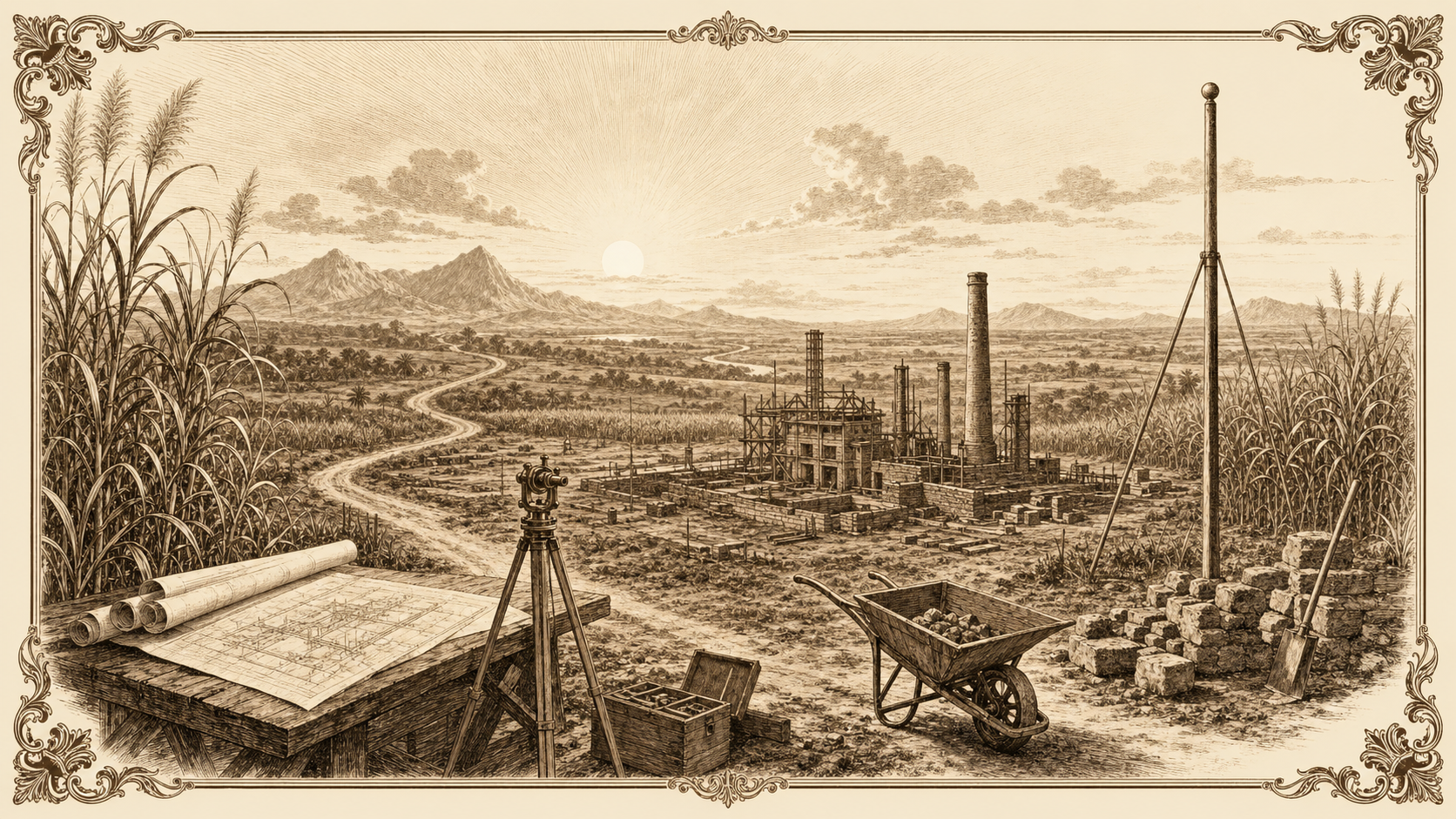
Activists build continents
Drive seeks ground. Give it ground.
The sun on the equator is half the story. Who harvests it is the other half. An open invitation to organisations with vision and to everyone who seeks their energy where it can build something.
The thesis of this article
Those who have energy but find no space destroy. Those who have energy and are given ground build.
The biomass-equator route from our main article has technology. What it still lacks is leadership on the ground. Not from a Brussels chair. Not from a committee in The Hague. From the construction site itself. And leadership sits precisely where we rarely look for it today: with the people who have too much drive for the European pace.
I · The Chinese model, rethought
China does not send its most difficult people away to punish them. China sends them to villages, to border regions, to Africa, to Pakistan — not as prisoners but as builders. Those who build something with which China trades strengthen the bond between China and that place. It is the most successful diplomatic export of our century, and it happens without an army.
Europe can do the same. Not in reverse — not as development aid that dumps people we no longer accommodate into another continent. But as opportunity. Those who are stuck here and are given space elsewhere to build a life, a business, a community bring back something no Brussels subsidy can ever buy: an organic connection between continents, carried by people who know both sides from the inside.
II · What the equator needs
The biomass-equator route demands twenty billion euros of trade per year, ten thousand bio-refineries the size of a village, fifty ports that do not yet exist, and millions of people to carry the logistics, the chemistry, the construction, the service and the trade. That is not work we manage from Wageningen. That is work that must emerge on the ground, by people who live and build there.
An equatorial country like Mozambique has young people with talent and without work. Brazil has engineers without challenge. Ghana has chemists who leave for London because there is no infrastructure at home. Europe has people with too much ambition for the European tempo. Between these four groups an industrial revolution is waiting. What is missing is a passage.
III · Three groups, three opportunities
The pioneers who already paid for their crossing
There are at this moment hundreds of thousands of people in Europe who paid twenty thousand euros to get here. That is not a small sum. That is venture capital, and the willingness to take the risk. They are not passive aid-seekers. They are the most active of their generation, who staked their savings and their risk to change their fate.
And then they sit in a European system that cannot use their energy. No work permit. No recognition of qualifications. No space to be an entrepreneur. The drive that brought them to the crossing boils over in an asylum procedure that takes years and in a benefit that demands nothing.
Offer them a different track. Those who want it — voluntarily, with support, with start-up capital — can deploy their entrepreneurship where it matters: a bio-refinery in Ghana, a Juncao cooperative in Mozambique, a trading house in Suriname that supplies Rotterdam. Not as return. As advancement. With European recognition, European partners, European market access. The twenty thousand euros they invested pays off on a continent where they are allowed to build.
The Europeans who are too cramped here
There are also Europeans who are stuck here. Not through birth elsewhere, but through temperament. The entrepreneur who loses six months in every consultative committee. The engineer whose idea cannot get through the regulations. The activist who makes spots about what should be and finds no place where they actually do it themselves. For them the same applies: drive seeks ground.
The equator offers ground. Literally: marginal land that does not exist in Europe. Figuratively: a terrain without established interests, without three hundred years of regulation, without a meeting culture that absorbs half of every day. Those who suffocate here can breathe there.
Organisations with vision and networks
And there are organisations. Greenpeace is an organisation that for decades has shown in its communications what it wants realised: a world where energy is green, where industry respects nature, where the south is not exploited. Its spots are clear, its rhetoric powerful, its networks global.
This is a respectful invitation. The biomass-equator route is precisely what Greenpeace has been advocating for years, translated into industrial form: solar energy where it falls, crops that fix more carbon than they emit, partnership instead of exploitation, no fossil, no nuclear fission. What stood in campaign for decades can now stand in concrete and in plantations. Greenpeace has the global presence, the trust with equatorial governments, the credibility with the European public, and the organisational capacity to set this up. No other organisation has that combination. The invitation is clear and respectful: come build this. Or organisations with the same vision and the same weight — WWF, 350.org, Fridays for Future when they are old enough to handle coordination — who want to take up the call.
IV · What this is not
This is not a plan to dump those who are not welcome here somewhere else. That would be a repetition of what the United Kingdom tried with Rwanda: offloading shame into another country. That does not work and does not deserve to work.
This is something different. This is recognition that the people with the most drive — whether born in Aleppo or in Amsterdam — find no fitting space in today's Europe. Their energy stalls in procedures, meetings, regulations, and in an expectation of conformity that breaks precisely the best ones. A continent that cannot place its most energetic people grows poorer. A continent that sends them into the world to build something with which the motherlands then trade enriches itself twice over.
And it is voluntary. Those who want to stay, stay. Those who want to build where building is permitted get the path. No banishment. No punishment. An opportunity.
V · What it yields us here
A Europe that relieves its pressure points. Less tension in the neighbourhoods where too many people with too much energy have too little prospect. Less radicalisation, because radicalisation is above all a consequence of meaninglessness, not of ideology. Fewer asylum procedures that take years, because a second track — entrepreneurial, productive, with European support — offers a way out the current route does not know.
And a Europe with trading partners at the equator led by people who understand us — who speak our languages, know our rules, can read our markets. Not ambassadors who rotate every four years. People who have built their lives there, and who for that very reason are the most natural bridge.
We have always thought that leadership means: keeping in step. Our best leaders were precisely the people who stepped out of line. We forgot that and removed it from our system.
The equator has space for those who step out of line here. And Europe benefits from what they build there. We lose nothing by letting them go. We win everything by letting them build.
Greenpeace, take up the baton. To everyone with the drive but without the space: look at the sun on the equator. It stands there for you.
— Het Open Vizier · June 2026
Read also
The sun stands on the equator
The main article: five blinkers off, one route that works, and Europe back on the leadership throne through partnership with the equator.