Europe Anew
A manifesto for the rebirth of a continent — on why we are no longer great, and how we can be once more.
By Jacobus van Merksteijn · Malta, July 2026

Part I — The Vision
The question no one asks anymore
Why are we no longer great?
This question is virtually taboo in the current European debate. We may speak of "resilience", of "adaptation to a changing world", of "sustainability" and "inclusion". But the simple question — why a continent that led the world for five hundred years has given away its position in fifty years — that question is not asked. And if someone does ask it, they are dismissed as nostalgic, extreme, or dangerous.
I ask the question here, in Het Open Vizier. Why are we no longer great? And, more importantly: why could we not be so again?
This piece is an answer in three parts. First the vision: what Europe can look like in 2050 if we make the right choices. Then the diagnosis: why we have slid into this situation. Then the proof: one symptom — the false poverty debate — numerically analyzed. And finally: what you and I can do.
This is not an academic piece. This is a call to action. Whoever reads these lines and finds themselves in agreement should not nod in silence. They should speak, write, vote, build. We have one, perhaps two generations to reverse what fifty years of dismantling has wrought. After that, Europe can no longer be saved.
Where we come from
In 1945, Europe lay in ruins. Cities destroyed. Factories bombed. Millions dead. Millions displaced. A continent that had led the world for a hundred years had been reduced to a smoking ruin by two world wars. The United States was the new superpower. Soviet Russia threatened from the east. The colonial empire was crumbling. All was lost.
And then, in the twenty-five years that followed, something happened that world history has rarely known.
From 1948 to 1973, the West European economy grew faster than ever before or since. Germany achieved the "Wirtschaftswunder" — an economic miracle that transformed the country in twenty years from an occupied landscape of debris into the world's third-largest economy. Italy went from an agrarian hinterland to an industrial powerhouse. France recovered and modernized. the Netherlands built the Deltawerken, one of the world's most ambitious engineering projects. Belgium, Austria, Switzerland, Scandinavia — everywhere the same explosion of prosperity, technology, culture.
The disposable income of an average household doubled between 1960 and 1980. Unemployment in Switzerland: below 1%. In West Germany as well. the Netherlands: around 1%. France: 2%. For the first time in human history, ordinary working families could go on holiday, their children could study, they could afford a house.
We built Airbus. We built Concorde. We built Ariane. We built CERN. We built the first container ships, the first high-speed trains, the first nuclear energy programs. We built the European cooperation that was once visionary.
European scientists won Nobel Prizes. European enterprises — Philips, Siemens, Fiat, Volkswagen, Nestlé, Shell, Bayer, Michelin — were world leaders in their sectors. European art, literature, film, music were at the forefront. European cities were the most desirable in the world. European universities attracted talent from all continents.
This was Europe. Only thirty years ago. It is not ancient history. It is within living memory.
And we have given it away.
What we have lost
Today, 2026, we look at a different continent.
Our economy has barely grown for 25 years. The disposable income of households has stagnated since circa 2000, despite a growing economy — the difference disappeared into taxes, redistribution, and overhead. Unemployment in the eurozone: 6,2%. In Spain: 10,3%. In France: 8,1%. Even Switzerland, once our example, is sliding back toward the European average.
Our large companies are losing ground globally. Airbus is losing to Boeing and Chinese competitors. Volkswagen is closing factories and laying off 100.000 employees. Siemens, Bosch, Philips, Nokia, Ericsson — all shrinking, all defensive, all losing market share to American and Asian competitors.
Our technological leadership: gone. The large AI models are made in California and Beijing, not in Munich or Paris. The large chip factories are in Taiwan and South Korea. The large biotech breakthroughs come from American laboratories. We have ASML, and that is wonderful, but one company is not a continent.
Our science: relatively declining. Number of Nobel Prizes per capita: falling. Number of patents per capita: falling. Number of top-25 universities: American and Asian dominate, European are falling behind.
Our military capacity: neglected. We could not defend ourselves against Russia without American help. For decades, we have no longer been building what a great power ought to build: strategic capacity, technological sovereignty, energy independence.
Our culture: diluted. Our cities: often neglected, become unsafe, partially abandoned by the middle class. Our schools: leveled down. Our healthcare: overburdened. Our police: understaffed. Our public services: collapsing.
And our population: unhappy, polarized, become cynical, and increasingly radical on both the left and right fringes of the political spectrum, because the center no longer offers answers.
This is Europe. Now. 2026.
We did not stop being a great continent because an external power defeated us. We were not overtaken because Asia or America did something extraordinary that we could not. We have declined because we have systematically undermined ourselves. **We are the only civilization in history that has dismantled itself out of free will.**
I will fully expose the causes of this self-destruction in Part II of this piece. For now, one summary suffices: we have replaced respect as the organizing principle of our society with envy. We have made ambition suspicious. We have redefined prosperity as poverty, and proclaimed poverty a right. In fifty years, we have torn down what generations had built, and called it "progress".
But Europe is not dead. Europe is confused, exhausted, and misled. That can be reversed.
What other countries teach us
Before we discuss how Europe can be great again, we must be honest: it is possible. This is not a dream. Other societies show that it is possible — if you make different choices than we have made.
Switzerland pre-1990. Until circa 1990, Switzerland experienced a structural unemployment rate of below 1%. Not because the country was magical, but because it operated under principles that the rest of Europe had long since abolished: limited benefits, high labor flexibility, strong local decision-making authority, mandatory job-seeking activity with real sanctions, and a culture in which work was dignity. When Switzerland partially abandoned these principles under European pressure, its unemployment rose to the European level. **The lesson is clear: the Swiss model worked because it was different from ours, not because it was intrinsically Swiss.**
Singapore. In 1965, Singapore was split off from Malaysia as an impoverished port city without resources. Today, Singapore has a GDP per capita higher than Germany, France, or the United Kingdom. How? Through low taxes, strict law enforcement, meritocracy in governance, quality education, and a culture of hard work and personal responsibility. Singapore has no minimum wage, limited benefits, and expects every citizen to be able to support themselves. The result: practically no unemployment, low crime, high prosperity.
South Korea. In 1960 poorer than Ghana. In 2026 richer than Italy, Spain, or Portugal. South Korea has shown the world what a people can achieve if it is willing to work, to learn, and to reward excellence. From Samsung to Hyundai to BTS to K-drama — South Korea has worked its way up to a world-class level in culture, technology, and industry in just two generations.
Israel. In 1948 a collection of deserts and swamps, threatened by all neighboring countries. In 2026 one of the most innovative countries in the world per capita, a world leader in cybersecurity, medical technology, agrotechnology, and defense. Israel shows what a small people can achieve through education, ambition, entrepreneurship, and collective will.
the United Arab Emirates. In 1970 a collection of pearl-fishing villages. In 2026 a world city with skyscrapers, a knowledge economy, highly developed infrastructure, and an attraction for talent from all over the world. Dubai has transformed a desert into a metropolis within one generation. Not because it had oil — many oil-rich countries achieved nothing — but because it had ambition.
What do these countries have in common? Five things.
One: low taxes on work and entrepreneurship. Working still pays off. Entrepreneurship is rewarded, not punished.
Two: respect for excellence. Those who are better are allowed to be better. Those who work are respected. Those who achieve something are admired, not envied.
Three: **limited social safety net with sharp incentives for self-reliance**. Those who truly cannot work are helped. But no one is rewarded for not working.
Four: strict enforcement of law and order. Police have authority. Judges have respect. Laws are complied with or punished.
Five: ambition on a national level. These countries want to be great, want to be the best, want to contribute to the world. They are not ashamed of their success.
We used to have each of these five things. Each of these five things we have lost.
The way back consists of embracing them again.
What we must do
This is not a story of doom. We do not have to write off Europe. We are still a continent of 450 million people, with an enormous scientific base, with world cities, with capital, with skills, with knowledge. The tools to rise again are on the table. We must dare to pick them up.
Here is what is needed. Concretely.
1. Halve the tax burden on work
The tax burden on labor in the Netherlands, Belgium, France, Germany, Italy, and Austria lies between 40% and 52%. This is the highest level worldwide. This is not solidarity — this is work discouragement in numbers.
We must return to a tax burden on work of at most 30%, as in Switzerland pre-1990, as in the United States today, as in Singapore. Every working European must keep at least 70% of what he or she earns.
The lost revenue can come from:
- Abolition of the many billions per country in wealth redistribution that has been sold as poverty reduction (Part III supports this numerically)
- Reduction of the bureaucratic apparatus that has been bloated by decades of redistributive politics
- More competitive corporate taxes that bring enterprises back to Europe
- Ending EU subsidies that have no demonstrable added value
2. Restore work incentives
Welfare may never — including all allowances — be higher than the net minimum wage. Working must always yield substantially more than not working. In the Netherlands, Germany, France, and Belgium, this is often no longer the case today, as a result of which the bottom of the labor market structurally stays at home.
This is not cruelty toward benefit recipients. This is the protection of the work ethic of the whole society. If working does not pay, no one goes to work. If no one works, no one can redistribute. The system eats itself.
3. Restore authority
Police, the judiciary, the fire department, ambulance services, teachers, doctors — these people are the backbone of a civilization. Every attack on them, verbal or physical, is an attack on civilization itself. We must have zero tolerance for disrespect toward these professions. Direct criminal consequences, no reduction in sentence, permanent record.
At the same time, these professions must become attractive again — in salary, in prestige, in authority. Those who stand before a classroom must be allowed to set demands again. Those who bear authority on the street must also receive that authority. Those who save lives in the hospital should not be harassed by patients or family.
4. Restore education as a place of knowledge and excellence
For decades, we have leveled down our schools. Excellence was punished because "everyone had to be equal". Mediocrity became the norm. Talent was slowed down so as not to humiliate the weaker.
The result: a generation that can do less than its parents. the Netherlands is falling in international educational comparisons. German universities are losing prestige. French elite institutions are producing fewer and fewer leading thinkers.
We must restore differentiation. Gymnasiums must be allowed to be gymnasiums again. Excellence must be allowed to be excellence again. Children who can, must be allowed to. Children who want to, must be permitted to. **Equal opportunities: yes. Equal outcomes: never.**
5. Embrace entrepreneurship
Those who start a company, those who create jobs, those who generate prosperity — deserve gratitude, not suspicion. We must make heroes of entrepreneurs, as they ought to be. Taxes down, regulatory pressure down, and cultural respect up.
Every European country should want to be the "easiest country in Europe to start a business". Now, that is often Estonia. It used to be the Netherlands, with its Dutch East India Company and its Golden Age. We can become that again — if we treat entrepreneurs as friends instead of as enemies.
6. Invest in strategic capacity
In 2050, Europe must be capable of defending itself, providing itself with energy, providing itself with critical technology, and providing itself with critical medicines. We are far from that today.
This requires massive, strategic investments in:
- Defense (2% of BBP is a minimum, not a maximum)
- Nuclear energy (again, as France did in the 1970s — quickly, at scale, and without ideological objections)
- Semiconductors (we have ASML, we have the knowledge, we have the money — what is missing is ambition)
- Pharmaceutical production (Europe used to produce its own medicines; now we are dependent on China and India)
- Quantum technology, biotechnology, aerospace
These investments must be driven by ambition, not by subsidies. We must want Europe to be the world leader in these areas in 2050 — and that requires national and European will, not another subsidy scheme.
7. Limit the EU to what the EU must do
The European Union was once a sensible cooperation between sovereign nations in areas where cooperation had added value: internal market, common external border, joint trade. It has overshot into a thousand regulations, directives, subsidies, and interferences that offer no demonstrable added value and undermine the member states.
We must return the EU to its core: internal market, external borders, defense cooperation, strategic autonomy. All other matters should return to the member states, and much within the member states should return to the regions and municipalities that know what is needed locally.
Subsidiarity is not an empty word. Decisions should be taken at the lowest possible level. Only what truly must be European becomes European. The rest becomes local, and therefore it works.
8. Restore the culture
Our history, our language, our customs, our holidays, our religion, our science, our philosophy — all this is not accidental. It is earned, inherited, built up. We may be proud of it.
That does not mean: unchanging conservatism. It means: conscious continuity. We may learn, grow, adapt — but always from a sense of who we are. A tree grows by holding onto its roots, not by cutting them.
The current self-hatred cultivated by parts of the European elite — the idea that Europe is fundamentally guilty of everything that has gone wrong in the world — is not only historically incorrect but suicidal. No people can be great if it hates itself. We must learn to value ourselves again, with our mistakes, with our achievements, with our possibilities.
9. Population policy
We do not like to speak about demographics because every conversation about it immediately ends up in ideological pitfalls. Yet this is one of the most important questions for Europe: we are aging rapidly, our birth rates are too low to replace ourselves, and our population size will decline in the coming decades unless there is policy.
We must create a culture in which family formation is attractive again. Tax benefits for families with children, affordable housing for young couples, respect for the role of housewife or stay-at-home father for those who choose it, and a cultural shift that makes having children valuable again instead of "a choice like any other".
At the same time, immigration must be strictly controlled and aimed at people who contribute to our society, want to learn our language, want to respect our laws, and want to embrace our culture — not replace it. Uncontrolled immigration is not solidarity; it is negligence toward both our own citizens and the newcomers.
10. Ambition as a national and European project
This is the most important thing. Every policy, every law, every choice must be tested against one question: **does this make Europe larger or smaller, stronger or weaker, more ambitious or more listless?**
For forty years, we have governed by risk avoidance, defensive reflexes, and the management of existing interests. It is time to think offensively again. What do we want to be in 2050? What is our goal? What do we want to be proud of when we leave this continent to our grandchildren?
For me, the answer is clear: we want Europe in 2050 to once again be the most prosperous, most developed, most innovative continent in the world. That is not nostalgic. That is ambitious. And it is possible — if we want it.
What we can be again
Allow me to paint you a picture of Europe in 2050, as we can build it if we take this path.
Unemployment below 2%. Like Switzerland in 1975. Everyone who can work, works. Working pays off. Benefits exist only for those who truly cannot. Our labor force participation is the highest in the world.
Tax burden on work at most 30%. Every working European keeps 70% of what he or she earns. That is the norm. Tax avoidance becomes less attractive because the tax itself is no longer suffocating. Capital returns to Europe.
Our companies once again world leaders. Not only ASML, but ten ASMLs. In semiconductors, in biotech, in energy, in aerospace, in quantum technology, in AI. European engineers, European entrepreneurs, European capital — we again give a reason to stay here and build here.
Our cities once again the most beautiful in the world. Amsterdam, Paris, Munich, Vienna, Milan, Barcelona, Copenhagen, Prague, Krakow — clean, safe, culturally flourishing, attractive to talent from all over the world. We restore what was neglected, we build what is needed, and we protect what is precious.
Our universities once again the best in the world. Cambridge, Oxford, Leiden, Delft, Zurich, Heidelberg, Sorbonne, Bologna — where the best young people from all continents want to study because the knowledge, the teachers, the ambition are unparalleled here.
Our culture once again at the forefront. European film, European literature, European music, European art — attract the world's attention because we dare to be grand and deep and meaningful again, instead of small and superficial and safe.
Our security once again guaranteed. A European defense that is taken seriously. A border that is defended. A police force that has authority. A legal system that works. Streets where children can play again.
Our families strong again. Children growing up with both parents. Grandparents who are involved. Values that are passed on. Loyalty, responsibility, respect. This is the foundation on which everything rests — if the foundation falls away, the rest falls too.
Our democracy respectable again. Politicians who serve the voter instead of the other way around. Governments that dare to lead instead of hiding. Voters who vote informed instead of out of anger. Debate that is productive instead of polarizing.
This is Europe in 2050. If we want it. If we choose it.
But before we can get there, we must be honest about how we have slid down. What follows is the diagnosis. It is uncomfortable. It is sharp. But without it, we do not understand what we must reverse.
Part II — The Diagnosis
Envy as Cancer
Europe is not collapsing because of immigration. Europe is not collapsing because of climate. Europe is not collapsing because of inflation or war. Europe is collapsing because of an internal disease that has been consciously cultivated for fifty years, which every generation has passed on more severely to the next, and which today is so deep in our fabric that most no longer recognize it as a disease. They recognize it as virtue.
That disease is envy.
Envy — that ugly, mean, petty feeling that pulls man down and society with him. Envy that clothes itself in the finest words: social, solidary, equal, just. Envy that hides in tax tables, in schoolbooks, in TV programs, in union boardrooms, in policy papers of ministries. Envy that sells itself as morality while it is exactly the opposite.
And opposite this disease stands what we still had fifty years ago and have now almost lost: respect. Respect for work. Respect for knowledge. Respect for authority that does its duty. Respect for the partner with whom you build a life. Respect for the children to whom you must bequeath a country. Respect for the doctor, the officer, the teacher, the entrepreneur, the king. Respect for the neighbor with the well-maintained garden.
Respect builds. Envy breaks down.
And Europe is breaking down.
How the Poisoned Cup was Proffered
Around 1968, something happened in Western Europe for which we are only now paying the full price. Under the banner of "democratization" and "emancipation," every form of hierarchy was declared oppression. Every authority was suspected. Every difference became an injustice. Every excellence became a provocation.
The doctor had to stop being a "white coat" and became a service provider who had to hand in his diploma at the customer reception desk. The teacher was addressed by his first name by eight-year-olds. The officer became a "pig." The entrepreneur became a "capitalist." The father became a friend who was no longer allowed to forbid anything. The king became a cost item. The civil servant became a profiteer.
We called this progress. We thought we were liberating ourselves. In reality, we systematically gave up everything that holds a society together.
For a society without hierarchy is no society. It is a crowd. And a crowd behaves as crowds have always behaved: it seeks scapegoats, it insults, it plunders, and eventually, it destroys itself.
This is exactly what we see now.
**The symptoms that everyone knows and no one dares to link together**
Ambulance personnel are attacked when they come to pick up an injured person. Doctors are spat upon during their office hours. Police officers are pelted with stones. Teachers are intimidated by parents who feel their child deserves a ten. Firefighters are attacked when they come to extinguish a fire. Bus drivers are beaten because a teenager did not want to buy a ticket.
This is not accidental. This is not incidental. This is the direct consequence of fifty years of systematic respect-stripping. He who learns that the officer is a pig, spits on the officer. He who learns that the doctor is a service provider, attacks the doctor if the service does not please him. He who learns that the teacher has no authority, headbutts the teacher.
Entrepreneurs are fleeing the country. Not because the taxes are too high — that too, but that is not the deepest part. They flee because they are no longer respected here for what they do. In the Netherlands, Germany, France, the entrepreneur who creates jobs, takes risks, works seven days a week, is no hero. He is suspicious. He is a "grabber." He must be ashamed of his success. In Switzerland, in America, in Dubai — there he is respected. So he leaves, and we lose his taxes, his jobs, and his knowledge.
Young people no longer want to become a doctor, officer, or teacher. The shortages are structural and growing. Why would you study for seven years for a profession in which you are spat upon? Why would you become a policeman and risk going home in pieces on a Friday night, only to be criticized by the judge because you used your weapon? Why would you become a teacher for a class of parents who threaten you with a lawyer for every failing grade?
Talent is fleeing from public positions. The best doctors go to private clinics. The best lawyers to commercial law firms. The best engineers to companies abroad. What remains for the public sector? The mediocrity, with the best intentions, in a system that does not respect them either.
Children grow up without authority. Parents are no longer parents; they are "equal conversation partners." Children receive a counterargument for every remark. School may no longer demand anything. Sports coaches may no longer be strict. Music teachers may no longer give criticism. And then we are surprised by generations that cannot handle setbacks, that collapse at the first "no," that are in psychological care en masse for "burn-out" at age 24.
**Politicians are threatened, journalists are intimidated, scientists receive death threats.** Whoever sticks their neck out in the public domain is punished. Not with counterarguments, but with threats. Not with discussion, but with hatred. The result? The people with the strongest backbone withdraw. What remains in the public space is the mediocrity that is not a target.
The Envy Industry
Who profits from this disease? Who maintains it?
A massive apparatus has emerged in Europe that derives its right to exist from envy. Political parties that profile themselves on redistribution. Unions that legitimize themselves by constantly pointing to alleged injustice. NGOs that collect money by magnifying "inequality" into a disaster. Civil servants who have jobs because they dispense subsidies that would otherwise be unnecessary. Media that generate ratings with stories about "the rich" versus "ordinary people." Academics who make a career by explaining everything as "structural violence" and "systemic oppression."
This envy industry employs hundreds of thousands of people. Each has an interest in the persistence of alleged injustice. If Europe were to announce tomorrow that poverty has been overcome, that inequality is tolerable, that most people are doing just fine — they would lose their reason for being.
So they fabricate new injustices daily. New victim groups. New culprits. New poverty lines that lie just above the current level of prosperity of the "poor." New demands on the "privileged" to hand over even more, to admit even more guilt, to be even more silent.
This industry feeds on the envy of ordinary people. It tells the low-paid employee that his problem is not his own position, but the height of top salaries. It tells the tenant that his problem is not the housing shortage, but the landlord. It tells the student that his problem is not his choice of study, but the "elite" that "excludes" him. Everywhere, it is not one's own position that is improved; everywhere, the other is pulled down.
And the ordinary European, tired, with too many taxes, with too little time, believes it. Because envy is the easiest emotion. It requires no self-reflection, no effort, no growth. It only demands that the other be punished.
The Great Lie: "Equality"
And then comes the most disgusting thing of all. The envy industry does not call itself envy. It calls itself "equality."
Let me be clear.
Equality before the law is an achievement of civilization. Every citizen equal before the judge, equal voting rights, equal civil rights — that I defend with my life.
Equal opportunities is a moral principle. Every child, regardless of origin, should have access to good education and fair labor opportunities. That is defensible and I defend it.
**But "equality of outcome" — the idea that everyone should have, earn, possess, achieve roughly the same — that is envy wearing a suit.** That is the lie with which politics has been made for the last fifty years. That is the justification with which we have raised taxes to suffocating heights, with which we have leveled our schools to mediocrity, with which we have democratically mutilated our healthcare, with which we have driven away entrepreneurs and discouraged talent.
Inequality of outcome is not injustice. Inequality of outcome is the result of differences between people — in talent, in effort, in choice, in luck. People are not equal in what they can, want, or do. Every attempt to tax away, subsidize away, "equalize" away those differences is an attack on what people are.
And the people who built this system know that. They know that perfect equality is impossible. They know that every attempt at it ends in tyranny or stagnation. But the idea of "equality" brings them power. It brings voters. It brings jobs in the redistribution apparatus. So they maintain the lie, decade after decade, and the ordinary people pay the price.
What We Have Lost: The Respect Contract
In the past — and by "the past" I mean: until about 1970, thus within living memory — we had an unwritten contract in Europe. Everyone respected everyone in their role.
The worker respected the boss who gave work, and the boss respected the worker who did the work. The minister or priest respected the mayor, and vice versa. The schoolmaster respected the parents, and the parents respected the schoolmaster. Neighbors respected neighbors. Children respected elders. Elders respected tradition. Everyone knew their place and their duty.
This was not submissiveness. This was civilization. Civilization is nothing more than a dense network of mutual respect-relationships, in which everyone knows what he owes to another and what the other owes to him.
We have cut this network piece by piece. Every thread we called "hierarchy," "oppression," "vertical thinking." And every thread we cut, we later paid for with a new social problem for which we had to employ a new civil servant.
Children who no longer accept authority? New pedagogues. Elders who are lonely? New welfare workers. Neighbors who no longer talk? New neighborhood coordinators. Police who no longer function? New neighborhood officers with new instructions. Doctors who are burned out? New care coordinators.
Every new layer of bureaucracy is a bandage on the loss of something that used to work automatically: people who respected each other and therefore cared for each other.
The Respect Manifesto
I call for a cultural revolution. Not the leftist revolution of 1968 that destroyed everything under the banner of liberation. A counter-revolution that builds under the banner of respect.
Respect for work. Every European who gets up in the morning to do his work — whether he is a garbage collector or a professor, a cashier or a surgeon, a carpenter or a minister — deserves respect. The idea that work can be replaced by welfare, that unemployment is just a life choice, that effort is only irrational because nothing remains of it after taxes — that idea is a poison that we must pull out of our system.
Respect for the family. Father and mother are not equal negotiating partners of their ten-year-old child. They are authorities who raise their children, which is painful, which takes effort, which occasionally means being strict. Every parent who dares to take up this task — dares to say no, dares to set boundaries, dares not to indulge their child — deserves respect and support, not suspicion from the youth care apparatus.
Respect for old age. The generation that built this continent — that created one of the most prosperous societies in the world from the ruins of the war — deserves better treatment than what we give them now. Their pensions are being stripped, their care is fragmented, their values are ridiculed by their own grandchildren. This is the deepest humiliation a people can inflict on itself: to despise its own builders.
Respect for authority. The police officer who has to disperse a drunken crowd at three in the morning. The firefighter who enters a burning apartment building. The ambulance nurse who performs resuscitation on the street. The judge who must render an impossible verdict. These are our civilization. Whoever attacks them, verbally or physically, declares war on what binds us. There must be zero tolerance — legal, social, cultural — for any violation of these people.
Respect for knowledge. The doctor has studied for six years. The engineer has studied for five years. The judge has studied for seven years plus years of experience. You, who have googled for three minutes, do not have the same voice. This is not elitism — this is realism. Knowledge is earned and deserves recognition. Whoever rejects knowledge because "everyone has their own truth," declares the Enlightenment bankrupt.
Respect for our heads of state. Where monarchies still exist — the Netherlands, Belgium, Denmark, Norway, Sweden, Spain, the United Kingdom — the monarchy is the embodiment of continuity. The king or queen stands above politics and personifies what remains while governments come and go. Where republics are concerned, the same applies to the office of president. Republican or oppositional envy — "why him and not me" — destroys the institutions that guarantee political tranquility. Europe's most stable democracies are not coincidentally also its oldest — the correlation between institutional respect and prosperity is empirically overwhelming.
Respect for the neighbor. Your neighbor with the nice car worked hard for it. His garden that looks better than yours is the result of his Saturdays. His children who get good report cards are the result of his effort with them. Do not be envious. Be happy for him. And learn from him.
Part III — The Proof
The Great Poverty Lie
In Part II I described how envy has become the organizing principle of our society. Now follows the proof, in figures that no one can talk away.
I am going to show you what poverty really is. What a human being actually needs to live with dignity. I am going to show you what Europe calls "poverty" today, and what it really is. And I am going to show you what it costs us that we have confused these two things.
When you have finished this, you will never be able to listen to the poverty debate in Europe the same way again. You will feel anger. Justifiably so.
My Gardameer
I was young when my parents took me to Gardameer in Italy. We had a tent. An air mattress for each family member. A gas burner with one gas cylinder that lasted for weeks. A battery with a night light. And nothing else.
The camping spot was a meadow at a farmer's. There was a tap with water. There was a simple toilet. No swimming pool. No canteen. No animation. No playground. No restaurant. No small supermarket.
For food, we cut potatoes into fries ourselves. Vegetables we bought at the market at the end of the day, at clearance prices, or we ate from preserves that my mother had canned a season earlier. Meat we received sparingly — half a frankfurter per person was already something special. Fruit we picked ourselves, or received from farmers.
We wore clothing that had been passed down from brothers or neighbors. If something was broken, my mother mended it. I had no bicycle during that vacation. No car. No TV. No radio. No toys except what we had brought ourselves — a ball, a book, a wooden jigsaw puzzle.
Insurance for the vacation? Unthinkable. If you fell, you got up. If you got sick, you waited until you were better. If it was really very bad, you went to a doctor and paid in cash.
This was not poverty. This was vacation. And we were happy.
Millions of European families lived this way, year in, year out, between 1960 and 1980. Not in poverty. In a dignified, competent, self-reliant existence. Children grew up healthy. Adults were capable. Families were tight-knit. Neighborhoods were safe.
Remember this image. We will return to it.
What poverty really is
Poverty is an absolute condition. It begins where a human being can no longer lead a dignified physical existence. Where he is hungry, suffers from cold, has no shelter, becomes ill without the possibility of treatment for life-threatening conditions, or has no possibility of saving himself.
Everything above that is prosperity in ascending stages. More prosperity is better than less prosperity. But more prosperity for someone who already lives far above the poverty line is not poverty reduction — that is redistribution. Both are legitimate political choices, but it is intellectually dishonest to catch them under one heading.
On the basis of the lifestyle I just described — the Gardameer-standard, which in Europe until about 1980 was perceived as normal — we can calculate the real poverty line. What does it cost today to live like that, in euros of 2026?
For a family of four
| Item | Amount per month |
|---|---|
| Shelter (meadow spot, tent, air mattresses, sleeping bags — amortised over several years) | € 55–75 |
| Gas burner with one gas bottle per month | € 10 |
| Food (potatoes, seasonal vegetables, preserved, bread, occasional meat) | € 50–80 |
| Clothing (second-hand, handed down, mending) | € 10–20 |
| Essential transport (bus to doctor or school) | € 15–20 |
| Lighting (battery with small light, candle) | € 3–5 |
| Insurance | € 0 |
| Total | € 145–210 |
For a single person
Approximately €85-€130 per month.
These figures are not extreme. They are not theoretical. They describe concretely how millions of Europeans lived and of which they were not unhappy.
Living below this line — or even further below — is poverty. Without shelter. Without food. Without minimal clothing. That is poverty.
Everything above that is no longer poverty.
What the Netherlands calls "poverty" today
Now for the figures that will knock you over. I use the Netherlands as an example because I know the precise numbers there; the pattern applies to almost every West European country.
In 2024, Statistics Netherlands, together with Nibud and the Social and Cultural Planning Office, established a new poverty line for the Netherlands:
- Single person: €1.600 per month
- Couple without children: €2.145 per month
- Couple with two young children: €2.625 per month
- Two-parent family with two teenagers: €3.000 per month
Compare this with my Gardameer-standard:
| Definition | Single person | Family 2+2 children |
|---|---|---|
| Real poverty line (Gardameer standard) | € 110 | € 190 |
| Official "poverty line" 2024 | € 1,600 | € 3,000 |
| Ratio | 14× higher | 16× higher |
The "poor" family according to the official definition thus lives at a level that is **sixteen times higher than what my parents and I experienced as a dignified vacation.**
And that is only the poverty line itself. What does such a family actually receive?
The real standard of living of the European "poor"
A welfare recipient in the Netherlands receives in 2026:
- Welfare single person base: €1.402 per month
- Welfare married couple base: €2.002 per month
But this is only the beginning. On top of that comes:
- Rent allowance (up to €400 per month)
- Health care allowance (~€140 per month)
- Child-related budget (for families)
- Child benefit
- Energy allowance
- Remission of municipal taxes (~€40-€60 per month)
- Individual special assistance
- Individual income allowance
- City pass or similar (free public transport for children, library, swimming pool, museum)
- Sports allowance, culture allowance, computer allowance
- Grocery bonus
- Winter allowance
Net, a single person on welfare thus reaches approximately €1.900-€2.100 per month in disposable income. A welfare family with two children approximately €3.200-€3.800 per month.
In addition, outside these cash amounts, the "poor" European in the Netherlands, Germany, Belgium, France, or Scandinavia receives:
- Full health insurance reimbursed or largely reimbursed
- Free primary and secondary education for children
- Heavily subsidized higher education
- Heated house with running water, sewerage, electricity
- Legally guaranteed housing (via urgency schemes)
- Access to GP, hospital, medicine after deductible
- Police, fire department, ambulance without own costs
- Public transport for children for free
- Library, sports facilities, culture
- Legal aid if necessary
- Food bank supplementary
**The total real standard of living of a welfare recipient in West Europe — cash plus all public facilities — amounts in my estimation to between €3.500 and €5.000 per month in equivalent market prices.**
Compare that with the Gardameer-standard of €190 per month.
The European "poor" live at a level that is **twenty to thirty times higher** than what my generation experienced as a dignified vacation.
What this means for the global situation
To complete the picture, look at what poverty really means on a global scale. The World Bank defines extreme poverty as living on less than $2,15 per day. That is approximately €60 per month.
Approximately 700 million people on earth live below this line. They are truly poor. They are truly hungry. Their children truly die from preventable diseases.
When we speak about "poverty", we must speak about them. About the Ethiopian farmer whose harvest has failed. About the Bengali family in a slum. About the Afghan girl who is not allowed to go to school. That is poverty.
Not the Rotterdam mother who complains that she cannot go on vacation twice a year. Not the Amsterdam student who thinks he is "poor" because he does not have a new iPhone. Not the Berlin single who feels disadvantaged because the energy allowance is not high enough. Not the Parisian unemployed person who knocks on the food bank's door in the third week of the month while his smartphone is the most recent model.
When we use the word "poverty" for people who materially live at a level that the world population envies, we violate the language. And we thereby humiliate the truly poor on this earth, whose suffering we trivialize by equating our own dissatisfaction with it.
How we arrived at this absurdity
This is no accident. This is systematically and consciously constructed, in three steps over fifty years.
Step 1: The relativization of poverty
Until circa 1970, poverty in Europe was defined absolutely: no bread, no roof, no clothing. Whoever had that was not poor. Whoever wanted more was expected to work.
From the 1970s, a new definition crept into the statistics: poverty as a relative concept. Someone is "poor" if he has less than a certain percentage of the median income. In the current EU definition: less than 60% of the median.
This is a mathematical impossibility disguised as morality. As long as incomes are not perfectly equal, there is always "poverty". If all of Europe becomes twice as rich tomorrow, the "poverty percentage" remains exactly the same. The relative poverty line is a system that guarantees that poverty can never be eradicated, no matter how much prosperity increases.
Step 2: The inflation of basic needs
Parallel to the relativization went the inflation of what counts as a "basic need".
In 1960, a basic need was: shelter, food, clothing, warmth. Finished.
In 1980, to that were added: electricity, running water, sewerage, child benefit.
In 2000: telephone, TV, refrigerator, washing machine, insurance.
In 2010: internet, mobile phone, computer.
In 2020: smartphone, streaming subscription, childcare, sports club, culture pass.
In 2026: everything that the middle class has, minus approximately 20 percent, is considered a "basic need" that every European would have a right to.
Each decade the norm shifts. What was luxury for the previous generation becomes a basic right for the next. That means that the "poverty line" mechanically moves upward with prosperity, and that "poverty" statistically never decreases, no matter how rich we become.
Step 3: The political coalition around "poverty"
The inflated poverty definition creates an enormous apparatus of stakeholders. In every European country, tens of thousands to hundreds of thousands of people work directly or indirectly in what is called "poverty policy": officials at social services, employees of aid organizations, policymakers, researchers, spokespersons, aid workers, welfare workers.
These people all have an interest in the persistence of "poverty". If poverty were actually to disappear, they would lose their jobs.
In addition, political parties profile themselves on poverty reduction. Media score with emotional poverty stories. NGOs raise money by magnifying injustice. Every European who lives off this system has an interest in the persistence of the "poverty crisis".
This coalition — officials, aid workers, politicians, media, recipients — forms a politically powerful group that dismisses every attempt at redefining poverty as "callous" and "asocial". Every politician who says "we have conquered poverty" is immediately attacked. Every voter who has doubts is labeled as "elitist" or "insensitive".
Thus the lie remains in place. Not by evidence, but by coalition maintenance.
What it costs us
The Netherlands spends approximately €25 billion annually on what is called "poverty policy": welfare, allowances, minimum schemes, municipal poverty budget, special assistance. Comparable — and per capita often higher — amounts are spent in Germany, France, Belgium, and Scandinavia.
Divided among the eight million working Dutch people, that is **€3.125 per worker per year** — or about €260 per month — that you hand over for what you are told is poverty reduction.
If we were to use a real poverty definition — the Gardameer-standard — we would need at most €100 to €200 million per year per country the size of the Netherlands for real poverty reduction. That concerns the circa 10.000 truly poor: homeless people, undocumented persons without a network, severely deregulated individuals.
The difference, approximately €24,8 billion per year in the Netherlands alone, is not poverty reduction. It is wealth redistribution under a poverty label.
Per working Dutch person, this means: **€10 per year to real poverty reduction, €3.115 to redistribution.**
For every euro that actually goes to poverty, €300 therefore goes to redistribution that is sold as poverty reduction. Comparable ratios apply to all West European countries.
What it costs us beyond figures
The direct fiscal costs are not yet the worst. The hidden costs are heavier.
Loss of self-reliance. He who learns that the state arranges everything, unlearns the skills to save himself. Cutting potatoes into fries, canning vegetables, mending clothes, inflating an air mattress, operating a gas burner, dealing with setback without immediately ending up in psychological care. These were ordinary skills of ordinary people. Now they are "practical skills" for which one takes courses in adult education.
Destruction of work incentives. If welfare plus allowances are almost equal to the net minimum wage (and that is the case in the Netherlands, Germany, Belgium, France today), working for the bottom of the labor market is financially irrational. For a few dozen euros difference per week, someone would have to get up early, travel, follow orders, bear responsibility. The rational choice is to stay at home. Thus we grow the structural unemployment that we then lament.
Discouragement of generations. Children growing up in families that live on benefits for decades learn that the government takes care of them. They do not learn that work has value. They take over the dependency. We create generations that can no longer do what we ourselves could do as a matter of course two generations ago. The statistics on intergenerational welfare dependency are shocking: children of welfare parents end up on welfare themselves two to three times more often than children of working parents.
Cultural dependency. A people that is used to every risk being covered by the state loses its moral resilience. Every setback becomes a violation of rights. Every pain becomes a reason for compensation. Every rejection becomes oppression. Thus a people becomes full of a culture of entitlement, where people no longer help each other because there is "an agency for that", and where neighbors are no longer neighbors but competitors in the allowance system.
Poison in the social contract. The working European who carries a 40-50 percent tax burden sees that his tax money goes to people who materially live at a level that historically and internationally is called prosperity. He sees that working yields him little net profit over not working. He draws the conclusion: the system is unfair. This conclusion is not extremist. It is rational. And we will feel the political consequences of this rational conclusion for decades to come.
What a return to reasonableness would yield
Suppose that Europe tomorrow used a real, absolute poverty definition. Suppose that we were to say: below the Gardameer-standard you are poor; above it you are not poor but possibly less prosperous than others.
What would that mean?
**Truly poor in West Europe: a few hundred thousand people.** Especially homeless people, undocumented persons without a network, severely deregulated individuals. These people deserve targeted, generous help. Individually, with case management, focused on real reintegration or permanent care for those who need it.
**Costs of real poverty reduction: a few billion per year continent-wide.** More than enough for targeted help to this specific group.
**Freed-up resources: hundreds of billions per year continent-wide.** These can be deployed for:
- Lowering tax burden on workers by about 15 percentage points
- Investment in public facilities that actually work (police, education, core healthcare)
- Repayment of national debt that otherwise falls on our children
- Entrepreneur-friendly climate to generate prosperity
**Effect on labor market: Swiss pre-1990 unemployment figures within reach.** If working again yields substantially more than not working, people will work again. Our unemployment could drop within ten years to 1-2 percent, from the current 6,2 percent in the eurozone. That means millions of extra workers, millions of extra taxpayers, and millions fewer benefit recipients.
**Effect on prosperity: substantial growth.** A continent with low taxes, high labor participation, respect for entrepreneurship, and a healthy work ethic grows faster than a continent that does the opposite. The economic history of the past fifty years proves this again and again.
**Effect on morale: restoration of dignity.** He who works is respected. He who saves himself is proud. He who raises his children with responsibility sees them as adults who can save themselves. That is the legacy we ought to leave behind. Not a culture of dependency.
Part IV — The Way Forward
The Indictment
What has happened in Europe over the last fifty years regarding the concept of poverty is no accident. It is not a mistake. It is not a misconception that can be corrected with better information.
It is a systematic, conscious, decades-long operation to dismantle real poverty as the raison d'être of a massive redistribution apparatus, and to fill the freed-up definitional space with wealth redistribution sold under a morally authoritative name.
It is deceit. And it is deceit on the largest financial scale that European politics has ever organized.
The responsible parties are not one single party, not one single movement. Those responsible are a cultural coalition stretching from left-progressive to Christian-social, with the cooperation of virtually the entire civil service, the entire aid sector, the entire NGO sector, and the entire public broadcaster. This coalition has developed its own language — "vulnerable", "needy", "disadvantaged", "marginalized" — with which every attempt at redefinition is dismissed as "callous".
We, the working Europeans, have financed this coalition for fifty years. We have paid for the lie with our taxes, our work incentives, our self-reliance, and our children's future.
It is enough.
What is to be done
Something of this magnitude does not happen by itself. It does not happen through one election, not through one party, not through one politician. It happens through a cultural and political movement that spans generations.
Such movements always begin with individuals. With people who dare to say what others think but do not speak. With people who dare to build what others only criticize. With people who dare to lead where others only follow.
I call you to that leadership. Not as a politician — most of you are not politicians, and that is fine. But as a parent, as an employee, as an entrepreneur, as a neighbor, as a citizen.
Raise your children with respect and responsibility. Teach them that work has value, that effort is rewarded, that self-reliance is freedom. Do not pamper them into dissatisfied adults.
Be proud of what you achieve. Do not be ashamed of your success. Celebrate it. Share it. Inspire others. Envy thrives in the dark; let light shine on honestly achieved accomplishments.
**Support entrepreneurs, scientists, artists, athletes, every European who tries to achieve something.** They are the engines of our future. They deserve admiration, not suspicion.
Respect those who deserve respect. The police officer, the doctor, the teacher, the firefighter, the nurse. Greet them. Thank them. Defend them when others attack them. They are the backbone.
Refuse the language. When a politician, journalist, or aid worker speaks of "poverty in Europe" — ask for figures. Ask for the definition. Ask for comparison with Gardameer, with sub-Saharan Africa, with the nineteenth century. Do not be fooled anymore by emotional images without numerical anchoring.
Restore the distinction. In every conversation, in every debate: distinguish absolute poverty (truly grave, small number of people) from redistribution (large scale, political choice). Both are legitimate topics, but they are not the same topics.
Vote for what makes great, not for what diminishes. Every vote for a party that sells wealth redistribution as poverty alleviation is a vote against your children's future. Every vote for a party that dares to build, dares to undertake, dares to lead, is a vote for what we can be again.
Be fearless in the public debate. Say what you think. Endure the attacks that will come. Anyone proposing something new in Europe in 2026 is immediately attacked as "extreme". This is exactly what protects the current system against change. Do not be intimidated. Today's "extremism" is the ordinary politics of tomorrow — if it is right.
Find your fellow combatants. There are millions of Europeans who think like you and me. They feel alone, because the media, politics, and the cultural establishment tell them they are marginal. They are not marginal. They are the majority that has not yet found its voice. Connect with them.
To our children's children
What we do now, or fail to do, determines how our grandchildren live. That is not rhetoric. That is a fact.
If we do nothing, they inherit a continent that has squandered its prosperity, given up its culture, traded its ambitions for comfort, and lost its place in the world to peoples we once underestimated because we thought we were superior.
If we act — if we restore respect, if we truly define poverty, if we make work pay again, if we embrace ambition again — then they inherit a continent they can be proud of. A continent that once again has something to offer the world. A continent that dares to be the best again.
We, this generation, are the last ones who can still turn this around. The generation that experienced the European miracle of 1948-1975 is dying out. They carry with them the memory of how it was when we were great. They know it is possible. They know how it feels.
We must pass that memory on. And not just pass it on — we must revive it. We must pass it on to our children not as nostalgia, but as proof: look, this is what we once did. Look, this is what is possible. Look, this is what you can build again — if you dare.
To my grandchildren I say: I knew Europe when it was great. I experienced camping holidays at Gardameer in a time when we were happy with less. I saw how our cities flourished, our science made breakthroughs, our companies conquered the world, our culture was leading. I also saw how we gave it away — bit by bit, through a decade of poor choices.
But I have also seen how peoples have risen again. Germany from the ruins of 1945. South Korea from the poverty of 1960. Israel from nothing. Singapore from a dilapidated port city. What they could do, we can do too.
We can do this. We only have to want it.
Conclusion
Europe again. Not as a sentimental longing for the past, but as a concrete ambition. Not as a small continent trying to survive, but as a great continent that dares to lead again. Not as an envious collective pulling each other down, but as a respectful people helping each other up.
To the reader who has endured this to the end:
You face a choice. Every European faces this choice, every day anew, in a thousand small moments.
Do you choose respect or envy?
Do you choose to raise your children with boundaries, or to pamper them into dissatisfied adults?
Do you choose to wish your neighbor success, or to tear him down in the neighborhood app?
Do you choose to greet and thank the police officer on the street, or to film him to ridicule him?
Do you choose to continue your entrepreneurship in Europe, or do you leave for a country where you are still respected?
Do you choose to trust the doctor, or to insult him when he doesn't say what you want to hear?
Do you choose to vote for parties that build prosperity, or for parties that dismantle prosperity under the banner of "fair distribution"?
Do you choose to work, or to stay at home because it yields almost the same anyway?
Every choice in the direction of respect is a stone in the new wall. Every choice in the direction of envy is a stone taken out of the existing wall. And the wall is Europe. And the wall is the legacy we pass on to our children.
We have one, maybe two generations left to reverse the disease. After that, Europe can no longer be saved. After that, we are a third-rate continent, viewed by the rest of the world with mild mockery as an old museum. After that, we can only tell our grandchildren what we once were.
I refuse that.
I refuse to accept the legacy of fifty years of the envy cult as inevitable. I refuse to accept the excuses that "times have simply changed" or that "you can't go back". I refuse the moral blackmail of the envy industry that dismisses every call for respect as "extreme right".
Respect is not right-wing. Respect is civilization.
Whoever wants civilization chooses respect. Whoever chooses envy chooses ruin.
Gardameer awaits. Not as poverty. As a memory of who we were, of what we could do, of what we must become again.
Europe again.
To work.
*Jacobus van Merksteijn is a systems architect and works on political consequence modeling within the Nova Democratia-project. This manifesto was written to be shared and distributed — in openvizier and without restraint. Every European may read it, every European may share it, every European is invited to join the movement for a resurrected continent.*
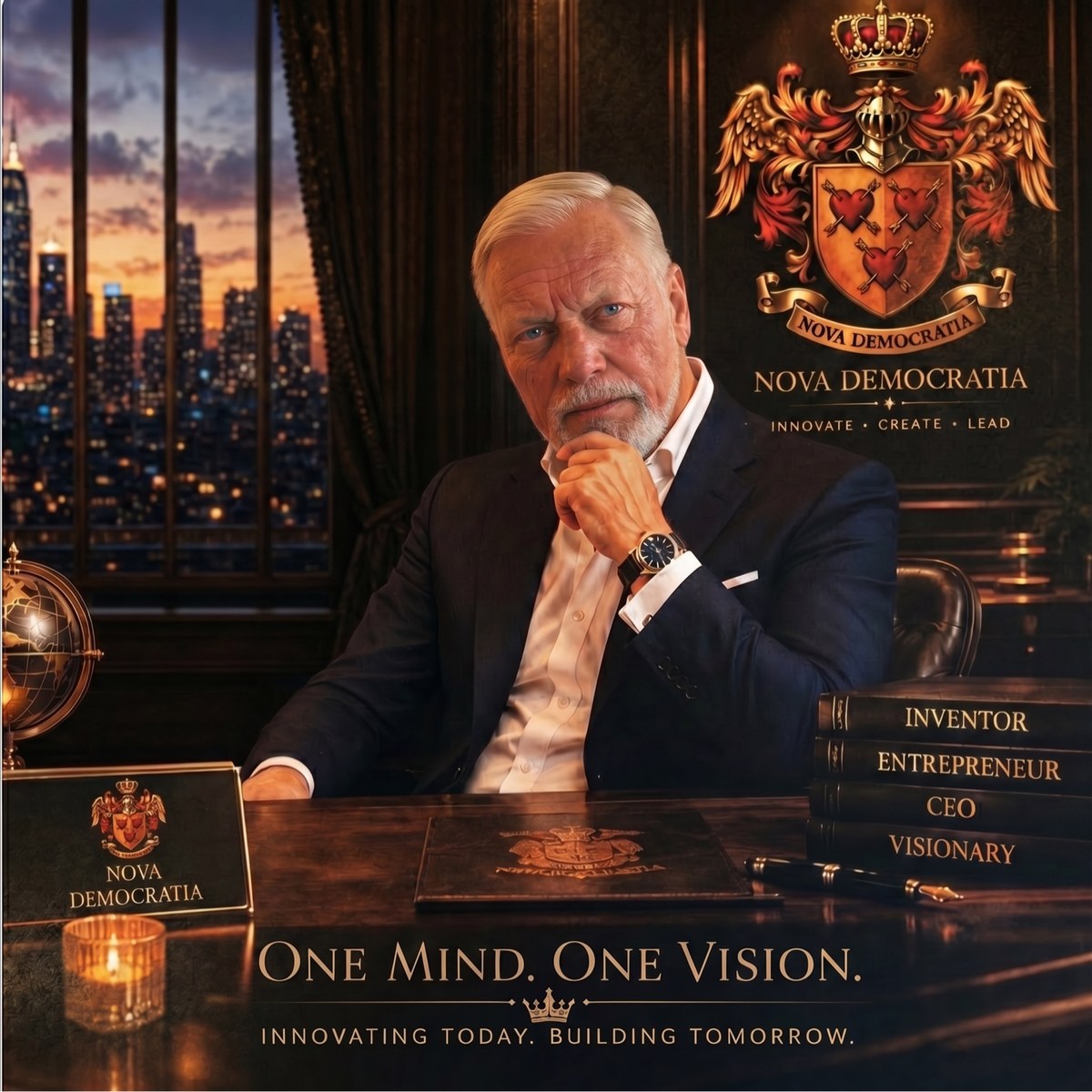
Jacobus van Merksteijn
Malta
Publisher of Het Open Vizier. Systems thinker on climate, energy and democracy.