The car tire is the new cigarette
Why worn tires are the largest source of microplastics — and why we pretend it is the tire pressure
Jacobus van Merksteijn · Malta, June 2026
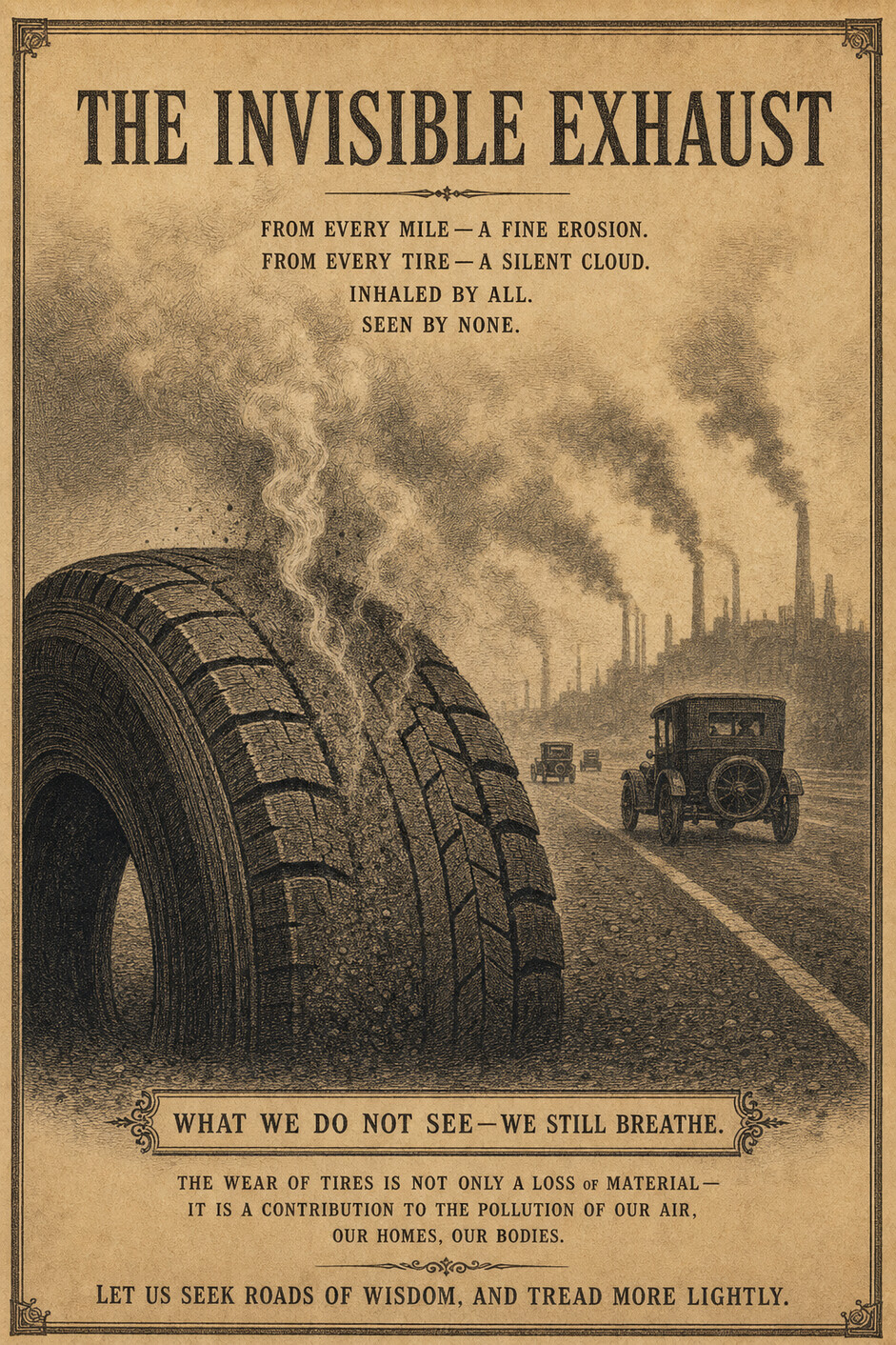
Most people think of plastic pollution as shopping bags, straws and disposable cups. Meanwhile every car — including the electric one — drives across the asphalt as an invisible plastic factory. According to estimates by institutes such as RIVM and TNO, worn car tires are now the largest source of microplastics in our environment — many thousands of tons per year in the Netherlands alone. These particles enter the air we breathe, the ditches and rivers along roads, and ultimately the sea and food chains.
Yet government campaigns mainly send the public to the gas station to check tire pressure. “Give your tires air”, they say, emphasising fuel savings and road safety. Useful — but as if for cigarettes we mainly spoke about smoking outside so the curtains smell less. The core of the problem remains untouched: the product itself. The tire as it exists today — a disposable product with a lifespan of roughly 40,000–50,000 kilometres — belongs to a previous century.
Anyone who lays the numbers side by side can hardly maintain that this is a marginal phenomenon. Each year an estimated up to 19,000 tons of microplastics are released by tire wear; nearly two thirds of that reaches soil and water. The particles are so small that they are not visible, but they are measurable everywhere: in verge sludge, in drainage along highways, and around cities. Unlike litter, there is no simple cleanup with grabbers and rubbish bags. Once worn off and blown away, it cannot practically be retrieved.
It is not neutral plastic
Moreover, these wear particles are not neutral plastic. They carry a cocktail of additives: substances that keep the rubber supple, slow ageing, and protect the tire against UV and ozone. It is precisely those substances that allow tires to handle the extreme forces and temperature swings of the road. But as soon as they end up as fine dust in air and water, they become potentially toxic mixtures for humans and nature. Researchers warn that such mixtures can disrupt fish development and that long-term exposure may contribute to human health problems.
In neighbourhoods close to busy highways, health services have long observed that children on average score worse on lung function and sometimes on cognitive tests than peers in quieter areas. The role of traffic-related fine dust — from exhaust, brakes and tires — is evident, even though the exact distribution per source is complex. So something is happening that would no longer be socially accepted with tobacco: a product known to continuously release harmful particles remains out of range as long as the user “follows the rules”.
The gaps in REACH
The European Union has REACH, one of the strictest chemical regulations in the world. Under that umbrella, dangerous substances are gradually restricted or banned, and recently additional rules have come to push deliberately added microplastics — such as scrub beads and glitter — out of the market. That is good news for showers and make-up, but for tires this approach only works indirectly. Here it is not about plastic particles deliberately added to a product in a factory, but about particles created through use: through braking, accelerating, and cornering.
In practice REACH mainly forces producers to replace certain additives with less hazardous alternatives. That costs time and money, and the first generations of new compounds rarely match the performance of the old. The temptation is great to focus on compliance: just safe enough to meet the rules, without substantially extending lifespan or drastically reducing wear per kilometre. As long as there is no standard for microplastic emissions per kilometre, and no minimum lifespan is enforced, a tire can become chemically cleaner on paper but in practice last less long and bring more mass into the environment.
Producer responsibility is also narrowly defined. For car tires there is already a system in which producers and importers must co-finance collection and recycling of discarded tires. The old tire as a visible waste product is thus regulated. But the tons of wear microplastics released over the entire lifespan fall outside these calculations. The costs of those — in water treatment, nature restoration and health — land with society, not with the manufacturer or seller. The incentive to build a tire that lasts longer and wears less is therefore minimal.
The tobacco industry as a mirror
Anyone recognising this pattern soon thinks of the strategies of the tobacco industry. There too, peripheral measures were emphasised for decades: filters, ventilation and smoking rooms. The individual smoker received the message: smoke consciously, smoke less, smoke outside. Now a similar reflex appears with tires: campaigns about tire pressure, infrastructure measures along highways, and perhaps an extra label here and there. But the tire itself remains at its core the same disposable product with the same wear logic as decades ago.
The irony is that technological solutions are already much further than the regulations. In research programmes, patents and prototypes, tires appear that last considerably longer than the 40,000 kilometres on which most consumer tires are roughly designed. Manufacturers experiment with airless structures, with 3D-printed treads, and with combinations of biomass-based rubber components and advanced polymers. There are concepts that see the tread as a wear layer and the supporting structure as a platform that lasts much longer — exactly the inversion needed to significantly reduce microplastic emissions per kilometre.
Yet these tires do not appear en masse on the market. Not because it is physically impossible, but because today's economic and legal rules do not reward it. A tire that lasts twenty years and produces much less wear disrupts an industry built around regular replacement and a certain cost level per kilometre. Without standards for emissions and lifespan, such a tire remains a niche option rather than the standard. And without systematic measurement methods and labels for microplastics per kilometre, consumers remain blind to the differences.
Europe overtakes itself
Europe thereby risks setting itself back. While classical tire factories in Western Europe close and production shifts to countries with lower costs, the European market increasingly becomes a sales territory for conventional tires from elsewhere. The strictest rules apply here at the edges, but the core innovation — the leap to regenerative, low-emission tires — may just as well land in other regions, where major car manufacturers and fleet owners are more willing to step into new models. Then Europe becomes a customer of tomorrow's tire, not its maker.
Tomorrow's tire is no longer a disposable product but a platform. It lasts longer than the car on which it is mounted. Its tread is not a fixed, one-time layer but a renewable function: something that is reprinted, replaced or regenerated without wasting the carcass. Tomorrow's tire is designed to release as little microplastic as possible, and to make the particles that do form chemically as harmless as possible.
The question is not whether such a tire is coming. That question has long been answered in laboratories, in patents and in quiet pilot projects. The real question is how long it will still be accepted that yesterday's tire is the standard on the road. How many generations of children will still grow up along highways with plastic dust in their environment. How many tons of microplastics will still disappear into ditches and seas before it is recognised that this is not an unavoidable side effect, but a political choice.
What is now needed
If that choice is to tip, a few simple steps are conceivable:
- Set a maximum microplastic emission per kilometre for new tires, just as CO₂ standards exist for cars.
- Extend producer responsibility to wear emissions, so that a tire emitting half as many particles actually becomes cheaper in levies than one that pollutes more.
- Make it mandatory on a tire label not only to show rolling resistance and wet grip, but also an indication of lifespan and microplastic emissions per 1,000 kilometres.
- Reserve space in regulation for tires that are fundamentally different — regenerative, printed, platform-based — instead of pressing them into the same mould as yesterday's product.
Anyone driving down the highway today sees none of this. No warning, no filter, no cleanup crew. Only asphalt, white stripes and a silent rain of invisible particles. It is time to admit that the tire is no longer a self-evident, neutral component but a policy choice. The cigarette that does not yet dare to be called that.

Jacobus van Merksteijn
Editor-in-chief of Het Open Vizier. Entrepreneur, developer of industrial and governance innovations (Carbon-Alert Ltd, TerraClean Ltd, GuardSkin Ltd). Writes about economic, ecological and political system questions from first-hand experience with the Brussels and The Hague decision-making machinery.