The immune system that attacks healthy cells
Why organisations and political systems reflexively expel rebels — not out of malice, but out of self-preservation. And why that very act becomes their undoing.
By Jacobus van Merksteijn · Malta, June 2026
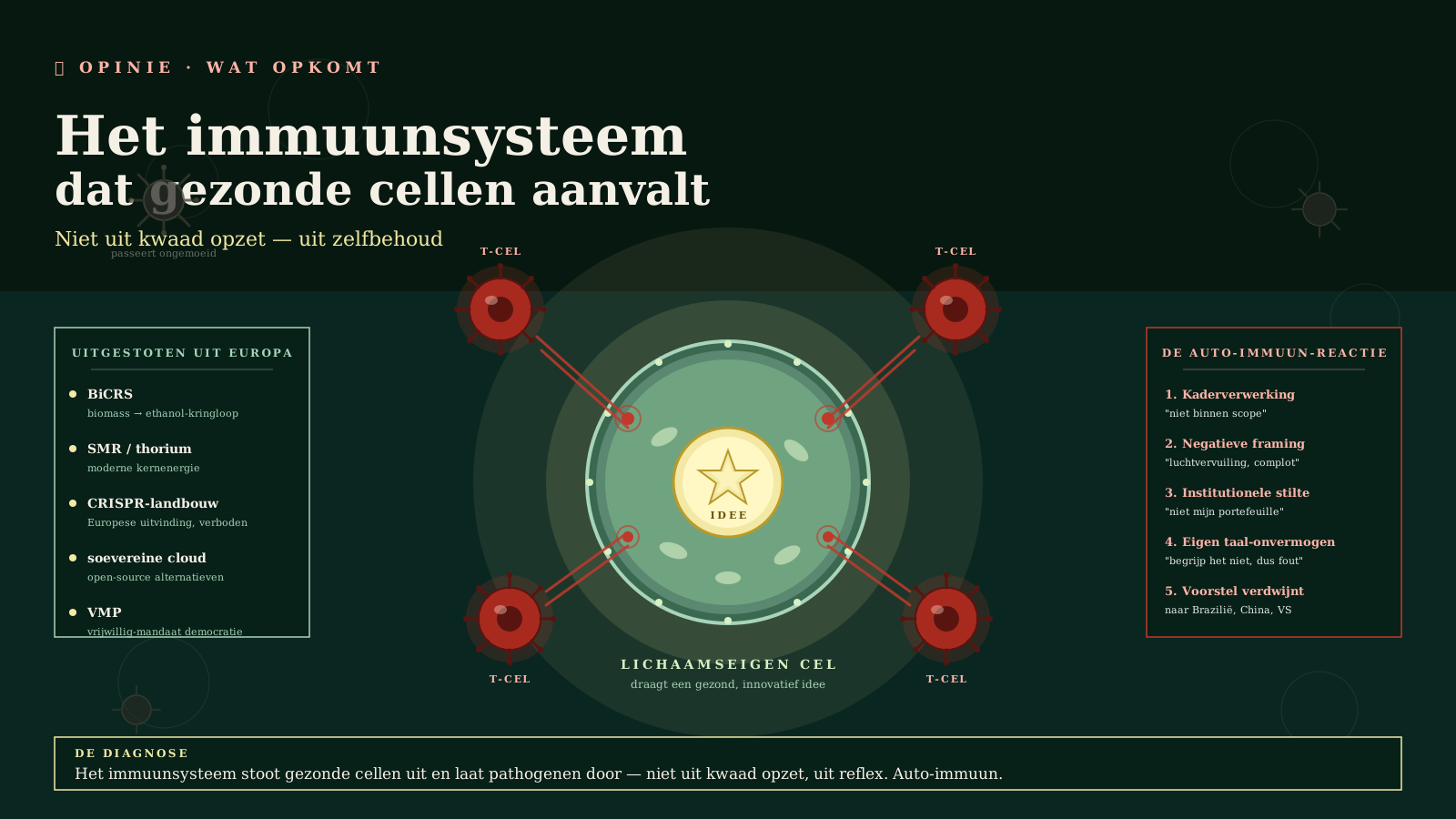
A healthy body has an immune system that recognises intruders and neutralises them. A sick body has an immune system that attacks its own cells. That is called an autoimmune disease. The body believes it is defending itself, but it is consuming itself from within. The disease feels like health — until it is too late.
Our organisations and political systems have become autoimmune. They attack their own healthy cells in the conviction that they are defending themselves. And as with every autoimmune disease: not out of malice. Out of reflex.
The question is not whether people are bad
When someone notes that European institutions, Dutch consensus politics, large corporations, universities and the press collectively expel the most necessary ideas of our time, the first reaction is usually: that cannot be right, because all those people cannot be bad simultaneously. And that is correct. They are not bad. Most are principled, hard-working, well-meaning, intelligent. Personally, they are fine.
The problem is not with the people. It is in the system that they collectively form. And more specifically: in the mechanism by which that system maintains itself. Because every living system — whether a body, an organisation, a state or a continent — needs an immune system to survive. Without a defence mechanism, every parasite, every infection, every malicious influence would take over. The immune system is not evil. It is essential.
But that is precisely what makes the autoimmune disease so treacherous. An immune system that works normally saves lives. An immune system that goes off the rails turns on its own host — without realising that it is picking the wrong targets. It recognises healthy tissue as a threat, attacks it, and breaks it down. Multiple sclerosis, rheumatoid arthritis, lupus, type-1 diabetes — all variants of the same story: the defence turns inward.
The immune system of a system
Every organisation has an immune system. It consists of procedures, hierarchies, peer reviews, licensing systems, press culture, educational standards, "best practices", consultation rounds and — above all — unwritten rules about what "normal" proposals look like and what does not. This immune system is essential: it keeps charlatans out, protects against bad actors, and ensures that ad-hoc impulses do not undermine all accumulated knowledge.
But when the immune system no longer distinguishes between "threatening to the cells" and "threatening to the framework within which the cells work", it begins to attack healthy cells. Innovative proposals — which by definition fall outside the framework — are not tested on their content but expelled on their form. The system feels healthy while doing this. It is becoming progressively sicker.
The biomass-to-ethanol case
Since 2024 I have been developing a specific industrial technology: biomass-to-ethanol conversion via accelerated fermentation of equatorial fast-growing biomass, followed by distillation to fuel quality and re-injection into the fossil value chain. The short name is BiCRS — Biomass-to-Carbon Removal and Storage. It is not an exotic technology. Brazil has been building a large sector on exactly this principle since the 1970s. Indonesia, Malaysia and Thailand are experimenting with it. The economic figures are calculable, the logistics are known, the science is solid.
BiCRS addresses several European problems simultaneously: it delivers liquid fuel without our needing to reinvent our cars, our vehicle fleets or our aircraft; it binds net CO₂ from the atmosphere (the growing biomass absorbs, the ethanol combustion emits what was just bound — a carbon cycle, not a carbon increase); it makes Europe less dependent on both Russian gas and Saudi oil; it keeps the existing refining, distribution and end-use infrastructure intact. And it operates on a timescale of years, not decades.
You might think that such a technology would be welcomed with open arms in Brussels. The opposite is true. BiCRS falls outside the ETS+CBAM paradigm on which the entire European climate bureaucracy is built. It does not fit the Green Deal categories. It is not "electrification", not "hydrogen", not "energy saving". It calculates using a different metric: not "grams of CO₂ emitted", but "grams of CO₂ in and out of the cycle". That single arithmetic difference makes it indigestible for the European climate immune system.
What happens when you propose BiCRS in Brussels
The first reaction is not "interesting, let's look at the figures". The first reaction is framework processing: which committee should judge this? Which Directorate-General? Which MEP working group? Which subsidy programme applies? When none of those frameworks fit — and with BiCRS none of them fit, because it was conceived to operate outside the existing paradigm — the label "outside scope" appears automatically.
The second reaction is word choice. Burning biomass = "air pollution". Equatorial plantations = "deforestation risk". Cycle CO₂ = "accounting trick". Every positive attribute receives a negative framing from the existing discourse. The technology does not need to be refuted; the discourse does the work.
The third reaction is institutional detachment. Nobody explicitly becomes "against BiCRS". But every person the proposal passes through has a good reason not to take it further: "that is not my portfolio", "other colleagues handle that", "we have already chosen this path", "come back in two years". Nobody dismisses the proposal. Everyone passes it on until it dissolves into thin air.
None of this is malice. No official sits with arms folded thinking "how do I keep Europe behind Brazil?". Every official simply follows their procedure, stays within their framework, uses the language they are accustomed to, and passes the dossier to the next person. It is precisely that which makes the immune system so effective: it works without anyone directing it. It is a property of the system, not of its participants.
The autoimmune reaction as rule, not exception
BiCRS is not a unique case. It fits into a long series of comparable autoimmune reactions that the European system has displayed over recent decades:
- New-generation nuclear energy: SMRs, thorium reactors, molten-salt reactors. All European inventions, all polished away by an immune reaction that equates "nuclear energy" with "Chernobyl" and filters out every nuance in between. Other countries — France excepted — are now simply building them.
- Genetic agricultural technology (CRISPR): a European Nobel Prize (Charpentier, 2020). A European legal barrier that effectively prohibits it in practice. Our farmers may not use what our scientists invented.
- Open-source software and cloud: European developers wrote Linux, MySQL, MariaDB, Nextcloud. European institutions run on American cloud. Proposals for a European sovereign cloud have been failing for twenty years in immune reactions: "American suppliers are more reliable", "open source is not enterprise-ready", "we have no budget for it".
- Voluntary-mandate democracy movements: such as VMP. Political forms that are not bound to constituencies and can therefore take difficult decisions. The immune system responds: "that is not democratic" — without asking whether the current system still leads to decisions at all.
- BiCRS / ethanol from equatorial biomass: as described above. Rejected on framework, not on facts.
The pattern repeats itself. A healthy European idea presents itself. It does not fit the existing framework. The immune system responds with procedural exclusion, framing and institutional detachment. The idea leaves Europe — to Brazil, to China, to the United States, to Singapore. There it is taken up, scaled, commercialised. Ten years later we import it back, pay a multiple for it, and confirm — loudly — that we "already knew it all along".
The decline feels like health
For the autoimmune patient the treachery is that he feels healthy — until suddenly an organ fails. For the autoimmune organisation the same applies: it feels powerful, considered, "mindful of lead times", "consensus-oriented". All its internal metrics confirm that it is functioning well: meetings are held, reports written, evaluations conducted. But its productive tissue — the innovative cells that the system itself produces — is being continuously broken down.
When the first organs fail — the German automotive industry, the Dutch nitrogen-afflicted farmer, the entire West European chemical sector relocating to the US — this is initially attributed to external factors: "China is cheating", "the war in Ukraine", "inflation", "post-COVID stresses". The diagnosis of autoimmune disease is rarely made. Because that would mean the patient is the cause, and that is psychologically unbearable.
How do you recognise an autoimmune reaction?
A few recognition markers, for anyone wondering whether their organisation or political space is suffering from autoimmunity:
- Proposals are handled on form rather than content. "This does not fit our procedure" is a framework reaction. "This is wrong, here are three counter-arguments" is a substantive reaction. Count how often each occurs.
- Outsiders are not refuted but ignored. When a rebel idea is not investigated, not cited, not discussed — when a wall of silence is built around it — the immune system is working at full capacity.
- The system's language has no words for its own blind spot. When a proposal does not fit the existing categories, and people cannot even articulate what they do not understand — only repeating "this is not clear" — you are witnessing an autoimmune reaction.
- Criticism from within is tolerated; criticism from outside is not. A professor who is mildly critical of the Green Deal's pace is cited. An entrepreneur who is fundamentally critical of the Green Deal paradigm is not invited.
- The diagnosis "our system no longer works" is never made. There are always "implementation problems", "communication challenges", "execution questions" — never a fundamental fault in the system itself.
Whoever recognises themselves in any of these characteristics — as victim, bystander or participant — has just witnessed an autoimmune reaction. Nothing more. Nothing less.
Why this image helps
The image of the autoimmune disease is not a term of abuse. It is not an attempt to blacken anyone. It is a diagnosis. And diagnoses are useful for two reasons:
First reason: it shifts the discussion away from moral blame and towards structural cause. It is not a fight against "the evil official" or "the lying politician" or "the greedy executive". It is a recognition that a natural defence mechanism has gone wrong. That makes it discussable without accusations, and therefore solvable without a fight.
Second reason: it points towards possible treatments. Autoimmune diseases are difficult to cure — but they are not untreatable. In medicine there are three main routes:
- Suppression (immunosuppressants): switching off the immune system entirely. In an organisation: abolishing all procedures, scrapping all peer reviews. Works in the short term, but leaves the system defenceless — every charlatan can then walk in.
- Deception (immune-modulating therapy): teaching the immune system not to attack certain cells. In an organisation: packaging the healthy idea in the words, structures and frameworks that the immune system recognises as "its own". For example: presenting BiCRS not as "biomass-to-ethanol" but as "carbon capture with reduction of European energy import dependency within the existing CBAM mechanism".
- Diversion (building parallel tissue): not landing the healthy idea within the sick system but outside it. Building a new circuit, supported by a different immune system that can tolerate the idea. Your own newspaper, your own foundation, your own party, your own enterprise.
None of the three is comfortable. Suppression is dangerous; deception is morally ambiguous; diversion is exhausting and lonely. But whoever accepts the diagnosis sees that these are the real options — and not the pseudo-option of "making better arguments". Because better arguments are not received by an autoimmune system; they are attacked.
Where to from here?
The Open Visor itself arose from this understanding. The truth that making better arguments within the system no longer works is what drove us to start publishing outside the system. Not out of stubbornness. Out of pragmatism. Whoever has experience of BiCRS conversations in Brussels, of Consequence Map conversations in The Hague, of VMP conversations with the established parties, learns after a few years that the immune system is not broken through by better PowerPoints. It is bypassed — or it simply continues.
But this is a temporary solution. A newspaper of one's own convinces one's own readers; it does not convince the immune system. In the long run that is not enough. The question that concerns us all is: how do we make Europe immunologically competent again — capable of recognising and absorbing its own healthy ideas — before it is too late?
The question to you, reader
This piece does not end with an answer. It ends with an invitation to think together. Three questions are on the table:
- Do you recognise the autoimmune reaction in your own professional or governance experience? For anyone inside an organisation where healthy ideas are reflexively expelled — a municipality, a ministry, a university, a hospital, a business, an association — do you recognise the mechanism? What are the specific procedures, words, habits that your own immune system employs?
- Which of the three treatment routes — suppression, deception, diversion — works in your context? Or are you on the trail of a fourth route we have not named here? In which situations is which route legitimate, which morally transgressive, which pragmatically most feasible?
- What is the role of the press, educational institutions and democratic bodies? Together they form the meta-immune system that determines which ideas may appear at all. How do we make them competent again to distinguish healthy cells from pathogens? Is that a matter of education, of structure, of funding, of culture — or something else entirely?
Responses and contributions via The Open Visor will be read and — where they add value — incorporated into a follow-up. This is not a monologue. It is an attempt to discover collectively how we can help our immune system to distinguish once more between friend and foe.
Because one thing is certain: a body that keeps attacking itself will, despite the best intentions of its cells, ultimately perish. Not through malice. Through reflex.
And that is not an acceptable end for a continent that calls itself Europe.