We Must Get Back to Work Ourselves
A manifesto on industrial backbone, productive power, and the end of non-committalism
By Jacobus van Merksteijn · Malta, June 2026
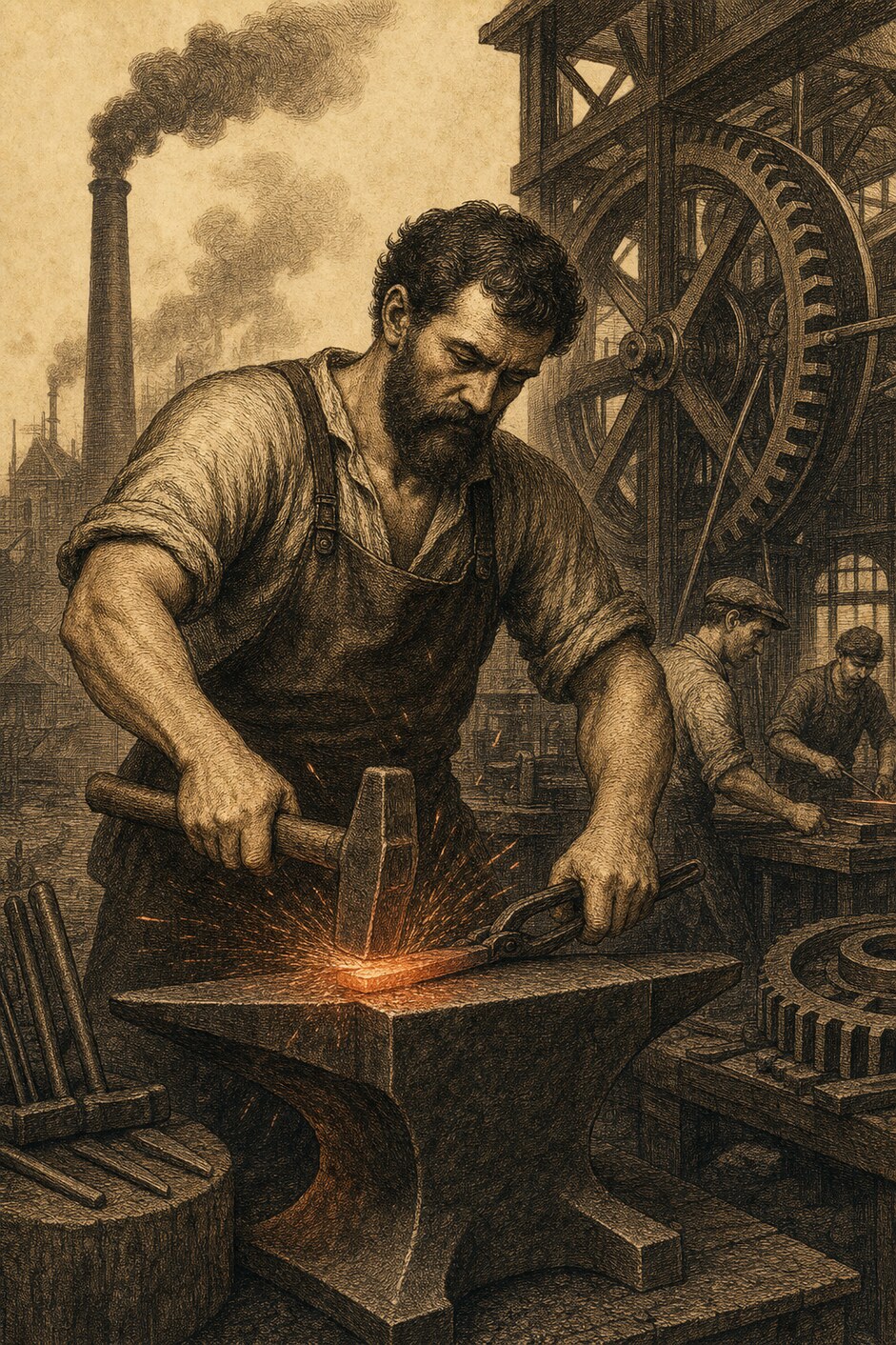
The Netherlands and Europe have lived for too long in the illusion that prosperity, security, and strategic autonomy can exist without effort, without risk, and without their own productive power. That era is over. Anyone who still thinks a society stays afloat mainly by regulating, importing, subsidizing, and morally soothing each other has not understood how civilization is built.
The reality is simpler and harsher. A country that neglects its industry, weakens its work ethic, suppresses its capacity for risk, and normalizes its dependence on others will, sooner or later, lose its backbone. First economically, then socially, and ultimately politically. Such a society does not slide away all at once, but slowly sinks through the ice — until it is discovered that the bottom has already vanished.
All systems follow the same law
Whether it concerns energy, radiation, industry, upbringing, traffic, or geopolitical dependence: the same basic rule applies everywhere. A system that is never stressed, never builds resistance, and never produces for itself becomes weak. A body without stimuli loses its defenses. An economy without its own industry loses resilience. A society that wants to exclude every risk in advance loses its ability to carry progress.
That is exactly where the Netherlands and much of Europe stand today. In recent decades, everything has been focused on avoiding friction. Work had to be lighter. Production could leave. Physical risk had to disappear. Strategic dependence was sold as “efficiency”. Cheap imports were mistaken for clever policy. Security was confused with comfort. And meanwhile, the foundations of a mature economy were dismantled bit by bit.
The price of outsourced power
Through years of outsourcing and import addiction, Europe's industrial immune system has weakened. China grew into the world's factory, while Europe increasingly positioned itself as a consumer, regulator, and end-user. In the short term, this yielded cheaper products and higher margins, but in the long term, it came at the expense of knowledge, manufacturing capacity, craftsmanship, and strategic independence.
That effect is now visible in critical chains: raw materials, batteries, solar panels, pharmaceutical components, electronics, and parts of mechanical engineering. In several sectors, not only has production disappeared, but also the industrial memory: the people, routines, tools, and mentality needed to scale up again on home soil. The conclusion is harsh but inevitable: what has been neglected does not return unscathed.
More labor, more productivity, more backbone
The reconstruction of economic independence will not fall from the sky. It requires more work, more discipline, and more productive effort from the population. Anyone who thinks everything can still be solved with subsidies, spreadsheets, and an extra technology program fails to recognize the real shortage: too few people who actually build, make, repair, maintain, and organize.
Machines and robots have their place, but they are no silver bullet. In many sectors, they are expensive, complex, energy-intensive, and dependent on capital, software, and chains that are themselves geopolitically vulnerable. The easy automation gains have largely been taken. What remains is the old truth that earlier generations still knew: a society becomes strong when its people are strong, skilled, willing, and productive.
That means, in concrete terms, that the number of serious working hours will have to increase, that craftsmanship must regain its status, and that productivity is no longer treated solely as a technical issue, but also as a moral and cultural one. The generation of parents and grandparents did not wait for perfect conditions; they laid the foundation upon which later generations could build with limited resources, hard work, and a high tolerance for discomfort. Anyone who wants to maintain prosperity will have to relearn that attitude.
No prosperity without risk
A society that wants to neutralize every physical, technical, or economic risk in advance cuts off its own future. This applies to industry, energy, mobility, and entrepreneurship. There is no path to prosperity without stress, danger, responsibility, and the possibility of failure.
That does not mean recklessness should become the norm. It does mean there is a fundamental difference between sensible protection and paralyzing overprotection. When every project is locked in rules, every physical profession in distrust, every industrial investment in a legal fog, and every technological step in fear, then prosperity is not protected but thrown into the trash in advance.
That is what happens too often now. The Netherlands no longer polders to pool strength, but to neutralize strength. Everything is flattened, slowed down, traded off, and delayed until nothing remains of the original ambition. The result is not harmony, but stagnation.
Energy, industry, and mature responsibility
This is exactly why the energy debate also deserves a mature tone. Modern societies do not live without risk. Not with fossil fuels, not with nuclear energy, not with international trade, not with infrastructure, and not with medical technology. The question, therefore, is not how all risks disappear, but how a society ranks, concentrates, manages, and bears risks.
Nuclear energy fits into that mature framework. Not as a fairy tale without danger, but as a technology with high energy density, limited waste volumes, and a waste stream that, in principle, remains concentrated and manageable. This is fundamentally different from a fossil model in which damage is diffusely spread through air, climate, and geopolitical dependence.
The same lesson applies here as in industry: do not reject everything because it carries risk, but choose systems that combine manageable risks with structural strength. A civilization can only move forward if it accepts that maturity does not mean danger disappears, but that one learns to bear it.
What must happen now
The change of course must be clear and firm:
- Rebuild our own industry in sectors that are strategically, energetically, and socially essential.
- Revalue labor, not only as a right but also as a duty and a source of civilizational power.
- Restore status to physical and technical craftsmanship in education, policy, and culture.
- Honestly name risks, but no longer use them as an excuse to stop taking action.
- Systematically reduce dependencies on external powers where they affect vital functions.
- Replace the administrative reflex of endless weighing and braking with direction, discipline, and execution.
Conclusion
The time for non-committalism is over. The Netherlands and Europe can choose: either rebuild the foundation themselves, restore productive power, and accept that prosperity always goes hand in hand with effort and risk; or continue with poldering, shielding, outsourcing, and moral soothing until the system empties from within.
Those who choose the first path choose discomfort, discipline, and recovery. Those who choose the second choose decay — slow, neat, regulated, and ultimately irreversible.
There is no other way. We must get back to work ourselves. Not later. Now.

Jacobus van Merksteijn
Malta
Publisher of Het Open Vizier. Systems thinker on climate, energy and democracy.