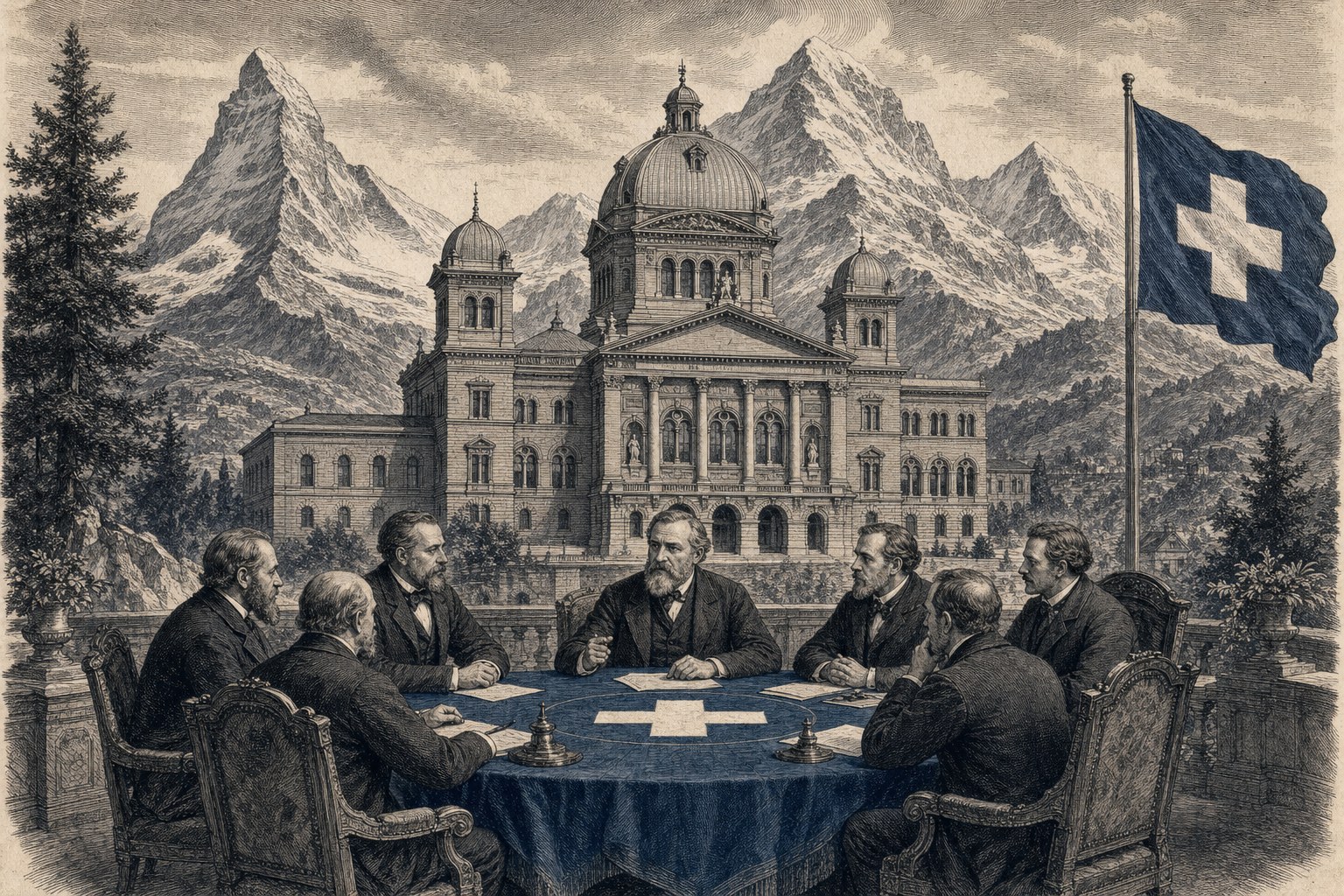
To tell a citizen of the Netherlands that the federal Swiss Bondsraad earns 477,688 francs annually — approximately 505,000 euros in conversion — is usually to encounter protest first, then jealousy. To tell that same person that 35,000 of their compatriots reside in Switzerland, and that they do not choose that system because of its poverty, is to be met with silence. The tension between those two reactions lies at the heart of the Nova Democratia-Switzerland dialogue.
Where Switzerland already implements Nova Democratia
No Balkenende-norm
Switzerland recognizes no salary ceiling for public roles. Bondsraad members receive 477,688 CHF, with top civil servants earning up to 405,000 CHF. The effect is measurable: Switzerland structurally attracts the highest quality of talent for public posts, in part because the private alternative does not constantly beckon with greater allure. What the Netherlands obstructs with the Balkenende-norm — top talent departing for the business world or moving abroad — Switzerland resolves by simply paying market-competitive rates.
Municipal autonomy as the rule, not the exception
Swiss municipalities possess genuine fiscal autonomy and their own legislative authority within cantonal boundaries. What the BBB in the Netherlands proposes for the first time — decentralisation with constitutional revision — has been standing practice in Switzerland since 1848. Phase two of Nova Democratia, with funding per inhabitant per tier of government, partially mirrors this approach.
Direct democracy as a system
Federal referendums on legislation, cantonal votes four times a year, municipal assemblies. What is termed “direct democracy” in the Netherlands and dismissed as a mere experiment is the primary form of governance in Switzerland. Not without its costs — voter participation varies significantly — but with demonstrable results in terms of citizen engagement and the legitimacy of the law.
Where the Netherlands deliberately diverges
Three points where Nova Democratia does not follow the Swiss route, and where Pareto analysis justifies the departure.
No collegiate governance, but individual leadership with deselection
The Swiss Bondsraad consists of seven equal members who rotate the chair annually. This is highly effective for a country with a strong tradition of consensus. The Netherlands lacks that tradition — polder consultations too often end in shared responsibility without anyone being ultimately accountable. Nova Democratia therefore opts for individual leadership with KPI-based deselection in cases of underperformance. The risk in Switzerland is that no one is personally accountable; the risk in Nova Democratia is an excessive concentration of power. The design counters this through a citizen council mandate and an escalation of sanctions.
The presence of sunset laws
Switzerland has no automatic expiration of laws. The Dutch legislative body is much larger, more complex, and more deeply entwined with layers of EU-richtlijnen. Without sunset clauses, Dutch legislation continues to silt up — a problem less acute in Switzerland due to referendums that correct poor laws early on. The Netherlands lacks that correction, and thus requires sunset laws.
Public order classification of Brussels
Switzerland stands outside the EU and was thus able to push back against institutional Brussels — see the Bilateralen-III-pakket of April 2026. The Netherlands is within the EU. Position B from episode zero — the public order classification of EU law — is the Dutch answer to a problem that Switzerland has resolved differently. Not identical, but functionally equivalent.
Switzerland proves that much of Nova Democratia works. But it also proves that the Netherlands requires its own solutions for problems that Switzerland does not face.
The earning narrative
The Dutch person calls Switzerland expensive, but the median Swiss wage is significantly higher than the Dutch equivalent. Bondsraad members earn 505,000 euros per year; top civil servants 430,000 euros. In the Netherlands, the Balkenende-norm of 246,000 euros applies to top public positions. That difference is not merely statistical; it is psychological: 35,000 Dutch people live in Switzerland and choose to do so deliberately. Their actions refute the objection they themselves might rhetorically raise.
For Nova Democratia, this earning narrative is one of the most powerful media levers. It makes the abstract story about the Balkenende-norm and KPI-remuneration concrete and attractive rather than threatening. The Netherlands can choose between continuing to earn what it currently earns, or joining in with what is considered normal in comparable nations.
Open Vizier · novademocratia.com · Working Material · Jacobus van Merksteijn · June 2026