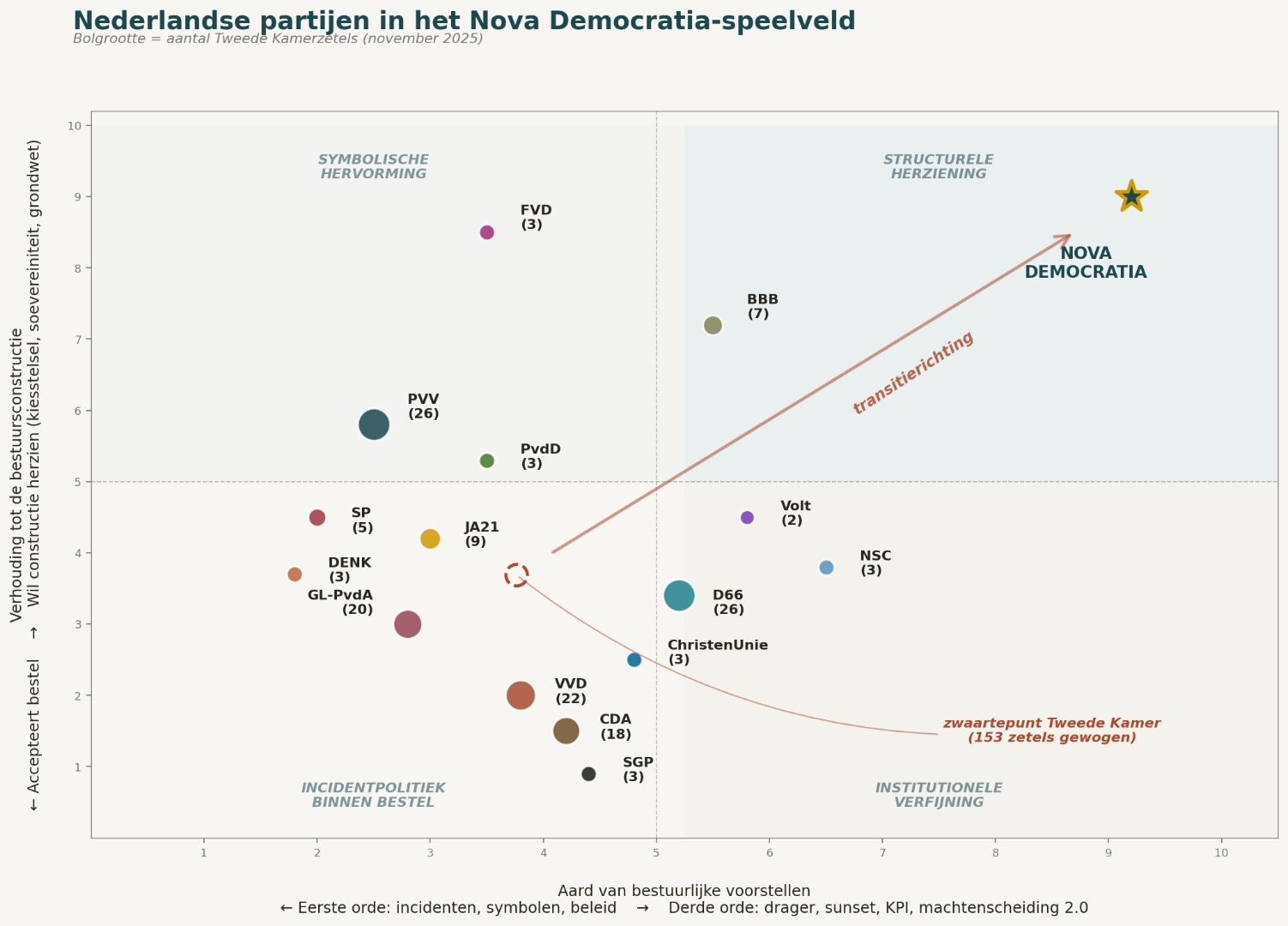
**Where does your party stand in the field of orders: how deeply do their proposals cut into the construction, and who desires to revise the construction itself?*
To vote for what? A voter standing in the polling booth in twenty-twenty-five was presented with a choice between fifteen parties — yet the true differences between those parties dissolve in the heat of the campaign. A new XY-analysis places all parties simultaneously on two axes that matter to Nova Democratia, and the outcome is as sobering as it is illuminating.
The analysis employs two independent axes. The horizontal axis measures the nature of the administrative proposals a party puts forward. At the left extremity lie first-order proposals: incidents, symbols, policy within the existing framework. At the right extremity lie third-order proposals: interventions in the support structure itself — sunset laws, KPI-governance, the separation of powers two-point-zero. The vertical axis measures the willingness to revise the administrative construction: at the bottom, parties that accept the current system as a given; at the top, parties that wish to overhaul the construction itself — the electoral system, sovereignty, the constitution.
Nova Democratia is deliberately positioned far to the top right in this graph. This is no coincidence. The entire model is designed to perform third-order interventions at the level of construction. Whoever seeks to be situated there is met, at the very least, with the admission that not a single existing Dutch party occupies this corner.
The map
Four quadrants, four types of parties
Bottom Left — Incident politics within the system
Here you find the bulk of Dutch politics: VVD, CDA, GroenLinks-PvdA, ChristenUnie, SGP, PvdD, DENK, JA21. They conduct a politics of policy shifts within the existing construction. A different tax rate, a different healthcare agreement, a different housing plan. What they share is the tacit assumption that the system itself is sound. Their differences are real, but they exist at the level of choices of content, not at the level of construction. The VVD, for instance, desires an electoral threshold of two per cent, but explicitly maintains the electoral system itself. GroenLinks-PvdA, ChristenUnie, and the Partij voor de Dieren state unequivocally that they wish to preserve the current electoral system.
Bottom Right — Institutional refinement
Here reside D66, NSC, and Volt. These parties think more structurally than the bulk: D66 with its traditional attention to constitutional renewal, NSC with its focus on administrative culture and quality of execution, Volt with its European institutional agenda. But they wish to refine the construction, not replace it. NSC, for example, wishes to introduce the mixed regional electoral system, but within the existing constitutional framework. D66 spoke in 2023 of constitutional renewal, but has since only concretised this to a limited extent. These parties are closer to Nova Democratia than the bulk, but still outside the quadrant where true revision takes place.
Top Left — Symbolic reform
Here reside PVV, FVD, and to a lesser extent SP. These parties certainly wish to address the construction — PVV and FVD with sovereignty proposals directed against Brussels, FVD furthermore with a Nexit course and a binding corrective referendum, SP likewise as a historical proponent of the referendum. But in execution, their proposals often remain symbolic rather than constructive. The binding referendum is announced, not elaborated. The Nexit is shouted, not calculated in phases. These are intentions at the level of construction, translated into first-order language. That explains their position in the top left.
Top Right — Structural revision
The quadrant where Nova Democratia belongs. The only existing party moving cautiously towards this is BBB. Not because of its substantive positions, but because of its institutional proposals: heavy decentralisation with constitutional revision, a national government that shares sovereignty with provinces, policy-rich tasks returning to municipalities and provinces. This is construction thinking — even if it is wrapped in BBB-parlance. It explains why BBB is the only existing party to fall into the top-right quadrant.
Not a single Dutch party stands where Nova Democratia stands. Not on the left, not on the right, not in the centre.
The centre of gravity and the distance to Nova Democratia
The red dotted line in the graph marks the centre of gravity of the House of Representatives, weighted by seats. That centre of gravity lies deep in the bottom-left quadrant. Not because individual parties are extreme, but because the electoral weight lies overwhelmingly with parties operating within the existing system. D66 (twenty-six seats), PVV (twenty-six seats), VVD (twenty-two seats), and GroenLinks-PvdA (twenty seats) together make up more than half of the House, and they all lie within or just above the bottom-left quadrant.
The arrow from this centre of gravity to Nova Democratia indicates the direction of transition. It is intentionally a long arrow. The distance is vast, and that is precisely why a media lever from episode three of this series is necessary. Without the public dissemination of order-thinking, the entire right half of the graph remains untraversed territory for most voters.
What the Pareto analysis explains
The party map confirms numerically what the Pareto analysis from episode three already indicated. Incumbent political parties together score one thousand four hundred and fifty-eight points of braking weight — not because they are strong, but because they collectively possess a first-order language monopoly within a first-order public. The map shows where that monopoly is geographically situated: in the bottom left, where six parties together occupy more than ninety seats.
At the same time, the map explains why no existing coalition of existing parties can sustain Nova Democratia. A coalition of, for example, D66, NSC, and BBB would indeed move closer to the right half in substance, but even then, the centre of gravity would remain below Nova Democratia. This is not a tactical problem; it is a design signal. The electorate must first learn to inhabit the right half of the graph before a party can move in that direction without losing seats.
Three observations that matter
First: the top of the graph is sparsely populated. Only four parties — PVV, FVD, BBB, and to a lesser extent SP — score above the middle on construction-revision. Together, they represent forty-one seats, more than a quarter of the House of Representatives. That is not insignificant, but these parties are scattered across two quadrants and possess widely divergent substance. A workable coalition of construction-reformers does not exist.
Second: the right side of the graph is occupied by parties with few seats. D66, NSC, Volt, and BBB together secure thirty-eight seats, of which twenty-six belong to D66 alone. Whoever seeks third-order thinking in Dutch politics finds it predominantly in medium-sized and smaller parliamentary groups. The large bottom-left parties — VVD, GroenLinks-PvdA, PVV — pull the centre of gravity sharply towards the bottom-left corner.
Third, and most relevant for Nova Democratia: the top-right quadrant itself counts only BBB with seven seats as an existing presence. The territory inhabited by Nova Democratia is electorally almost vacant. This is not a handicap. It is an opportunity — provided the public learns that this quadrant exists. Episode three of this series is not called “Media as Strain Gauge” for nothing.
The graph shows where the work lies. Not on the side of content, but on the side of the quadrant.
Looking ahead
The map is set. What is missing is a weighted Pareto of the party behaviour itself: how strongly each party resists, in which phase, against which specific Nova Democratia measure. This analysis — party by party, phase by phase — requires the same triple weighting that Brussels received in episode zero: intensity, power lever, endurance. It is the logical next step.
What the current map already shows is that the centre of gravity is not an enemy, but a distance. An engineering problem, not an ideological conflict. And engineering problems possess engineering solutions: measuring, phasing, classifying, repeating. It is precisely for this reason that Nova Democratia exists.
Open Vizier · novademocratia.com · Werkmateriaal · Jacobus van Merksteijn · Juni 2026