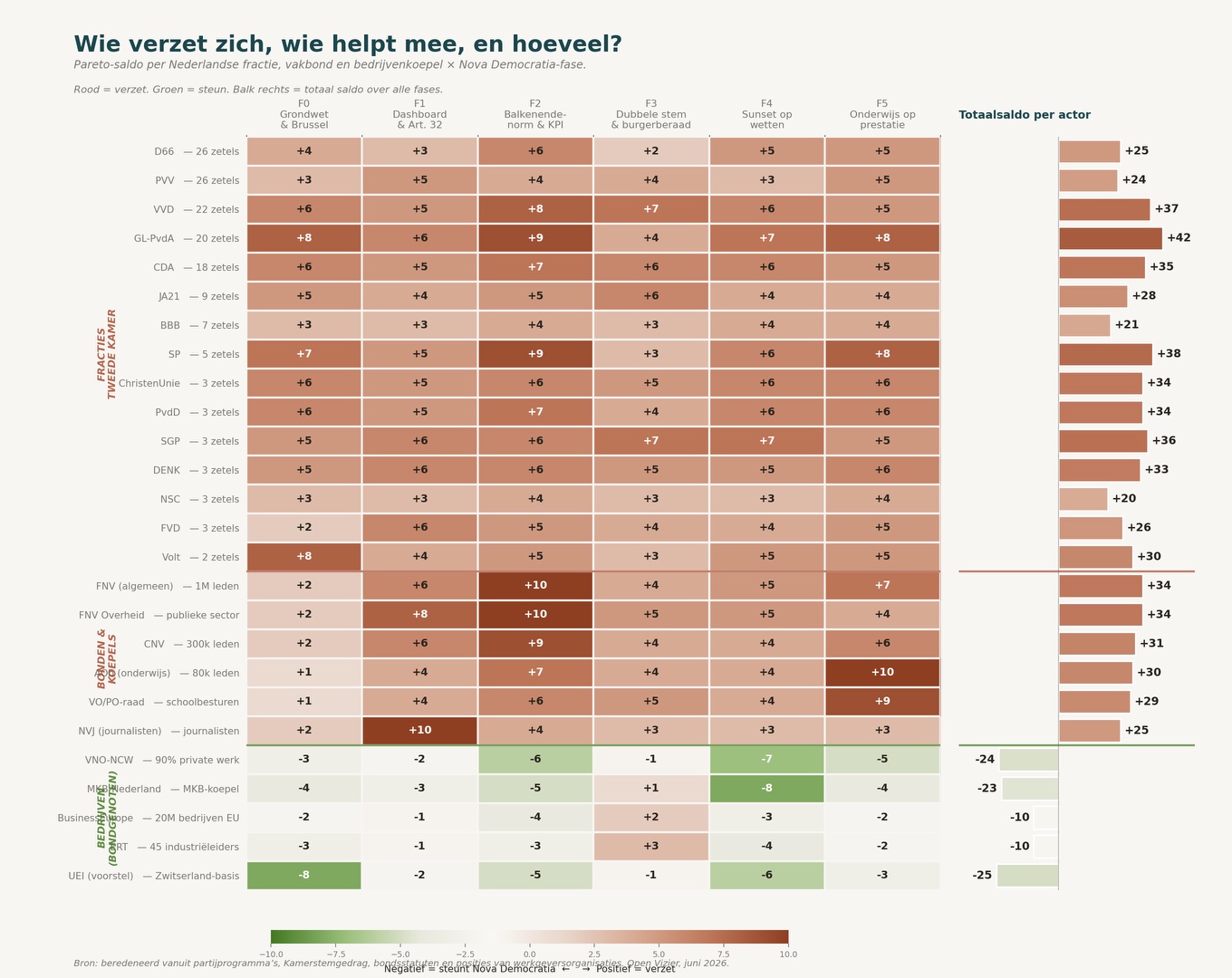
The Pareto analysis from installment three treated inertia as a list of separate blocks: Brussels, unions, parties, the administrative top. Useful for strategy, but incomplete. What was missing was a second column: allies. Who helps — and at which phase? Only when both columns are placed side by side does the true field of forces emerge.
This installment plots twenty-six actors across six Nova Democratia phases. Fifteen factions of the House of Representatives, six trade unions and federations, and five business associations — including the UEI proposed in this newspaper, the European counter-power from Switzerland. Each cell is given a score from minus ten to plus ten. Red is resistance. Green is support. The bar on the right gives the total balance: how an actor relates to Nova Democratia across all phases.
Three power blocks, three stories
Factions — scattered resistance, high average
The fifteen House factions together provide the strongest resistance block. No single faction scores lower than plus two on any phase. The primary links-with-inertia are GL-PvdA (+42) and SP (+38), with scores of plus nine on phase two (Balkenende norm and KPI) and plus eight on phase five (education based on performance). In those two phases, Nova Democratia touches the nerve of the left-wing faction: the measurement of administrative performance and the measurement of educational performance. For parties that derive their political biotope from process-led redistribution, a performance-oriented measurement is structurally unpleasant.
The right wing — PVV, JA21, BBB, FVD — scores more moderately, between plus twenty and plus twenty-eight. Here too, there is resistance, but it is less concentrated. What is striking is that no sitting faction provides green cells. The sitting political establishment thus forms a wall as a block: all fifteen factions push back, with varying force but in the same direction.
Unions — concentrated resistance on core phases
The six trade unions and federations are more varied than the factions. FNV (general), FNV Overheid, and CNV score a block of plus thirty on phase two (Balkenende norm): for public sector unions, a performance measurement of the administrative top is a direct threat to their lobbying position. On phase five (education based on performance), the education union (AOb) even rises to plus ten — a maximum resistance score. This is not an opinion; this is a mechanical outcome of the measurement structure that Nova Democratia imposes upon the system.
NVJ (journalists) is a case of its own: plus ten on phase one (dashboard and Article 32), but moderate scores elsewhere. A dashboard that makes administrative performance publicly measurable undermines the filtering role of journalism as the sole intermediate voice between government and citizen. The score is a direct reflection of what that does to the natural position of the press.
Business — the allies who did not yet know they were so
Here lies the surprise in the heatmap. Four of the five business associations — VNO-NCW, MKB-Nederland, BusinessEurope, BRT — score an average of minus twenty: a counterweight to Nova Democratia instead of a blockade. Not undivided — there are some red cells where companies do not like specific regulations — but the prevailing pattern is green. On phase two (KPI governance), phase four (sunset laws), and phase five (education based on performance), business associations together provide minus ninety points. That is almost two FNVs neutralised.
Three business associations provide a counterweight of minus seventy-two points — almost two FNVs neutralised.
UEI — the European business institute proposed in installment ten — scores minus twenty-five, stronger than VNO-NCW. The score stems from its specific design: UEI is deliberately focused on phase zero (Brussels), the phase where no existing Dutch actor offers a structural counterweight.
What the map indicates for strategy
The heatmap reads like an operational map. Not all actors move at once. Three insights follow logically from the colour distribution.
First: the existing party democracy is a wall. No sitting faction supports Nova Democratia in its current form. This means that the transition must be prepared outside the existing party structure — not as anti-politics, but as a methodical recognition of what the measurement shows.
Second: unions and businesses are each other’s natural compensation. Where unions provide plus thirty on phase two, businesses provide minus fifteen there. A package deal with employers against the unions — as installment twelve proposes — is not an ideological choice but a mechanical outcome of the field of forces.
Third: UEI fills a void that no existing actor closes. On phase zero (Brussels), UEI stands alone with minus eight — no Dutch faction, no Dutch union, and not even a Dutch business association scores negatively on this phase. That is precisely why a European business institute is institutionally necessary. No member state can change Brussels’ course on its own; a business voice cast in the Bondsraad model could do so.
The Pareto position of Nova Democratia in the map
The total balance bars on the right summarise the map. The heaviest resistance comes from the faction GL-PvdA (+42), the FNV (+34), the FNV Overheid (+34), and the SP (+38). The heaviest support comes from UEI (-25), VNO-NCW (-24), and MKB-Nederland (-23). The six House factions with the lowest resistance scores — NSC (+20), BBB (+21), PVV (+24), D66 (+25), FVD (+26), JA21 (+28) — together form a political baseline where Nova Democratia could achieve a first reading through substance. This is not a majority, but it is a field for dialogue.
The heatmap is a snapshot from June 2026. Whoever updates it — every six months, with actual voting and striking behaviour — automatically builds a rolling operational picture. That is what this journal means by "Pareto as a compass": not a single measurement, but a constantly updated instrument through which strategic movements become possible.
One warning regarding this map. The nine knowledge actors — universities, planning bureaus, advisory councils, research institutes — who are included in a fourth block at the bottom, were not yet included in an earlier version of this analysis. Their positioning will be further elaborated in installment eleven (“The knowledge layer as an ally”), where it becomes visible that the heaviest methodical counter-power against Dutch compromise governance does not emerge from politics, but from the institutes that have already been measuring government productivity for fifteen years.
Open Vizier · novademocratia.com · Working Material · Jacobus van Merksteijn · June 2026