Deciding without sight
GDP lies by €419 billion. The Dutch debt ratio is not 43%. It is 69%. And parliament votes with its eyes closed.
Jacobus van Merksteijn
- Author --- Jacobus van Merksteijn
- Date --- 5 July 2026, Palma, Mallorca
- Section --- Political-economic analysis · Edition 2 (Tax Policy) · with implications for Brussels
- Sources --- CBS Government Finance 2024, Financial Annual Report of the Kingdom 2024, CBS National Accounts 85879NED, CBS Imputed Rent on Owner-Occupied Housing, OECD Revenue Statistics 2024 — Netherlands, Simon Kuznets, "National Income 1929–1932", 1934
- Method --- Correction of GDP for three non-productive accounting items; recalculation of the EU debt and deficit ratios against the productive base
On Friday the Dutch House of Representatives will vote using a yardstick that has been stretched three times. The Netherlands carries €492 billion of debt and is called fiscally disciplined — because the debt ratio is 43.3% of GDP, comfortably below the EU 60% norm. Remove from that GDP the three items that are not production — imputed rent, FISIM and the benefits paradox — and the real ratio is 69.3%. Well above the EU alarm threshold. Same debt. Same budget. Same ministers. If they saw this, they would vote differently on Friday. They do not see it. And what stops them from seeing is a blindfold made of leaves.
What a minister sees on Friday
On the note pads of the cabinet members there is a single number that decides everything: 43.3%. That is Dutch public debt divided by Dutch GDP for 2024. The Ministry of Finance calls it "the lowest level since the financial crisis of 2008". Rating agencies nod. Brussels is reassured. Investors demand no premium. On the basis of this single number, €20 billion of nitrogen buffer zones will be committed on Friday, €450 million will be sunk into hydrogen storage beneath Zuidwending, and the EU contribution will be raised — without one minister asking whether the Netherlands actually has the fiscal room the indicator suggests.
The answer: it does not. And this is not controversial. It stands in the published tables. It is simply not being read that way.
The three items that are not production
Dutch GDP for 2024 stands at €1,128 billion. It contains three items that represent no productive activity — items that measure nothing, yet are counted as production:
€97 billion — imputed rent on owner-occupied housing. Statistics Netherlands (CBS) calculates what homeowners "hypothetically" pay themselves in rent and adds it to GDP. No one is paid. No service is rendered. No transaction occurs. It is an accounting assumption, embedded in the international System of National Accounts since 1993. Over ten years, this item has risen from 6% to 8.6% of GDP — purely because Dutch housing costs rise 3.5% per year.
€40 billion — FISIM. Fictitious banking services, calculated as the spread between lending and deposit rates. No explicit transaction; a model output that closes the national accounts. When the ECB sharply raised rates in 2022, Dutch GDP grew by roughly €6 billion of FISIM air — without a single additional financial service being provided. A tree that grows thicker because the ruler shrinks.
€282 billion — the benefits paradox. Benefit payments — unemployment insurance, social assistance, state pensions — do not count as production. Correct. But the moment the recipient spends the benefit on groceries or rent, that same amount appears in GDP component C (household consumption). Net effect: mass unemployment depresses the GDP figure far less than economic reality warrants. Correct for the actual productive base, and another €282 billion falls away.
Deduct these three items, and €709 billion of real, production-linked prosperity remains.
Expressed against that base, the reassuring story collapses in a single move:
| Indicator | Under GDP (€1,128 bn) |
Under corrected GDP (€709 bn) |
EU norm |
|---|---|---|---|
| Debt ratio | 43.3% | 69.3% | 60% |
| Deficit ratio | 0.90% | 1.42% | 3% |
| Public expenditure | 44.1% | 70.1% | — |
| Social transfers | 20.4% | 32.4% | — |
| EU contribution | 0.66% | 1.06% | — |
The same €492 billion of debt. The same €10 billion deficit. The same €497 billion of government expenditure. Only the denominator changes — and with the denominator, the political landscape.
For the time series 2022–2024 the picture is unforgiving: under the corrected measure, the Netherlands has been above the 60% threshold three years running (74.7% → 70.8% → 69.3%). Under the official GDP it sits comfortably below (48.3% → 45.1% → 43.3%). Two entirely different countries. One reality.
Kuznets warned in 1934
GDP did not become this way by accident. It was designed this way — by Simon Kuznets, in the 1930s, to measure the US economy during the Great Depression. Kuznets himself had no illusions about the reach of his own instrument. He wrote, literally, in the report to the US Congress in 1934:
"The welfare of a nation can scarcely be inferred from a measurement of national income."
That sentence was ignored. After Bretton Woods (1944), GDP became the international standard. Since the Maastricht treaties of 1992, it has been the basis of the EU budget norms: 3% deficit, 60% debt — both as a share of GDP. A treaty signed by people who took the instrument as it lay, without looking at the footnotes.
This works so long as GDP actually measures what an economy produces. But in the meantime three categories of "production" have been embedded that are not production. Imputed rent in 1993, to make countries with many renters comparable to countries with many owner-occupiers. FISIM in 2010 EU-wide, to solve the technical problem that banks provide services without an explicit price. Both repairs are defensible in accounting terms. Both are also stacks of air that are added to the national accounts as production, and to which the EU budget norms are then applied.
The third — the benefits paradox — is the most fundamental. It is not a construction fault built in between 1993 and 2010. It has been in GDP since Kuznets himself, and it has never been repaired. At 8% unemployment — a normal recession — the gap between "what the Netherlands would produce at full employment" and "what it actually produces" is roughly €90 billion, according to the classical Okun formula. Of that, at most €30 billion is visible in the GDP figure. The rest is camouflaged by benefit spending recorded as consumption.
At 98% unemployment, Dutch GDP would not fall to zero.
That is not a distant thought experiment. It is the logical extrapolation of the definition. Imputed rent remains (homeowners "pay themselves rent"). FISIM remains (banks keep their spreads). Benefits are spent and appear as C. GDP would continue to portray an economy without working people as positive. An ecosystem without species could not score 60% on a healthy-nature index. GDP can.
What a minister does not see on Friday
Anyone who grasps this also grasps why three Dutch political-economic facts can coexist without being seen as contradictions:
- The Netherlands claims to be fiscally disciplined, with a debt ratio comfortably below the EU norm.
- The Netherlands leans on EU lifelines — recovery fund, joint debt issuance, ECB bond purchases — as if its fiscal position were fragile.
- The CPB warns annually of "declining structural growth" and "an eroding productive base".
Under the current GDP frame, these are three incompatible statements. Somebody is lying, and no one knows who. Under a corrected GDP they are three consistent descriptions of the same underlying fact: the Dutch fiscal position is already above the EU alarm threshold — this is simply hidden by an indicator that counts €419 billion of accounting air as production.
For policy, this changes everything. Every euro of borrowing capacity, every budget plan, every EU contribution negotiation, every rating assessment rests on the assumption that GDP represents the size of the economy. If that assumption is wrong, none of the decisions derived from it are right. The €20 billion buffer-zone package rests on it. The €450 million hydrogen package rests on it. The EU contribution rests on it.
No ministry denies the figures above. No economist will dispute the items — they simply sit in the tables of CBS StatLine 85879NED. There is only a collective agreement to keep using the indicator that has been agreed upon. Like a group of navigators who know the compass is defective, and sail on because "we agreed on the same compass".
The blindfold of leaves
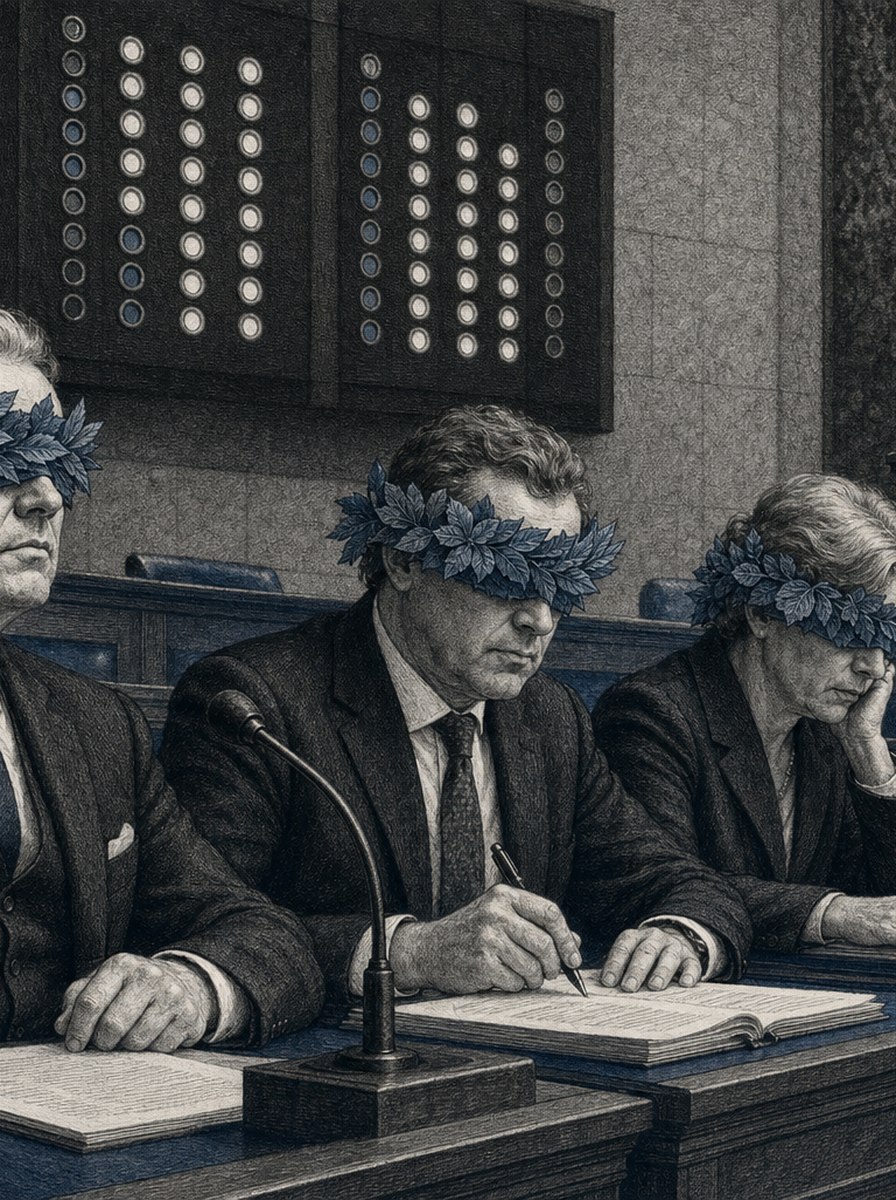
In the hero illustration above, a row of ministers sits on the government bench. They wear no black blindfold. They wear a blindfold of oak, laurel, ivy and linden. Leaves are no evil; they are even dignified. They are what has grown and what has stayed green. But bound across the eyes, they become what any blindfold becomes: no sight. And still the hand rises, the pen signs, the button is pressed.
Any instrument used without looking at what it measures is a blindfold. Even if it is made of honourable materials.
What nature does know
Nature works with balanced ledgers. Every carbon chain locked away three hundred million years ago as oil, gas and coal was a solution to an atmospheric problem: the Earth relieved itself of its CO₂ surplus by dumping it into the geological layers. The biosphere does not falsify its accounts. What is stored is stored; what is burned returns to the atmosphere. There is no "imputed" carbon atom added because "a tree hypothetically pays itself in CO₂".
Policy built on an indicator that counts €419 billion of air as real production does not imitate those natural laws. It rewrites them. An economy cannot grow by shortening its own yardstick, just as a forest cannot grow by redefining its own tree rings. What remains is the physical reality beneath the figure — and in the Netherlands in 2026, that reality sends one signal: the productive base is eroding. The CPB knows. CBS has published it. The Ministry of Finance holds the tables.
Ministers looking at these figures on Friday should ask themselves what nature has known for three billion years: a system that manipulates its own bookkeeping does not last long. Ecosystems that camouflage their own input measurement collapse. Companies that stretch their own revenue definition go bankrupt — with or without a rating agency. Countries that stretch their own production definition, at some point, lose the creditworthiness they held on paper. Not because "the market becomes irrational". Because the reality beneath the indicator waits patiently until somebody looks.
What Friday should look like
What should happen in the House on Friday is not complicated. It is not expensive. It costs nothing. One minister could lower his or her hand and ask a single thing: alongside the official 43.3%, publish the corrected debt ratio of 69.3% too, in the same budget papers, on the same page, with the same sources. Not because one replaces the other. But because parliament would then know what it is voting on.
What will actually happen on Friday, we also know. There will be a vote. The hand goes up. The pen signs. The button is pressed. And the tally board lights up — partially green, partially red, in patterns that no one behind the blindfolds can see. Kuznets saw it in 1934. Nature saw it all along. In 2026, the Netherlands still does not see it.
The blindfold is not black. It is green. And it fits tight.
Related reading
- Edition 2 — Tax Policy — the broader frame of fiscal yardsticks
- Should the Netherlands follow suit? — Germany eases the burden, the Netherlands does the opposite
- Four hundred and fifty million euros for a hole in the ground — same logic, different item
- Let the politicians go back to nature school first — the parallel piece, a different blindfold