Four Hundred and Fifty Million for a Hole in the Ground
Zuidwending, HyStock, and the Anatomy of Political Waste
Jacobus van Merksteijn
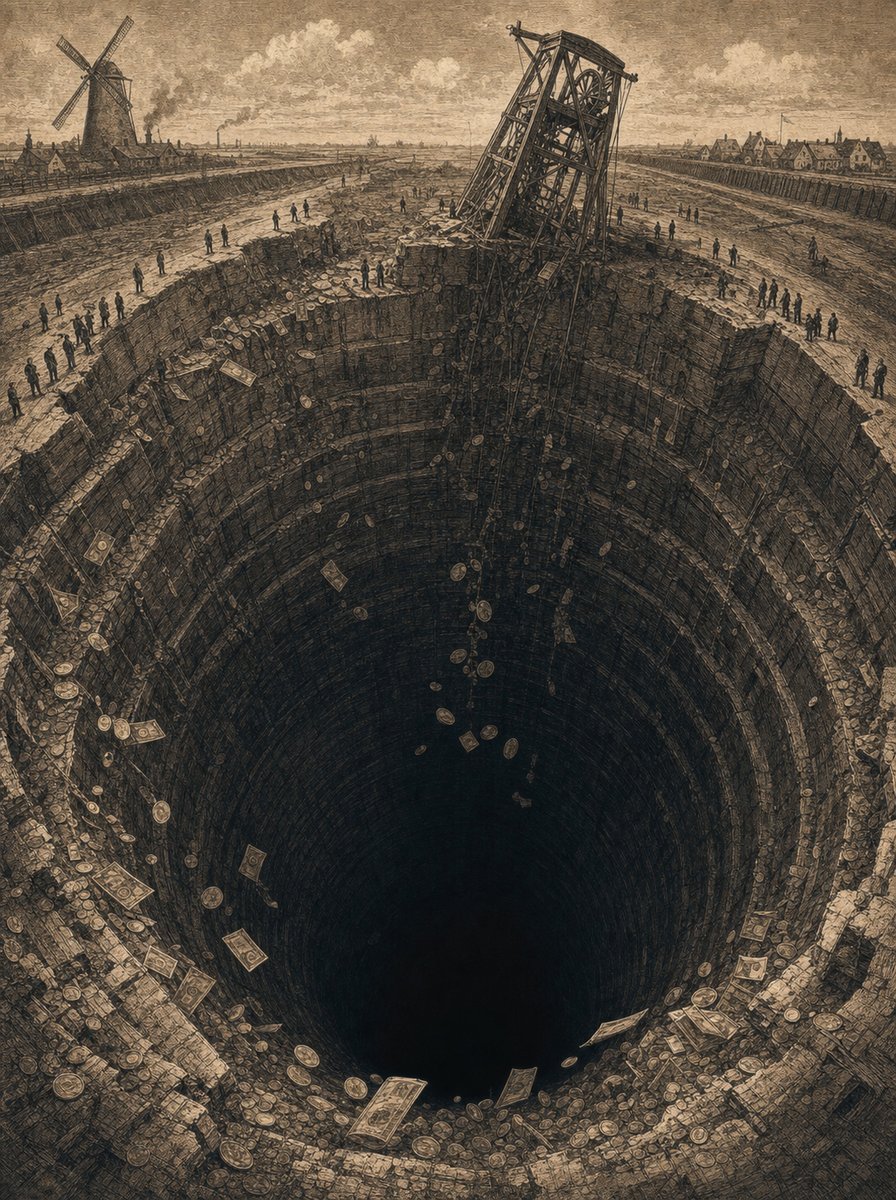
On July 4, 2026, the cabinet announced it would allocate €450 million for the HyStock project in Zuidwending, Groningen—the first large-scale underground hydrogen storage facility in the Netherlands. Four salt caverns, leached out by Nobian, ready to store hydrogen that should start flowing through them by 2032. The Minister of Climate and Green Growth spoke of market failure. She meant something else. She meant that no private investor wants to foot this bill. The reason is not market failure. The reason is physics.
What the cabinet has decided
The news itself is simple. HyStock receives €450 million. Nobian will leach out four salt caverns under Zuidwending—an operation spanning several years. A hydrogen transport pipeline is planned for 2032. Eventually, thirteen caverns could be created. The money is intended for three specific risks that "a normal investor does not yet want to bear": the uncertain price of so-called cushion gas, the risk that the storage won't fill up enough in the first few years, and potential delays due to permits. Any operational setbacks remain HyStock's responsibility.
Read that last part again. The taxpayer bears the risk that the storage never turns a profit. The company bears the risk of making too much profit. That is not market failure. That is a specific form of state aid usually called 'strategic investment' in Brussels and 'support for the industrial transition' in The Hague. Both terms are euphemisms for the same thing: a private company that refuses to carry a public risk profile receives public risk capital—without a share in the upside potential.
In itself, that is not interesting. Where it becomes interesting is the question: which technology are we betting on?
The price no one is putting on the table
In In the Driver's Seat or on the Luggage Rack of June 20, one figure was isolated that immediately makes Dutch hydrogen policy untenable. At the factory gate, without any subsidy, a megawatt-hour of primary energy costs:
| Source | € / MWh |
|---|---|
| Uranium | €12 |
| Geothermal | €20 |
| Carbon-Alert bio-ethanol | €32 |
| Natural gas | €40 |
| Wood pellets | €45 |
| Grey hydrogen | €67 |
| Fuel oil | €70 |
| Green hydrogen at the Dutch pump | €540 |
Five hundred and forty euros per megawatt-hour. Against thirty-two. Seventeen times more expensive than the cheapest available alternative. This is not a price difference that more efficient electrolysis or larger scale will wipe away. Electrolysis structurally requires 52 kilowatt-hours of electricity per kilogram of hydrogen. Compression to 700 bar costs another ten percent. Transport and storage another fifteen. These loss factors are written in the laws of nature—not in business plans. They do not disappear with €450 million in cavern construction, nor do they disappear with ten years of government perseverance.
For heating an average Dutch home, this means—calculated in The Nature-Adjusted Analysis—that a household at the welfare level would spend more than a quarter of its income on energy alone in a hydrogen transition. That is not a transition. That is household destruction.
The rest of Europe is walking away
For those wondering if this is a biased Het Open Vizier analysis, here are three facts that did not originate with us.
Stellantis—parent company of Peugeot, Citroën, Fiat, Opel—stopped with hydrogen in 2025. Publicly, definitively, citing structural cost disadvantage. Bosch—the German supply giant—ceased its fuel cell division in the same period. Volkswagen, Mercedes, and Stellantis had been working on ethanol fuel cells since 2017 within the IPEN framework; that effort was halted when the wind in Brussels and The Hague shifted toward battery-electric and hydrogen. These parties are not naive. They have done the math that the Minister of Climate and Green Growth apparently hasn't had done.
And in Tochigi, Japan, a Nissan plant has been running since 2026, converting bio-ethanol into power with seventy percent efficiency. No 700-bar cylinder. No cavern construction. No cushion gas. A liquid in a tank, a catalyst, a membrane—and electricity flows out at room temperature. Brookhaven National Laboratory demonstrated the underlying cold oxidation in 2009. PNAS published a catalyst in 2022 with 99.9 percent CO₂ selectivity at a record-low potential of 0.35 volts. In 2025, Brookhaven licensed the technology to Chemcat Japan. Seventeen years between the American scientific breakthrough and the Japanese commercial license. Europe was present during those seventeen years as a spectator.
The €450 million for Zuidwending is the Dutch way of perpetuating that spectator role. Not by correcting a mistake, but by making it more expensive.
What that same four hundred and fifty million would yield elsewhere
This is the point where the discussion stops being academic. €450 million is not an abstract number. It is a concrete stack of money that could have been spent on something else. Four comparisons, all five based on figures from previous Het Open Vizier analyses.
Comparison one — Carbon-Alert energy hubs. A 100-kilowatt hub costs €180,000 to build, produces 800,000 kilowatt-hours per year at 9.97 cents, and pays for itself in three years without a single cent of subsidy (The Thirty Cents That Turn Europe Around). For €450 million, you build two thousand five hundred hubs. Together, these account for 250 megawatts of installed capacity, two billion kilowatt-hours per year, and approximately 1,750 permanent jobs in installation, maintenance, and operation. Spread across Groningen, Brabant, Friesland, and Zeeland—exactly where grid congestion hurts the most.
Comparison two — the rapeseed hectare. In The Rapeseed Multiplier, it was calculated that switching from rapeseed to Carbon-Alert NL brings gross farm income from €1,400–1,900 per hectare to €7,500–12,000 per hectare—a factor of four to eight. At the Dutch level: the startup funding for a 1,000-hectare pilot project, according to the same analysis, amounts to €15 to €25 million. With €450 million, you pay for fifteen to thirty such pilots, or one national rollout of 20,000 hectares with associated Tier-1 processing infrastructure. That's a quarter of the Dutch nitrogen crisis hectares solved in one go—with a farm income that leaves subsidy dependence as an afterthought.
Comparison three — BiCRS carbon removal. In The Brussels Impact Map — BiCRS version, the model price for permanent CO₂ removal via anoxic biomass injection in the equatorial belt was set at €40 per ton—against an actual production cost of €22–28 per ton. For €450 million, you buy 11.25 million tons of permanent CO₂ removal—nearly a tenth of annual Dutch emissions, definitively and verifiably removed from the atmosphere, at half the current EU ETS price. The hydrogen cavern alternative yields zero tons of removal. It yields a hole in the ground for something to flow through that is seventeen times more expensive than the alternative today.
Comparison four — five to ten thousand European vocational training spots. In What Brussels Really Gets, the equivalent value was calculated for a 3,500-hectare Carbon-Alert pilot in the Netherlands, Germany, and France: €15–25 million via Horizon Europe. From the €450 million remaining after the agricultural pilots and energy hubs, enough would be left to set up the complete Dutch MBO and technical theory modules for ethanol-operation and SOFC-maintenance in five hundred vocational colleges (ROCs)—making two generations of unemployed workers from the metal and installation sectors immediately employable in the industry now forming in Japan and Korea.
The true anatomy of the waste
In total, the €450 million for HyStock in the scenario of "the political passenger"—as we called that route in the previous triptych—yields a cavern complex after ten years storing a molecule whose final price at the pump is seventeen times above the best alternative. In the scenario of "the coachman," the same resources yield: 2,500 energy hubs, twenty thousand hectares of agricultural transformation, eleven million tons of permanent carbon removal, and the complete vocational training for the industry we have been watching for seventeen years. The choice is not ideological. It is arithmetic.
The responsible official—the Minister of Climate and Green Growth—speaks of market failure. But there is no market failure. There is a market that reads the price signals and retreats. That market is called Stellantis. That market is called Bosch. That market is called Volkswagen. They have seen the figure of €540 per megawatt-hour and they have left. What the cabinet is doing is not correcting market failure. What the cabinet is doing is artificially maintaining a physically untenable route with taxpayer money—exactly as happened before with SDE wind farms, gigafactory subsidies, and hydrogen corridors, all three now documented as financial sunk costs.
The three silent assumptions that make this waste possible
Behind every state expenditure of €450 million on a loss-making route lie three silent assumptions that no one in the House of Representatives explicitly tests. One—that hydrogen "will remain necessary for industry anyway." That argument is correct for exactly two applications (refinery hydrocracking and ammonia synthesis) and is incorrect for mobility, heating, or stationary electricity. For those three applications, ethanol-SOFC exists and is proven cheaper. Two—that "the learning curve will make hydrogen even cheaper." That is a curve that, after fifteen years of subsidy, hasn't even reached a twenty percent cost reduction, compared to an ethanol learning curve of seven to nine percent per year since 2020, documented by IEA Bioenergy Task 39. Three—that "we shouldn't put all our eggs in one basket." This fallacy hides that the current basket consists of only one egg: battery plus hydrogen, while specifically omitting the third egg—the ethanol-SOFC—reverses the diversification argument.
What a responsible minister can do today
The €450 million has been pledged, not spent. The decision lies with the House of Representatives. A responsible minister would do three things today. One—pause the commitment until an independent calculation on the website eu-bicrs.openvizier.org is performed, in which the same €450 million is tested against alternative spending on bio-ethanol-SOFC rollout. Two—send a letter to Parliament explicitly acknowledging that green hydrogen at the Dutch pump costs €540 per megawatt-hour and that ethanol-SOFC costs €32, and that policy is being reconsidered in light of this. Three—publicly state that the seventeen-year Asian lead in ethanol-SOFC can only be closed if the Netherlands chooses production in Groningen, Brabant, and Friesland now—in 2026, not in 2032.
These three steps cost no extra money. They save €450 million. They also unlock a technological route that can provide 350,000 European jobs without a single cent of subsidy.
The bill presented to the voter
What remains is the question of who pays the bill. €450 million in taxpayer money is not neutral money. It is money coming from households that, according to the calculation in The Nature-Adjusted Analysis, are structurally spending a thousand euros more per year on energy under the government track than under the ethanol-CHP track. Those same households are now paying, via taxes, for a cavern construction that exacerbates rather than alleviates the energy poverty they find themselves in. For Sandra's welfare household—€5,667 per year for hydrogen transition energy versus the current €1,824—that is not a fiscal nuance. It is an existential one.
The question the House of Representatives must answer next week is not whether Zuidwending will yield a technically interesting cavern. It will yield a technically interesting cavern. The question is whether the Netherlands can afford €450 million to confirm seventeen years of Asian lead on the cheapest available energy route—while the same resources, spent elsewhere, would precisely close that lead.
The answer is arithmetic. And the answer is no.
— Het Open Vizier · Climate edition · Research & analysis · 5 July 2026
Related reading on openvizier.org:
- The Thirty Cents That Turn Europe Around — the physics and the learning curve
- In the Driver's Seat or on the Luggage Rack — the complete energy price comparison
- The Nature-Adjusted Analysis — what households actually pay under three tracks
- The Rapeseed Multiplier — factor of four to eight on farm income
- What Brussels Really Gets — Carbon-Alert on a European scale
- The Brussels Impact Map — BiCRS version — CO₂ removal at €40 per ton
News source: NRC, July 4, 2026, "Cabinet allocates 450 million for hydrogen storage in Zuidwending" (photos provided by the author).
Look into the matrix
The Voting Behavior app calculates Party × Person × Baseline for the Dutch case. Seven questions—one projection for you.
Open Voting Behavior
Jacobus van Merksteijn
Malta
Publisher of Het Open Vizier. Systems thinker on climate, energy and democracy.