People Building Together
Tropical ethanol cities 2040 — a way out that serves both sides
People Building Together
Tropical ethanol cities 2040 — a way out that serves both sides
Don't send them away. Don't lock them in. Don't discuss endlessly. But move further. Those who have no work here in Europe, those standing in the waiting room, those who cannot utilize their talent here — they can help build the ethanol chain in the tropics that makes Europe independent. With a good house. With a school for the children. With a library. With internet that works. With a future.
- Author
- Jacobus van Merksteijn
- Date
- 20 June 2026 — Palma, Mallorca
- Genre
- Visionary piece · not intended as a policy plan, but as a direction of thought
- Status
- Sequel to the triptych "On the Box or on the Luggage Rack"
- Keywords
- Migration · ethanol factories · tropics · partner countries · urban planning
The problem we dare not solve
For the past fifteen years, Europe has conducted a migration debate that spins in circles. Pro and contra. Open or closed. Strict or mild. Percentage points in polls. Nitrogen at the Polish border and fences at the Mediterranean Sea. What the discussion never does: offer a third option. A way out that benefits both sides.
At the same time, Europe faces another problem it isn't solving. The ethanol factories we need for the Carbon-Alert route do not end up in the right place by themselves. Cellulose feedstock grows fastest in the tropics. The sun stays high the longest. The water falls more often. The growing seasons are year-round. An ethanol cluster in Mozambique, Brazil, or Indonesia produces two to three times per hectare what a Dutch maize installation achieves — and builds a village around it.
Combining three thoughts. Unlocking three problem-deadlocks. One way forward.
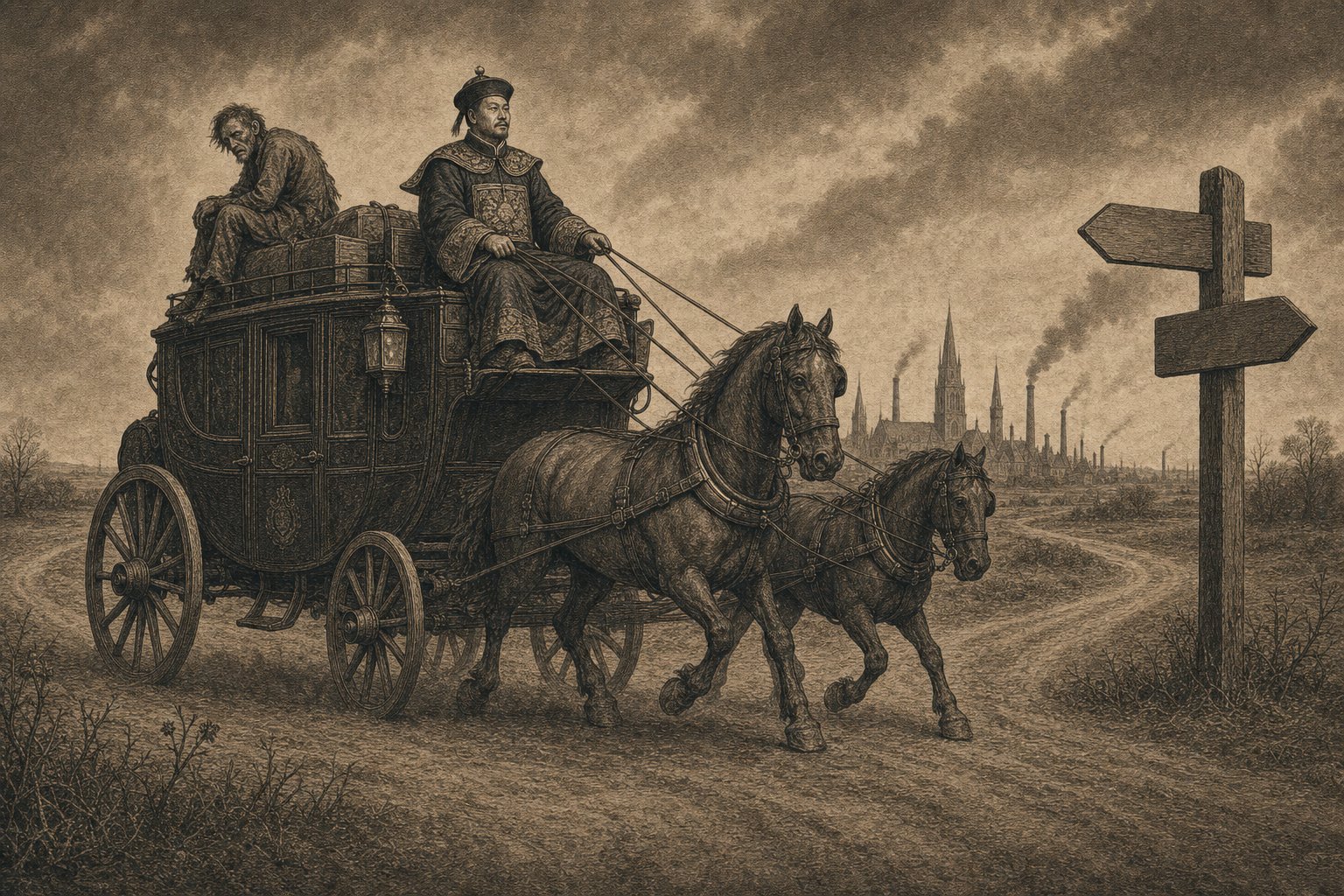
The driver on the box sees the road. He also sees who can help steer. Not as a burden. Not as a number. But as a human being who is being asked for something.
Who waits here, can lead there
In the Netherlands and across all of Europe, a group of people is stuck. They have arrived here. They want to work. They want to build something. They want to move on. But our system keeps them in a waiting room — sometimes for five years, sometimes longer. No residency status, no work permit, no perspective. For those who want to stay here, that is already painful. For those who actually don't want to stay here — who didn't even have a choice in where they fled to — it is downright cruel.
Imagine: these same people are given a different offer. Not "go back." Not "we'll handle it." But: come build with us. We have work that fits where you come from and what you want to become. A two-year training program in pellet production, distillation operation, SOFC maintenance, agricultural logistics. Then a three-year contract in a partner country in the tropics. Their own house. Their own salary. Their own perspective. And, if they wish, citizenship in that country afterward — or back to Europe with a trade.
The numbers behind this proposal are simple. Carbon-Alert at 50 GW European rollout requires 350,000 direct jobs in the chain. One-third of those — approximately 120,000 jobs — are in tropical feedstock production. That means 120,000 people are needed in places where they are welcome, with salaries that are good in a European context and excellent in a local context, with a role that concretely contributes to the world.
What we build — concrete, raw, and sincere
Tropical ethanol city 2040
No work camp. No barracks. No temporary housing with container homes. A real city. With the things that make people dignified.
- Good houses — 80 to 120 square meters, private garden, cooling construction adapted to tropical climates. Ownership after five years of work.
- Schools — primary and secondary education, with English and local curricula. Teacher salaries at a level that attracts talent.
- Libraries — physical and digital. Book collections in local languages, English, and the primary languages of the employees. Study spaces, children's corner, lectures.
- Good roads — paved, with rainwater drainage, constructed before the factory opens. Not after.
- Fast internet — fiber optic, 1 Gbit per household minimum. Not 4G-via-cell-tower. Real internet, reliable, affordable.
- A hospital — not a first-aid post, a hospital. With operating room, maternity care, pediatric ward.
- A central square — market, cafe, music stage, sports field. The heart of the city. No soulless industrial area.
It costs money. But less than you think. A complete tropical city of 10,000 inhabitants costs about what one Dutch bypass costs. And it gives back something a bypass cannot: a community that sends productive energy to Europe for fifty years.
Why this isn't naive
Anyone reading this for the first time thinks: this will never work. Too complicated. Too politically sensitive. Infrastructure too expensive. Too much diplomacy. Too many risks. Three counterarguments are predictable — three answers as well.
"The receiving countries won't want this." Incorrect. Mozambique, Tanzania, Brazil, Indonesia, Ghana, Senegal, Colombia, Peru, Vietnam — each of these countries has a national agenda for industrialization. None says no to €500 million in infrastructure in exchange for a fifty-year feedstock agreement. The question is not whether they want it. The question is whether we dare.
"People don't want to leave Europe." Some don't. Many do — if the offer is good. Villages full of houses, schools with internet, salaries that are generous in a local context and reasonable in a European context, five years of work for ownership. Compare that to five years of waiting in an asylum procedure without the right to work. The choice doesn't need to be forced on anyone — only offered.
"This is colonialism under another label." On the contrary. Colonialism took people and raw materials from a country without giving anything back and without local ownership. This proposal builds cities where the residents are the owners. Fifty percent local workers, fifty percent migrant. The factory becomes the property of a local cooperative after fifteen years. The European contribution is capital and technology for an agreed period, not possession forever.
What this means for the Netherlands and Europe
The Netherlands has 380,000 job seekers in 2026. A portion of them — some without ever having been able to take root here — get a fair chance at something new. That immediately relieves the pressure on housing, on healthcare, on social security. But more importantly: it gives people a future they couldn't get here. And it gives Europe a feedstock chain where we source independence rather than imports across a border.
Spain counts 2.6 million unemployed. Italy 2.0 million. France 2.4 million. Germany 2.8 million. Every government is overwhelmed. No one knows what to do. A European program that builds 20 ethanol cities in a partner country in the tropics costs less than one year of unemployment benefits in these four countries combined. And it solves two problems at once.
We must move further. Not stand still.
Think out of the box. No more debating in the same circle.
The driver is on the box or on the luggage rack. The cities in the tropics will be built by us — or by China. That is the choice no one articulates, but it is the one on the table.
Those who believe in this, believe in people
This proposal depends on one assumption. That people, provided they get a fair chance, want to seize their own future. That an Eritrean boy who has now been waiting for three years in a Brabant asylum center would rather live in a tropical city with good work and his own house than in endless uncertainty. That a Syrian teacher who is not allowed to teach here would rather give English lessons in a new library in Mozambique than pack grocery bags at a Dutch supermarket.
Those who do not want to make this assumption do not believe in people. Those who do, see a way out of two deadlocked discussions at once.
The driver on the box looks ahead. Not just at the road. Also at who can ride along, help steer, help build what comes next. That is not idealism. That is simply the courage to think further than the waiting room we are both sitting in.
This piece belongs to
The triptych "On the Box or on the Luggage Rack":
1. On the Box or on the Luggage Rack — the guiding article
2. Vision 2036 — Carbon-Alert Energy Hub — the technical design
3. Open Letter to the Governments of Europe — the call

Jacobus van Merksteijn
Malta
Publisher of Het Open Vizier. Systems thinker on climate, energy and democracy.