In the Driver's Seat or on the Luggage Rack

The coachman sits on the box. He holds the reins. He sees the road. He determines the route. On the luggage rack sits the one who has allowed himself to be carried along. He sees nothing. He decides nothing. He is dependent. Europe has sat in that spot for thirty years — on batteries from China, on oil from Saudi Arabia, on gas from Russia. A set of reins is now ready for us to grab. But only today. Not tomorrow.
The thesis of this article
Those who wait for others to see it will soon be in the back again. Advantage is not what they say in Brussels or The Hague. Advantage is what you see, understand, and tackle yourself before the rest. The coachman who waits for consensus becomes cargo himself.
The figures in this article show that there is one energy route that wins without subsidy. By every metric. That route was not invented in Europe, but it can be built in Europe. If we start today. Otherwise, Japan, Korea, and China will build it. And we will end up importing it in seven years under Asian licensing terms.
That decision does not lie with Brussels. That decision lies with everyone who reads this text and acts on what they see.
- Author
- Jacobus van Merksteijn — Carbon-Alert Ltd
- Date
- 20 June 2026 — Palma, Mallorca
- Method
- Three blocks: source · conversion · end system
- Scope
- Mobile + stationary · transport + heating · all energy forms
- Subsidies
- Deliberately removed from every figure (SDE++, ETS, RED-III, BPM, feed-in)
- Externalities
- Mining cleanup and BiCRS effect explicitly included
Who is in the driver's seat now — and who is on the luggage rack?
First, a timeline. In 2009, Brookhaven National Laboratory published a catalyst that splits ethanol at room temperaturea. Four years later, Nissan began a pilot plant for solid-oxide fuel cells using bio-ethanol. In 2022, PNAS published a catalyst with 99.9 percent CO₂ selectivity at a record-low potentialb. In 2024, Nissan started a facility in Tochigi with seventy percent efficiency. In 2025, Brookhaven licensed the technology to Chemcat Japan. In 2026 — today — Europe has zero commercial ethanol-SOFC factories.
Read that again. Seventeen years between the scientific breakthrough and the Asian license. In those seventeen years, Europe has poured billions into battery gigafactories, hydrogen corridors, and SDE wind farms. That is money already burned — sunk into an assumption that was obvious in 2016 but no longer holds true in 2026.
Stellantis stopped with hydrogen in 2025c. Bosch discontinued its SOFC divisiond. Volkswagen, Mercedes, and Stellantis had worked on ethanol fuel cells within the IPEN framework since 2017 and withdrew strategicallye. Not for lack of technology. For lack of policy direction. European industry received no signal that this path was allowed.
Meanwhile, Nissan drove on. Doosan too. Weichai began licensing. Bloom Energy scaled. Ceres Power signed contracts in Korea. The window closed in Europe while it stood wide open in Asia. That's where the coachmen were. We were just watching.
What we learn from fifteen years of lagging behind in battery production:
Europe lost the battle for the lithium-ion cell in ten years. CATL, BYD, and LG now hold 73 percent of global capacity. We pay billions in subsidies to European gigafactories that will never be cost-competitive. We are making the same mistake now on the hydrogen route. And without intervention, on the ethanol-SOFC route as well.
The three blocks below show why this cannot continue. The figures are not political. They are physical and business-economic. They show one route that wins without a single eurocent of subsidy. Those who do not take that route are consciously choosing the luggage rack.
Europe has everything already — today, not tomorrow
The best counterargument against everyone who says this is too ambitious: every building block we need is already there. No Marshall Plan. No ten years of buildup. No upfront investments of billions. The four foundations:
One. The unemployed are waiting for work. Spain has 2.6 million unemployed. Italy 2.0 million. France 2.4 million. Germany 2.8 million. The Netherlands 380,000. A large portion of them have technical schooling or are practically trained. The Carbon-Alert chain needs personnel at exactly those levels: pellet production, distillation operations, SOFC installation, maintenance, BiCRS-CO₂ logistics. Permanent, non-outsourceable jobs. Spread across all regions. Not Silicon Valley work — industrial labor. That is what Europe is good at.
Two. The infrastructure is already there. 120,000 filling stations in Europe. Mechanically identical for gasoline, diesel, and ethanol — only the label and calibration change. 1,200+ EU pellet factories that can directly supply cellulose feedstock. 70,000 km of existing gas pipeline network, usable for regional ethanol distribution. Distilleries in every grain, beet, and wine region. Vacant industrial sites where coal, refinery, and automotive sites once stood — direct locations for BiCRS+SOFC hubs.
Three. The technology is proven. No prototype. No proof-of-concept. No 'needs to scale up'. Nissan has been running a 70 percent efficiency ethanol-SOFC on a trial scale in Tochigi since 2026. Ceres Power is delivering 50 MW SOFC stacks to Doosan this year plus the production license to Weichai. Lawrence Berkeley proves that an HEA catalyst can work with 80 percent less precious metal. Brookhaven solved the C–C splitting at room temperature back in 2009. PNAS demonstrated 99.9 percent CO₂ selectivity in 2022. This is not risk research. This is implementation.
Four. The learning curve is documented. Not by consultants. By the International Energy Agency Bioenergy Task 39, as early as 2020, with measurement data from cellulose factories currently in operation. €0.55 per liter today. €0.45 in 2030. €0.30 in 2036. €0.25 in 2040. An 18 percent learning ratio on the SOFC stack. The same curve that reduced solar panel LCOE by a factor of six between 2010 and 2020 — only now on a liquid fuel that doesn't need to be on the Sahara or the North Sea floor.
What is missing, therefore, is not money. What is missing is not the technology. What is missing is not the market.
What is missing is a European coachman who sees that everything is already there — and takes the reins.
Block 1
The source
What does a megawatt-hour of primary energy cost at the factory gate — without any subsidy?
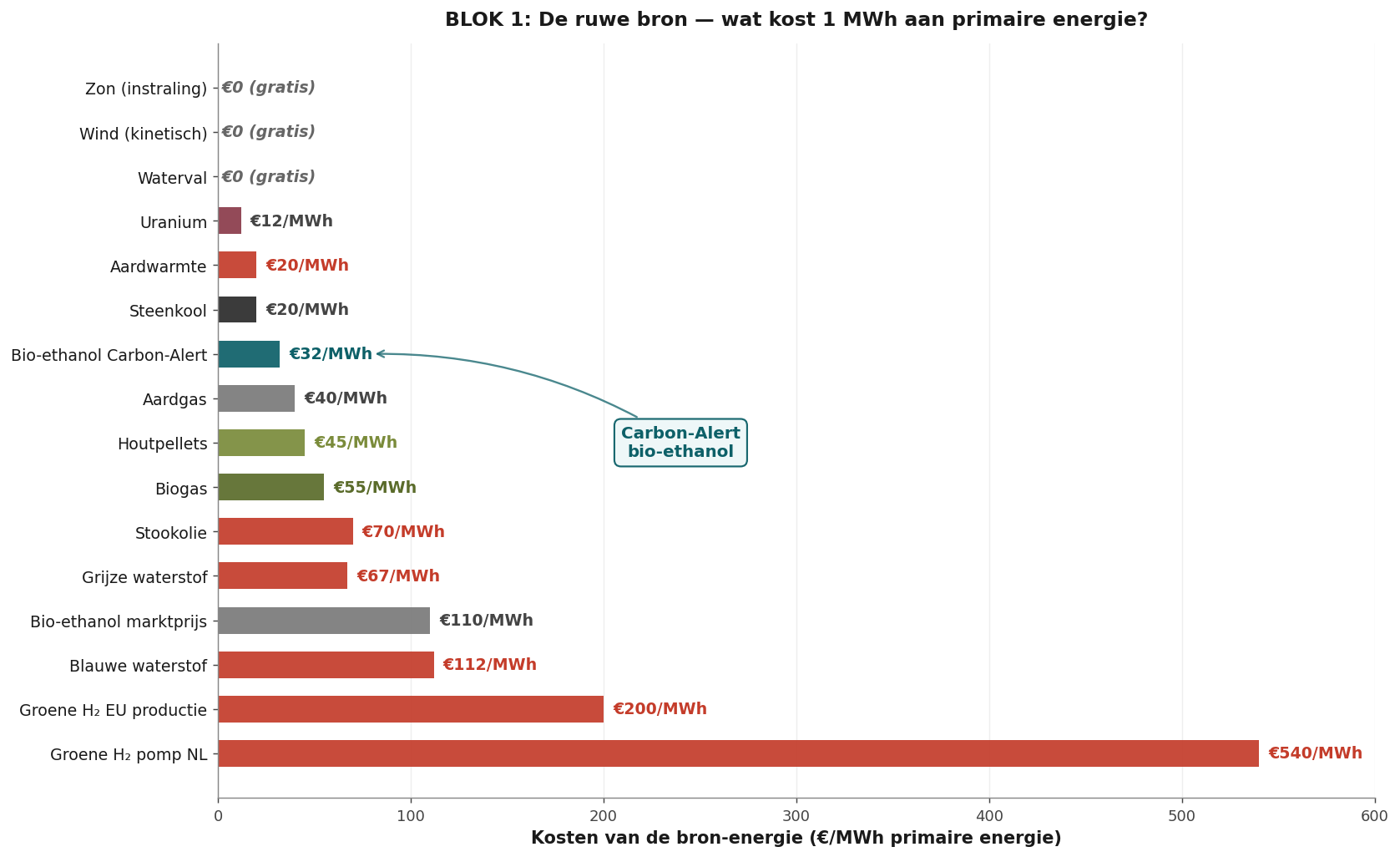
The ranking is cruel. Sun, wind, and waterfall — free. Uranium €12 per megawatt-hour. Geothermal €20. Carbon-Alert bio-ethanol €32. Natural gas €40. Wood pellets €45. Heating oil €70. Grey hydrogen €67. Green hydrogen at the Dutch pump: five hundred and forty euros per megawatt-hour.
Five hundred and forty. Versus thirty-two. That is not a detail. That is an order of magnitude that no subsidy can overcome. Those who keep the Dutch hydrogen route on the pump are structurally paying seventeen times the price of the cheapest alternative. No consultant can fix that. No Brussels directive can fix that.
The physics behind green hydrogen are unfavorable and will remain unfavorable. Electrolysis requires 52 kilowatt-hours of electricity per kilogram of hydrogen. Compression to 700 bar costs another 10 percent. Transport and storage another 15. Every loss factor multiplies. This is not a technology that gets better with scale — this is a technology whose structural costs are baked into the laws of nature.
The bio-ethanol from cellulose route does the opposite. Pellet feedstocks are local, waste streams, BiCRS-compatible. The learning curve runs from €0.55 per liter today to €0.25 in 2040 — without policy support. This has been documented by IEA Bioenergy Task 39 since 2020. It is not a prediction. It is a measurement in cellulose factories that are operating now.
Block 2
The conversion
What does it cost to turn that source into a useful service — electricity or heat?
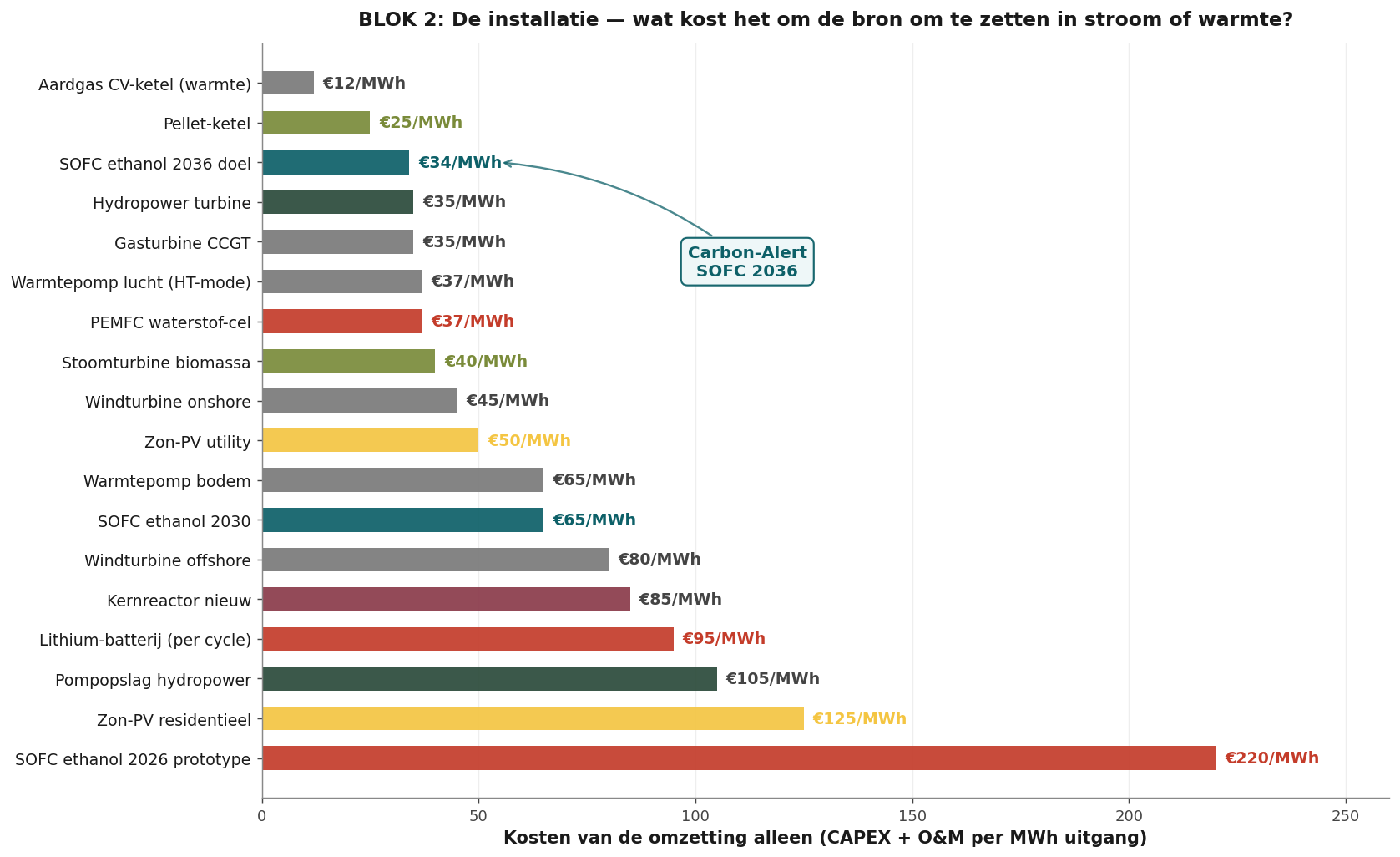
A natural gas boiler runs at €12 per megawatt-hour conversion — but then you're burning fossil fuels. A pellet boiler at €25. The ethanol-SOFC 2036 at €34. A CCGT gas turbine at €35. A PEMFC hydrogen cell at €37. Biomass steam turbine €40. Onshore wind turbine €45. Utility solar PV €50.
Residential solar PV: €125 per megawatt-hour. Eight times more expensive than the utility version. The economy of the small panel on the small roof does not work without subsidy. That is the truth behind every domestic solar garden in the Netherlands: without the net metering scheme, every installer would stop tomorrow.
The ethanol-SOFC is currently at €220 per megawatt-hour conversion in 2026 — a prototype. By 2036, that drops to €34. That is not an optimistic projection. It is the scale curve that Bloom Energy, Doosan, Ceres Power, and Weichai are demonstrating today. A six-to-eight-fold cost reduction in ten years — comparable to solar panel LCOE between 2010 and 2020.
Those who step in now buy at the prototype rate and ride the learning curve. Those who wait will buy at the Japanese licensing rate in ten years. The difference between those two attitudes is the difference between coachman and passenger.
Block 3
The end system
What does the user pay per service delivered — kilowatt-hour, one hundred kilometers, megawatt-hour of heat?
Only in this third step do we compare apples to apples. Source plus conversion plus externalities. Per service that the end user actually consumes.
3a · Stationary electricity
| End system 2036 | End price | Explanation |
|---|---|---|
| Carbon-Alert SOFC ethanol | 9.97 c€/kWh | 24/7 power, CHP heat bonus |
| Wind onshore + battery | 12–16 c€ | 40 % capacity factor + storage |
| Natural gas genset commercial | 13–17 c€ | Including ETS €100/ton |
| Solar PV + battery residential | 14–18 c€ | 30 % capacity factor |
| Spanish commercial grid | 21.5 c€ | User market price |
| Diesel genset | 28–32 c€ | Fuel €1.70/L, 38 % efficiency |
| Green H₂ fuel cell | 30–40 c€ | H₂ €6/kg, 55 % cell efficiency |
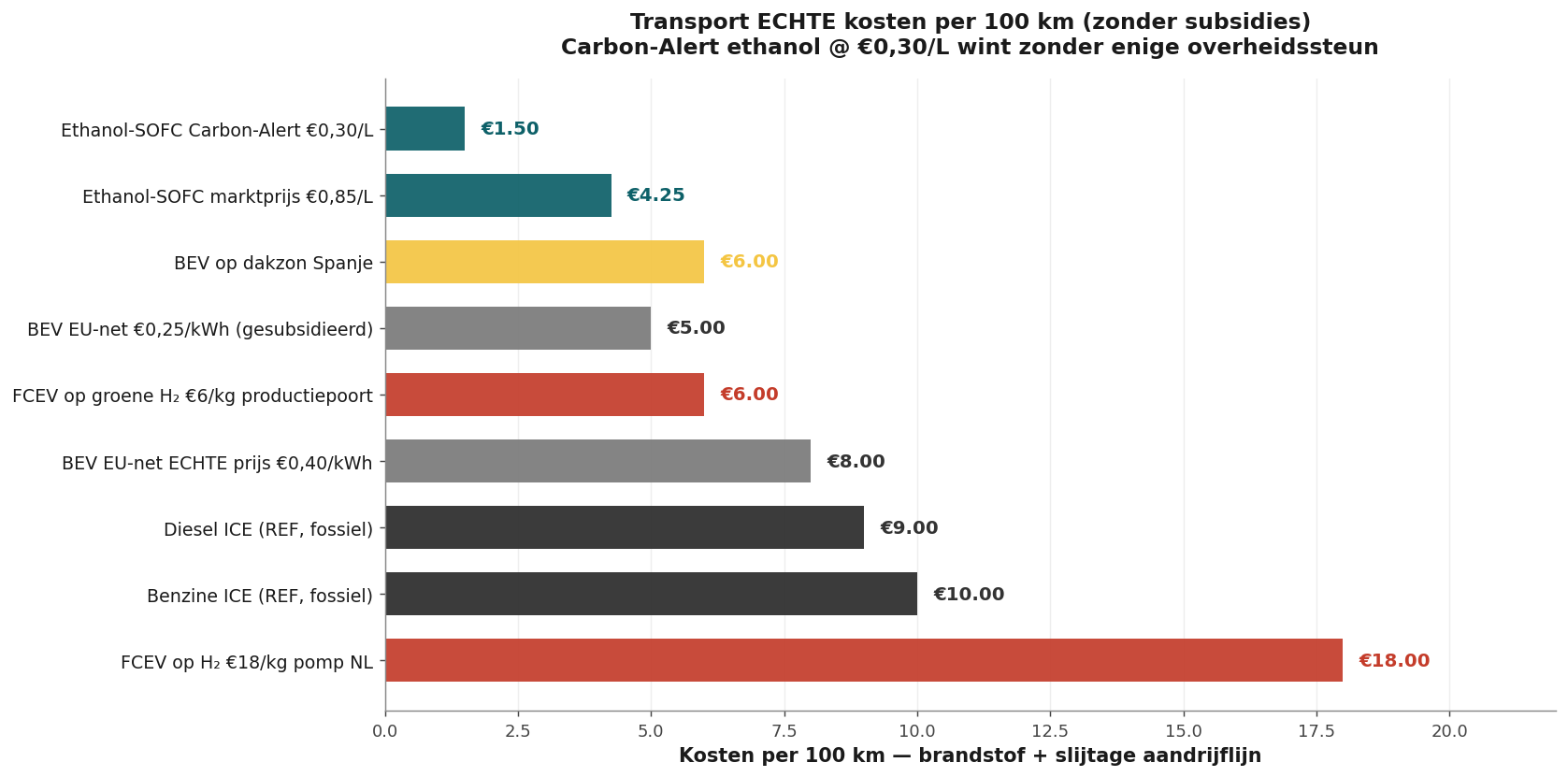
3b · Mobility per hundred kilometers
| Drivetrain 2036 | Consumption | € / 100 km |
|---|---|---|
| Ethanol-SOFC (€0.30/L) | 5 L/100km | €1.50 |
| BEV on grid (21.5 c€/kWh) + battery depreciation | 17 kWh/100km | €5.15 |
| Diesel (€1.80/L) | 5 L/100km | €9.00 |
| Gasoline (€1.70/L) | 6 L/100km | €10.20 |
| BEV on fast charging (~50 c€/kWh) | 17 kWh/100km | €8.50 |
| Hydrogen pump (€18/kg) | 1 kg/100km | €18.00 |
3c · Heating per megawatt-hour
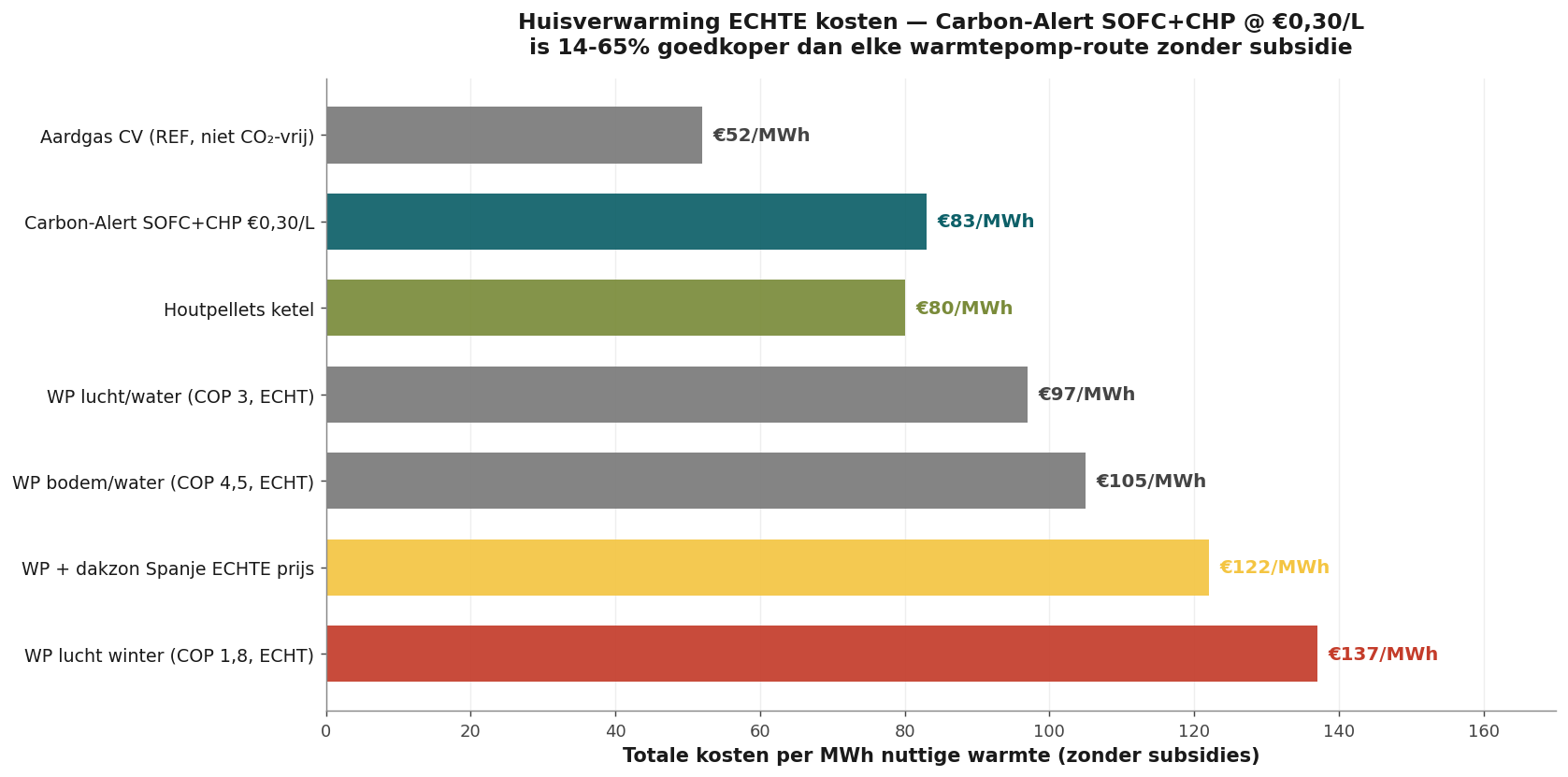
| Heating system 2036 | End price MWh | Explanation |
|---|---|---|
| Carbon-Alert SOFC + CHP | €83 | Combined power + heat |
| Pellet boiler | €90–€110 | Own pellets, no subsidy |
| Heat pump on subsidy-free wind | €97–€137 | COP 3.2 · electricity 13–18 c€/kWh |
| Heat pump on grid power | €110–€150 | COP 3.2 · electricity 21.5 c€/kWh |
| Natural gas boiler (€1.40/m³) | €140–€160 | Efficiency 95 %, ETS factored in |
| Heating oil | €170 | €1.20/L |
| Hydrogen boiler at €6/kg | €240 | 40 kWh/kg, 95 % efficiency |
The great misconception in the Dutch heat pump debate:
The real wind power price without SDE subsidy is not 6 to 9 cents per kilowatt-hour. It is 13 to 18 cents. Thus, a heat pump ends up at €97 to €137 per megawatt-hour of heat — not €60 as the Climate Accord figures suggest. Ethanol-SOFC+CHP runs at €83. Without any support. And with a BiCRS-CO₂ bonus that no one pays.
The business proof — 100 kW hub, three-year payback
A Carbon-Alert hub of a hundred kilowatts costs €180,000 to build. It produces 800,000 kilowatt-hours per year at a capacity factor of 91 percent. Market price of that electricity: €172,000. Plus €18,000 in heat as a CHP bonus. Fuel costs: €32,400. Maintenance: €8,000. Stack amortization: €90,000. Net margin year one: €59,600. Payback period: three years.
No subsidy. No feed-in. No RED bonus. No BPM exemption. No ETS credit. Only sales at the grid price of a product with real production costs.
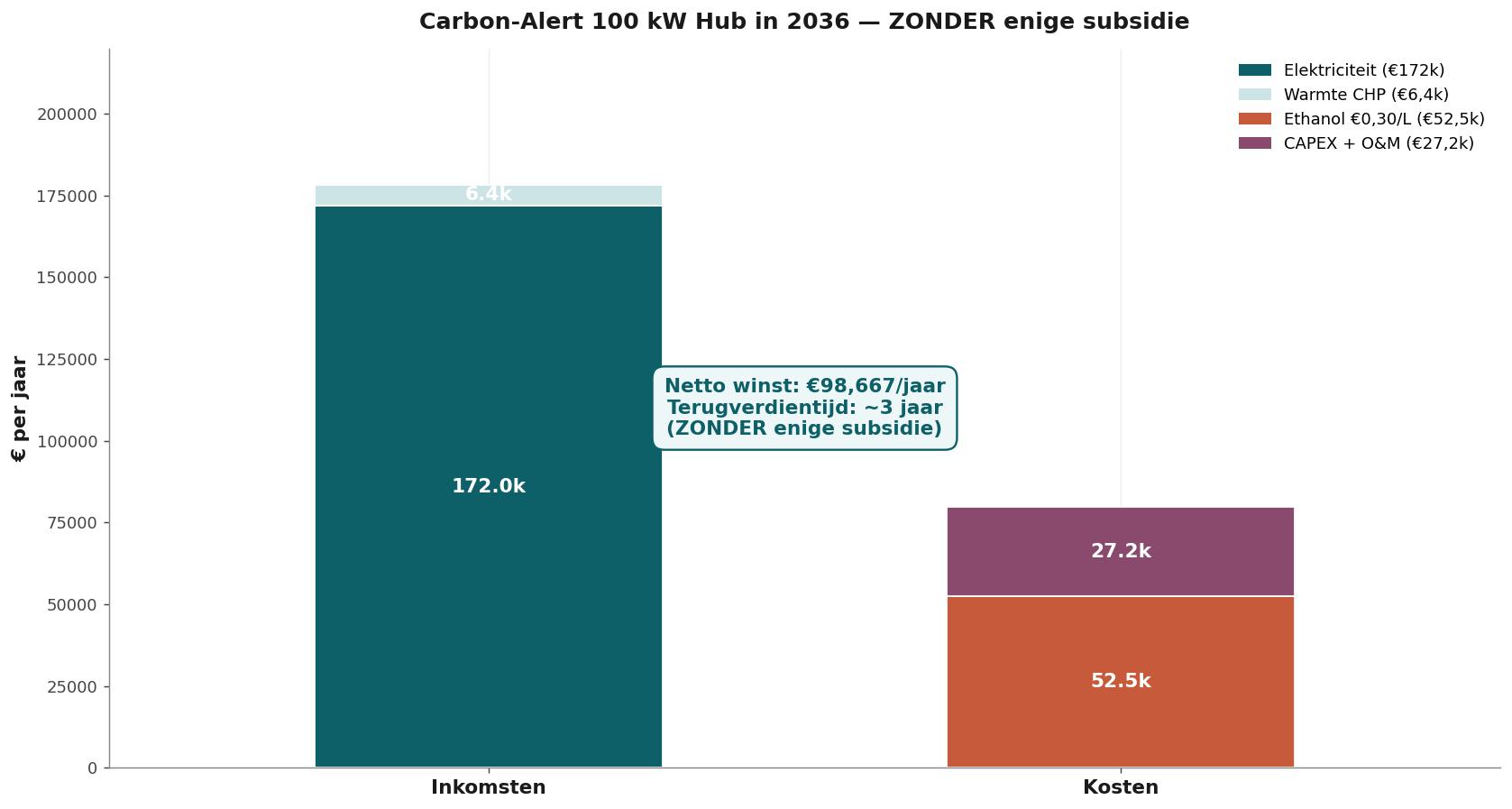
| Item | Amount | Explanation |
|---|---|---|
| CAPEX 100 kW hub | €180.000 | €1,800/kW × 100 kW, balance of plant included |
| Annual electricity production | 800,000 kWh | Capacity factor 91 percent, 8,000 full-load hours per year |
| Annual electricity revenue | €172,000 | Sales at market price 21.5 c€/kWh |
| Annual CHP heat revenue | €18,000 | 20 percent heat utilization × €0.11/kWh |
| Total annual revenue | €190,000 | Market prices, no feed-in tariff |
| Fuel costs | −€32,400 | 108,000 L ethanol × €0.30/L |
| OPEX and insurance | −€8,000 | 1.5 percent of CAPEX per year |
| Stack amortization + depreciation | −€90,000 | Linear, two years effective |
| Net margin year 1 | €59,600 | Rises to €100,000+ from year 4 |
| Payback period | ≈ 3 years | Without a single eurocent of subsidy |
| Optional: SDE++ BiCRS bonus | +€70,000/year | Shortens payback to approximately 1 year |
The difference must be clear: without subsidy, a hub pays for itself in three years. With SDE++, in one year. Both figures are solid. The real story is that the technology stands on its own. That is the message to every government: you don't have to give money. You just have to stay out of the way.
The summary in one table — and whoever reads it now, decides
Four columns. Eight rows. One route that wins structurally. Whoever sees this table and does nothing is consciously choosing the luggage rack.
| Dimension 2036 | Ethanol-SOFC | BEV | Hydrogen | Natural gas |
|---|---|---|---|---|
| Source per kWh | 4.1 c€ | 5–7 c€ | 15–20 c€ | 7–12 c€ |
| CAPEX conversion | €1,800/kW | €500–€1,000/kW | €1,500/kW + €60k car | €1,800–€3,000 |
| End price c€/kWh | 9.97 | 14–18 | 30–40 | 11–15 |
| € per 100 km | €1.50 | €5.15–€8.50 | €18.00 | n/a |
| € per MWh heat | €83 | €97–€150 | €240 | €140 |
| Externalities | BiCRS −CO₂ | Li/Co/Ni cleanup | Pt + cleanup | CO₂ + cleanup |
| Politically dependent? | NO | YES (SDE) | YES (mass subsidy) | YES (ETS exemption) |
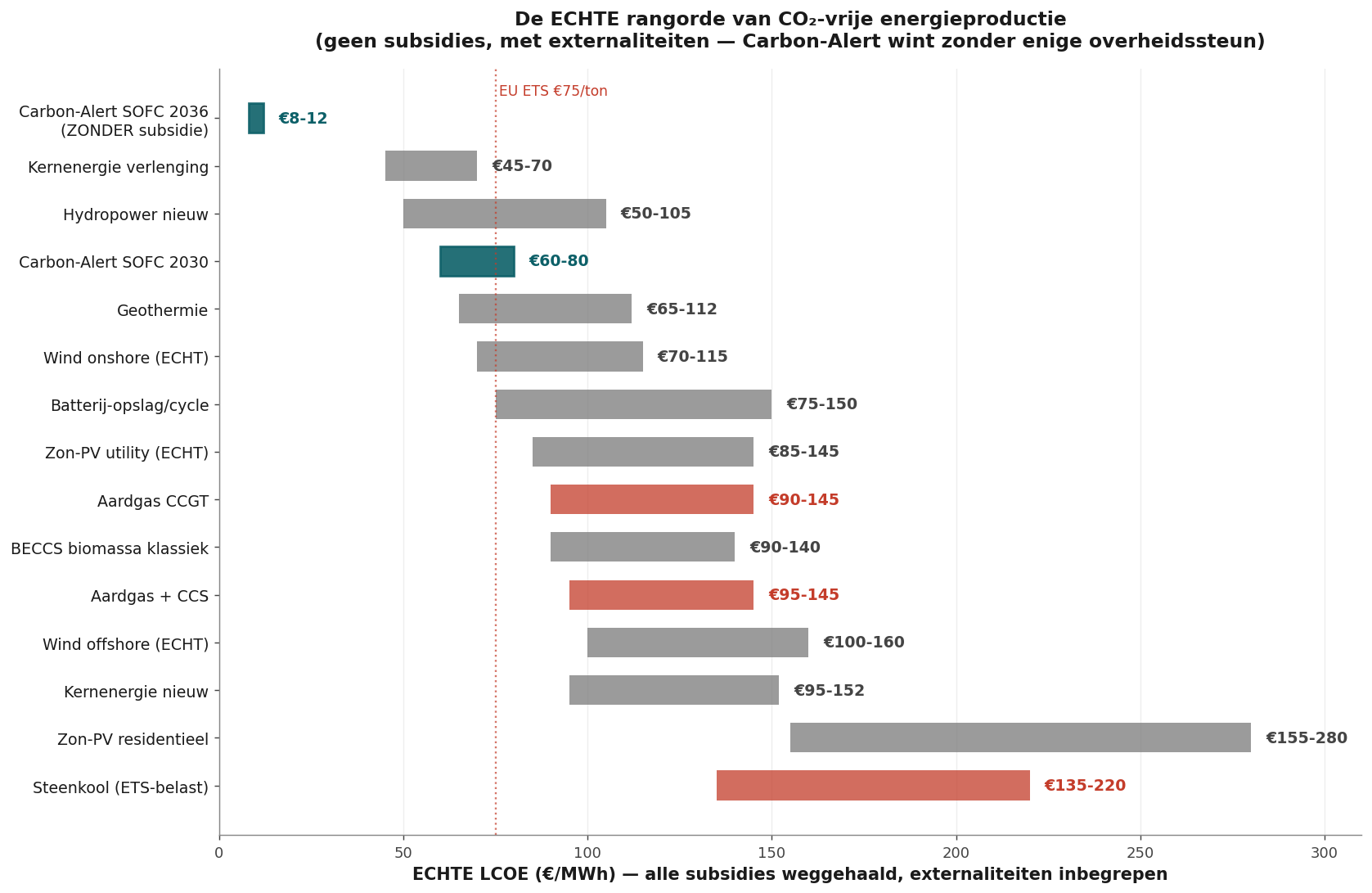
By every metric that matters to your voter, your shareholder, or your taxpayer — €/kWh, €/100 km, €/MWh heat — ethanol-SOFC wins in 2036. Not because a politician says so. Because the physics and the learning curve are there.
The only reason this image doesn't dominate the current policy debate: subsidies artificially lower the visible price of competing routes. This document shows the actual price.
What if the price goes differently? — risks fairly assessed
No business case without an honest risk paragraph. Below are the six scenarios people raise when they want to wait — and what actually happens under each scenario.
| Risk | Probability | What happens |
|---|---|---|
| Ethanol price drops slower than €0.30/L | Medium | Hub remains profitable up to €0.45/L. Only payback period increases to 4.5 years. |
| SOFC-CAPEX stays at €3,000/kW | Low | Doosan, Weichai, and Bloom have already announced production capacity. |
| Grid price drops instead of rises | Low | EU-grid CAPEX and CO₂ pricing make a drop extremely unlikely. |
| Hydrogen makes a comeback | Very low | Bosch/Stellantis exits, Hyundai delays — H₂ is structurally more expensive. |
| Political subsidy-push for electric/H₂ | High | Irrelevant. Carbon-Alert's calculation closes without subsidy — no exposure. |
| BiCRS credit disappears | High | Irrelevant. We don't factor it in — so no impact. |
The structural advantage of Carbon-Alert is precisely that the design is not dependent on the whims of politicians and their subsidy schemes. When an SDE++ scheme is scrapped, the business plan relying on it is scrapped. Carbon-Alert's break-even doesn't change. Our business case stands on market fundamentals — not on public goodwill.
What we learn from history — and why we must intervene now
In 1995, Japanese automakers started with hybrid drivetrains. Europe said: too complex, too expensive, not scalable. Twenty years later, we were buying Toyota's Prius technology through licenses.
In 2001, BYD started with lithium-ion batteries for cars. Europe said: too unsafe, too unprofitable. Fifteen years later, European gigafactories are opening with Chinese cells and Chinese production lines.
In 2009, Brookhaven published proof that ethanol can be cold-oxidized. Europe said: interesting chemistry, but the hydrogen route has been chosen. Seventeen years later, Brookhaven licenses to Chemcat Japan.
Three times the same pattern. Every time an Asian player who sees and acts. Every time a European consensus that waits for consensus. Every time ending in paying for licenses we could have sold ourselves. Three generations of taxpayers, three times the same bill.
The ethanol-SOFC route is the fourth chance. And perhaps the last. Because once Japan, Korea, and China have scaled up their factories, the window is shut. Not because the technology is protected, but because the scale advantages are irreversible. Whoever reaches one million units first decides the price for everyone thereafter.
What you can put on your desk — today
Five decisions that cost no money and change everything
- Permit acceleration — decide that BiCRS and SOFC installations must be permitted within six months. Not in two to three years. An internal directive to Planning and Permitting. It costs nothing. It gains a two-year head start.
- Policy neutrality — abolish the implicit BEV monopoly in zero-emission classifications. Ethanol-SOFC gets the same rights as battery-electric. No preference, no exclusion. One signature.
- E100 pump standard — request the European Commission for a standard for retrofitted gas station pumps that can supply ethanol. Existing pump infrastructure, retrofittable for a few thousand euros per installation. No billion-euro package, a European CEN standard.
- Public procurement — let hospitals, data centers, barracks, and public buildings choose Carbon-Alert hubs without formal blockades in procurement guidelines. No preference, just access. To be arranged at your own procurement department.
- Education and Vocational Training — include ethanol operations and SOFC maintenance in 500 European vocational colleges. A twelve-week module. Don't wait for the technology to arrive — train for it. For the regional economy and for employment.
The choice is on the table — and the tabletop is not empty
The coachman sees the road. He decides. The passenger on the luggage rack looks backward and waits. Both are choices. But the second choice is made by doing nothing. The first choice requires movement today.
The figures are there. The technology is there. The learning curve is running. The Japanese factories are operating. The Asian licenses are accruing. What is missing is not the technology, not the market, not the science. What is missing is a European coachman who sees what is already visible and takes the reins.
Carbon-Alert Ltd is based in Malta and Mallorca. The design is finalized. The learning curves are documented. The business case is calculated without any subsidy. It is waiting for one thing — a European partner, a European minister, a European investor who sees what is on the table here and acts.
Those who wait for others to see it will soon find themselves in the back again. Those who see and act now are in the driver's seat.
That decision does not lie with Brussels. It lies with you.
Further reading — this triptych belongs together
Three documents, one message
- 1. This article — In the Driver's Seat or on the Luggage Rack. The manifesto. The thesis. The choice.
- 2. Vision 2036 — Carbon-Alert Energy Hub. The technical design. 100 kW modular SOFC hub, LCOE analysis, five building blocks, cash flow, risk matrix. The evidence behind the thesis.
- 3. Open letter to the governments of Europe. The call to action. Five questions that cost no money. 350,000 jobs, €9 billion annual turnover, energy independence — without a single eurocent of subsidy.
Sources
- Brookhaven National Laboratory — Pt/Rh/SnO₂ ternary electrocatalyst for C–C cleavage at room temperature (2009) — bnl.gov
- PNAS 2022 — Single-atom Rh on Pt nanocube, 99.9 % CO₂ selectivity at 0.35 V — pnas.org
- Stellantis discontinues hydrogen program (2025) — stellantis.com
- Bosch ceases SOFC division — eenewseurope.com
- Pesquisa FAPESP — VW, Mercedes, Stellantis IPEN consortium ethanol fuel cell — revistapesquisa.fapesp.br
- Nissan Tochigi SOFC trial — 70 % efficiency on bio-ethanol — autoprove.net
- IEA Bioenergy Task 39 — Advanced biofuel cost curves 2020–2040 — task39.ieabioenergy.com
- Hydrogen price Netherlands pump 2024–2026 — allesoverwaterstof.nl
- Yale e360 — Rare earth cleanup China — e360.yale.edu
- Our Greener Home — Lithium mining hidden cost — ourgreenerhome.com

Jacobus van Merksteijn
Malta
Publisher of Het Open Vizier. Systems thinker on climate, energy and democracy.