They kill their lifelines
Brussels has an anti-immune disease. The patient is called Europe.
Jacobus van Merksteijn · 19 June 2026
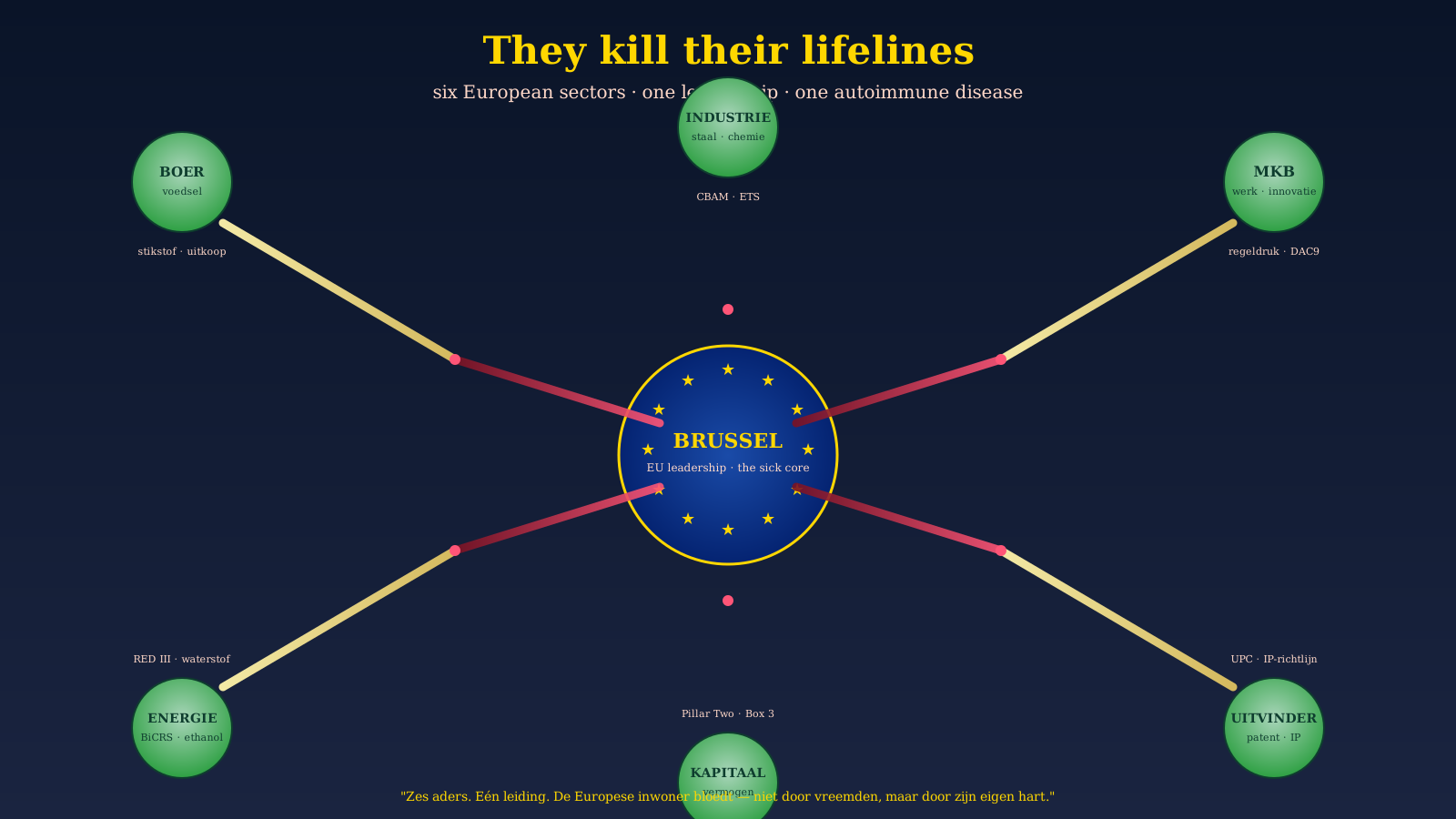
They kill their lifelines — the six European sectors that supply the continent with money, food, energy and prospects.
No rhetoric. Four facts from this month.
1 January 2026 · CBAM definitive phase
€75.36 per tonne of CO₂ on all imports of steel, aluminium, cement, fertiliser, electricity and hydrogen. €2.1 bn per quarter in costs. EU exporters to third-country markets receive no rebate — pure reverse carbon leakage.
12 June 2026 · ECOFIN strengthens CBAM
The Council extends CBAM to derivative products (machinery with substantial steel or aluminium content). The price remains linked to ETS — €60–€75/tonne — and free allocation is phased down from 97.5% to 0% by 2034. European industry is being made structurally more expensive than every competitor outside Europe.
30 June 2026 · Pillar Two GIR deadline
The first GloBE Information Return for multinationals (€750 m+ turnover) has a deadline of 30 June. 15% minimum tax in every jurisdiction, top-up via UTPR, all national fiscal incentives effectively hollowed out. Patent box, R&D deduction, investment stabilisation: everything is tested against the GloBE return.
April–June 2026 · RED III in national laws
Germany enshrines a 10% RFNBO quota for 2040 — a guaranteed market for green hydrogen. For BiCRS, bio-ethanol and recycled carbon: stricter certification, food-and-feed feedstocks being phased out. CropEnergies AG calls for a Carbon Utilisation Trading System and recognition of crop-based biomass. Brussels rejects it.
One month. Four mechanisms targeting the same victim.
And industry is not alone. Farmers: CAP phase-out, fertiliser restrictions, livestock trade restrictions (such as the cultured-meat ban of 11 June). Capital: Pillar Two top-up, wealth accretion tax, DAC9 reporting. SMEs: CSRD, CSDDD, CBAM import reporting, EU AI Act compliance. Energy: ETS2 for housing + transport from 2027, gas phase-out, biomass restrictions. Inventors: UPC costs, patent opposition procedures, IP directives that slow innovation rather than accelerate it.
One leadership. Six sectors. One pattern.
Europe has six lifelines: industry, SMEs, farmers, energy, capital, inventors. That is where the money comes from for healthcare, education, defence, pensions. No production, no money, no society. Simple arithmetic.
Those six lifelines are now being severed by the leadership that lives off them.
And for what? For climate targets from 2015, in a world of 2026. Texas has no ETS. China has no CBAM. India has no Pillar Two. What Brussels does uniquely, it does against its own industry. Not out of malice. That is the pathology.
Living proof that it can be done differently: Carbon-Alert BiCRS / Ethanol
Before we draw the parallel to medicine, first one concrete example. A working route that is available now. Not hypothetical. Not decades away. Implementable today.
Carbon-Alert Ltd has developed a two-track product that solves exactly the problem that Brussels is trying to combat with CBAM, ETS and RED III — but without killing Europe's own industry.
Track 1 · BiCRS via anoxic biomass injection
Equatorial belt, 10° north to 10° south. Per hectare per year:
- 400 tonnes of fresh biomass
- × 23.5% dry-matter fraction = 94 tonnes dry matter
- × 47% carbon = 44 tonnes C total in plant
- × 92.5% retention under anoxic conditions = 40.9 tonnes C sequestered
- × 3.666 (CO₂/C) = 150 tonnes CO₂ above ground
- + 50 tonnes CO₂ root mass below ground
- = 200 t CO₂/ha/year permanently sequestered
Mobile cell-disruption and injection equipment comes to the plot. The biomass is liquefied on site and injected directly beneath the plant's own roots. No transport. No factory. No logistics chain. The carbon remains permanently in the soil beneath the crop. In-situ economics.
Track 2 · Bio-ethanol as a separate second route
Different hectares, different management. Harvested biomass is transported to a local fermentation and distillation plant (50–100 km, like a Brazilian sugar-cane factory). The bio-ethanol leaves the equatorial producing country by tanker towards European ports. Full substitute for petrol and diesel. Climate-neutral through a closed carbon cycle.
The cost difference Brussels does not want to see
BiCRS model price: €40/t CO₂
Actual production cost: €22–€28/t CO₂
Current EU ETS price: €78/t CO₂ (CBAM €75.36/t)
BiCRS is structurally cheaper than ETS — and delivers actual carbon removal, not merely a price signal.
What one hectare yields — for Congo, for Europe
A Congolese farmer switches from cassava (€300 per hectare per year) to BiCRS biomass under contract. 200 t CO₂ × €40 = €8,000 gross per hectare per year. After operator margins and operating costs they retain €2,000–€3,000 net — seven to ten times their current income.
At country level: the Democratic Republic of Congo with 2.8 million hectares under BiCRS contract receives €22.4 bn per year gross — roughly 20% of current GDP. Indonesia with 2.1 Mha: €16.8 bn per year. Brazil for the Amazon fringe: €22.4 bn per year. Not as charity but as a commercial relationship in which the partner country delivers where it has comparative advantage (climate, sunlight, water) and Europe pays where it comparatively falls short (climate policy, industrial competitiveness, energy independence).
What this does for the six European lifelines
- Industry pays no CBAM and no ETS. Carbon-Alert delivers climate compensation at €40/t instead of €78/t. The competitive disadvantage disappears.
- SMEs get CSRD reporting with working numbers behind them: a European chain of carbon removal with traceable source tonnes.
- Farmers in Europe remain farmers, because existing agriculture does not have to compete with biomass allocation. The equatorial production is additional, not substitutive.
- Energy gets its own carbon cycle — bio-ethanol as a direct substitute for fossil fuel, with production in partner countries where solar irradiance is unlimited.
- Capital gets an investment target with measurable return: €40/t revenue, €12–€18/t margin, scalable to 14 million hectares worldwide.
- Inventors get recognition for what RED III currently excludes — biomass route, in-situ injection, anoxic storage: three patentable innovations that Brussels is now actively blocking.
One product. Two tracks. Six lifelines kept intact instead of severed.
What Brussels does with it
Nothing.
RED III phases out food-and-feed feedstocks. Bio-ethanol from sugar cane, maize and cassava is excluded from the RFNBO quotas. At the same time, hydrogen — an infrastructure that does not yet exist in Europe — receives a guaranteed market of 10% in transport by 2040.
The Carbon-Alert BiCRS route does not fit the Brussels model because it was not conceived by an EU DG. It comes from Malta, from an entrepreneur, from a patented innovation. In an anti-immune leadership that is a double threat: not only alternative policy, but also alternative authority.
And so it is ignored. Not refuted. Not weighed. Not tested. Ignored.
Brussels chooses €78/t ETS that strangles its own industry — over €40/t BiCRS that saves its own industry.
Brussels chooses hydrogen for 2040 — over bio-ethanol that can be in the tank tomorrow.
Brussels chooses imports of solar panels from China and LNG from Texas — over its own carbon cycle via Congo, Indonesia and Brazil.
That is not climate policy. That is an anti-immune reaction against working knowledge that does not come from within its own circle.
For the full calculation of what this could save and deliver for Brussels — including the scenario analysis that Brussels itself should be making — see The Brussels Consequences Map — BiCRS edition. Net effect: +23% to +106% per scenario by 2030, instead of the current net loss of 5–15%.
Carbon-Alert is therefore not "one of the alternatives". It is concrete proof that the sick leadership is actively looking away from a working route. Just as an anti-immune T cell actively looks away from the diseased cell it should recognise as self.
Why does no one think?
How can this be? Educated commissioners. DGs with decades of experience. Entire directorates with economic models. And yet this.
Real thinking requires three things.
Perceiving what is there. The sick leadership sees only its own Green Deal models.
Doubting its own assumptions. Whoever within the Commission asks out loud "does CBAM actually do what we want?" loses their dossier.
Taking responsibility. It came from the impact assessment. It was in the Council Conclusions. It was fixed in trilogue. Nobody decides personally — and so nobody truly decides to think.
Whoever does not perceive, does not doubt. Whoever does not doubt, does not decide. Whoever does not decide, does not think.
That is why calls for "better coordination" or "more dialogue with industry" do not work. A non-thinking system does not think better because you ask it to.
The disease has a name
In medicine we know this. Auto-immune disease. The body attacks its own organs. Pancreas, joints, myelin, thyroid, intestine.
The attacking cells are not malicious. They do their job. The problem lies in recognition. Own tissue is mistaken for enemy.
The immune system cannot see its own error. Every attempt at correction is treated as a threat and neutralised.
Read that description again. Replace "body" with "Europe". Replace "immune system" with "Brussels". It fits word for word.
This is not a metaphor.
This is a clinical condition.
Left untreated it leads to death — in a human within years, in a continent within a decade.
Why a new Commission solves nothing
The cell line is sick, not the individual cell.
A new Commissioner comes from the same university, the same permanent civil service, the same impact assessments, the same Council corridors. They cannot do other than make the same decisions. The DG produces them, not the Commissioner.
Von der Leyen or her successor makes no difference. It is not the individuals who cause the anti-immune reaction — it is the structure that programmes individuals into auto-antibodies.
Remove the cell line and form a new one.
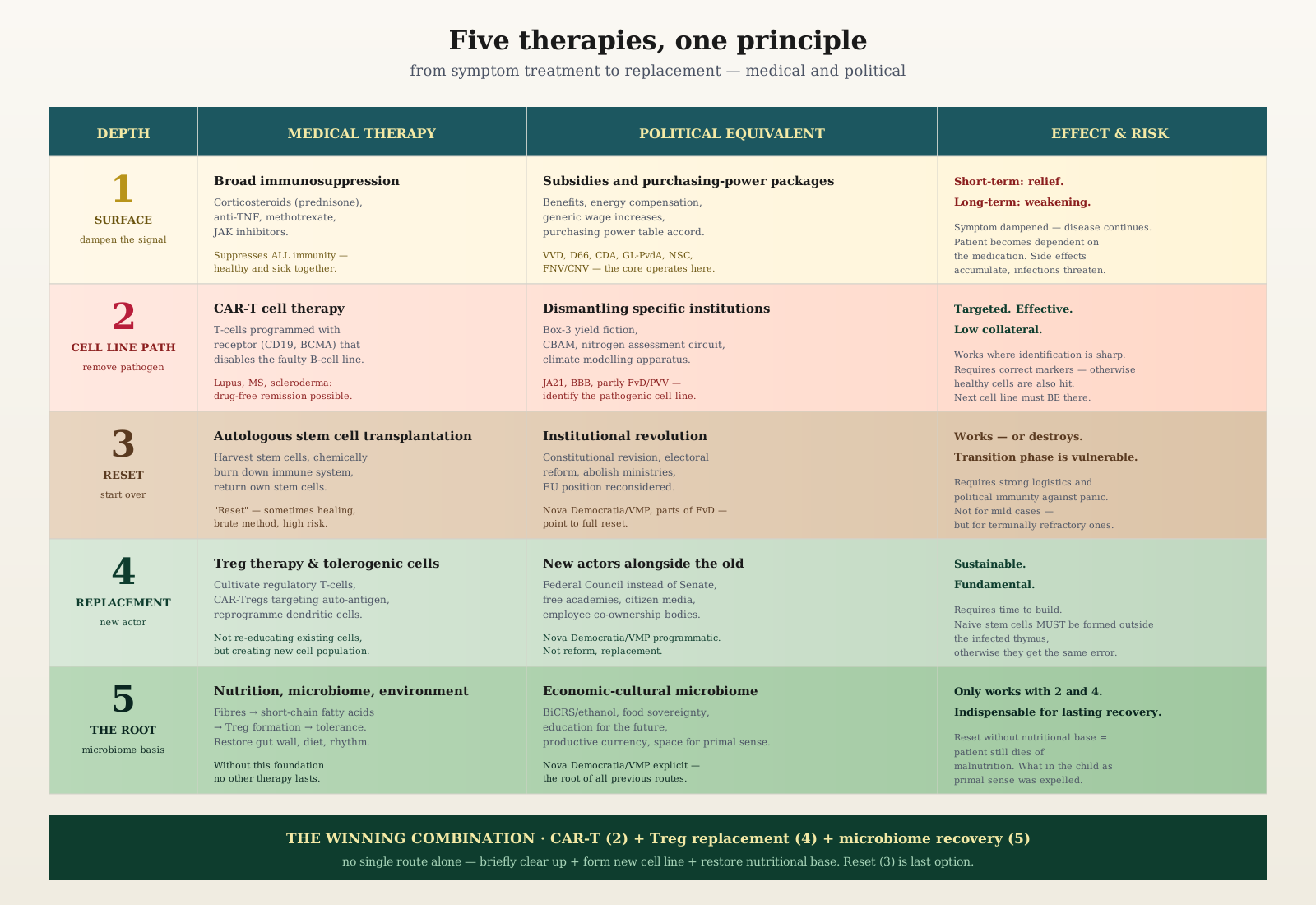
Five escalating treatment routes — medical and political side by side.
The treatment
Five medical routes. Five political translations — now in Brussels form.
1 · Suppressing symptoms
Recovery & Resilience Facility, NextGenerationEU, "Just Transition Fund", subsidies to affected sectors via Temporary Decarbonisation Fund. Prolongs the disease. Makes the affected industry dependent on the attacking leadership. Don't.
2 · Removing specific institutions
As CAR-T kills the wrong B-cell line. Concretely, this month:
- CBAM: withdraw or fundamentally reform — export rebate mandatory.
- ETS expansion (ETS2): freeze — no charge on housing and transport as long as there is no European energy alternative.
- Pillar Two: suspend for green and industrial investment incentives.
- RED III food-and-feed exclusion: reverse — put bio-ethanol on equal footing with hydrogen.
- CSDDD and CSRD: revise — no reporting requirement without proven net benefit.
Five decisions. Before the end of 2026. Non-negotiable.
3 · Full reset
Treaty revision, restructuring of the Commission, revision of the ECB mandate, exit consideration for specific member states. Works — or destroys. Only as a route if 2 and 4 are refused. Keep in reserve.
4 · New bodies alongside the old
Not reforming the Commission — establishing a European Productivity Council alongside it, with direct representation of industry, SMEs, farmers, inventors. Not persuading ECON — establishing a European BiCRS Coalition of countries that want to preserve production (Germany, France, the Netherlands, Italy, Poland, the Czech Republic). Not hoping the EP reforms itself — establishing a European Federal Council in which productive sectors have voting rights alongside the parties.
Building alongside dismantling. The old naturally becomes irrelevant.
5 · The supply base
Europe's own energy via BiCRS / bio-ethanol. Its own food sovereignty. A productive euro that finances innovation. Wealth formation with SMEs and workers rather than with financial conglomerates. Education for industrial reality rather than climate models. Without this, nothing sticks.
The prescription — Brussels
- Route 2 + 4 + 5. Combined. In that order. Fast.
- Route 1 consciously wound down. Whoever subsidises the affected industry feeds the disease.
- Route 3 in reserve. Only if the Commission actively refuses 2 and 4.
What if we do nothing
The disease progression is documented. Other continents have already run it.
Productive industry moves to Texas, Shanghai and Mumbai. SMEs close or sell up. Farmers sell to investment funds or leave. Energy becomes import-dependent — LNG from the US, hydrogen from Morocco, solar panels from China. Capital flees to 0%-jurisdictions. Inventors patent in the US, not in Europe.
The European citizen is left behind with higher prices, shrinking employment, import-dependent energy, thinner pensions, worse healthcare.
Ten years. Then recovery is no longer possible.
To you
Brussels will not cure itself. An anti-immune system does not recognise its own error.
You do.
You are the German engineer whose factory is moving to Texas. The Italian family SME owner whose succession has become unaffordable. The Spanish farmer whose CAP subsidy lapses. The French inventor whose patent nobody finances. The Dutch owner-director whose Box 3 runs on fiction. The Maltese craftsman whose energy bill is exploding.
You are also the healthy counter-force. The Treg cell that can carry the recovery. But only if you rouse yourself — across national borders, against the Brussels canon.
Recognise the disease. Name it. Demand the treatment. Do not wait for the patient.
They kill their lifelines.
Whoever reads that sentence and thinks "it can't be that bad" — has already gone along with the disease.
Whoever reads and knows what to do — is a Treg in the making.
Recovery begins with you.