Back to the Workbench, Forward to Thinking
Manifesto — Dutch education needs an overhaul. A straightforward recovery of quality, craftsmanship, and breadth.
By Jacobus van Merksteijn · 24 min read · 28 May 2026 · Edition 2
First part of the education trilogy · in the context of Nova Democratia
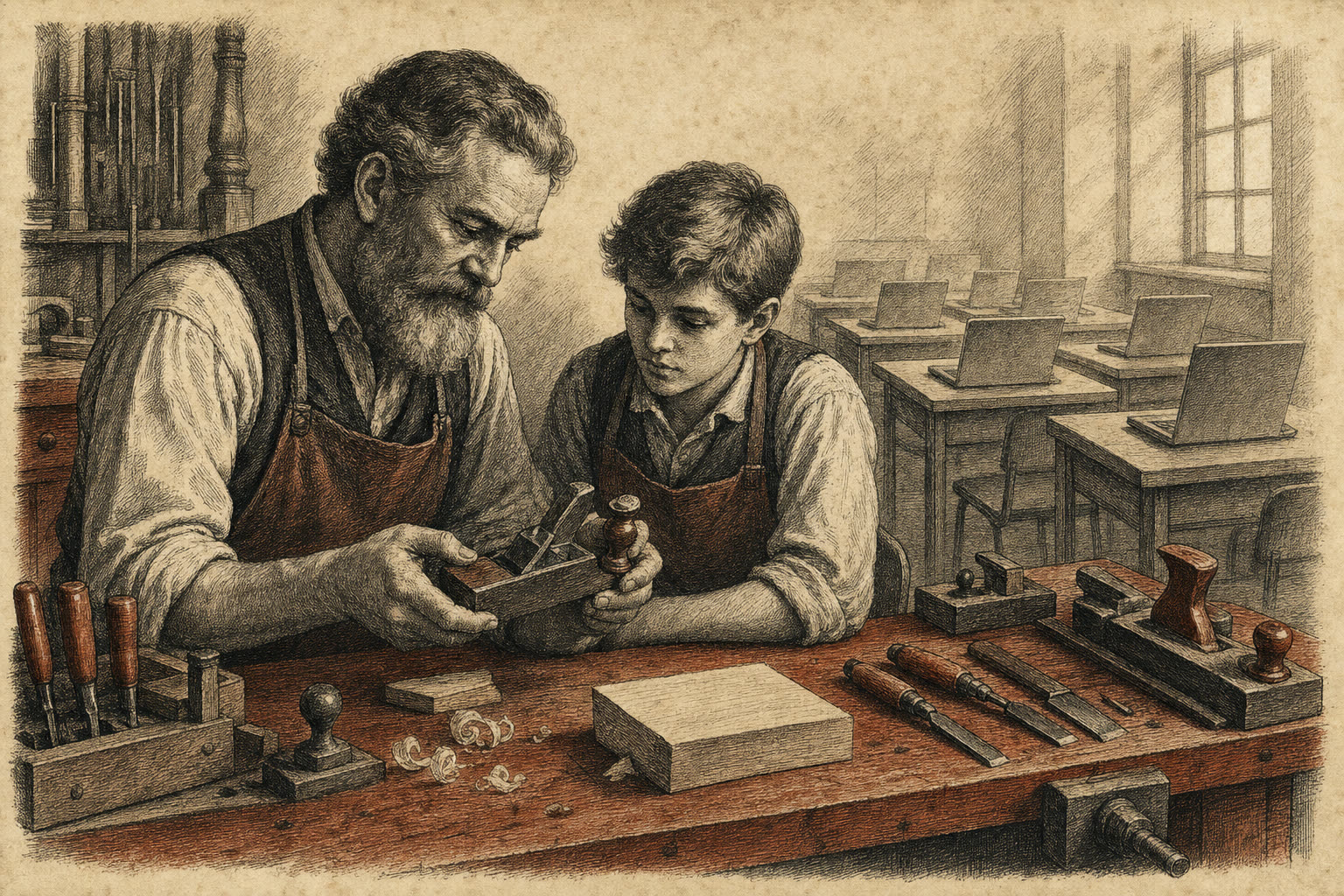
A trilogy on education
This manifesto is the first of three interconnected pieces. The second describes what it costs. The third asks you to choose a side.
"A country that teaches its children to wait in front of a screen teaches them to wait for their own replacement."
— Opening proposition.
The diagnosis.
One accounting error, disguised as social policy, has wrecked Dutch education.
From the nineteen-seventies onward, the funding logic was reversed. No longer money for quality. Money for quantity. Every pupil who stays enrolled is revenue. Every failure is a loss. A student who fails their exam costs the school money — so nobody fails anymore.
This is not an accident. It is what the system is designed to reward. School factories can only survive by lowering the bar. Inspectors announce their visits in advance. Exams become in-house affairs. Diplomas become paper.
The real deficit.
What distinguishes a human being from an algorithm in 2030 is physical skill, judgment under uncertainty, broad synthesis, and the courage to think beyond the existing. None of those qualities are systematically rewarded right now. We are training our young people for precisely the jobs that will disappear first.
Sources: ¹ OCW in cijfers — PISA 2022 · ² ESB, May 2025 · ³ MBO Council, March 2025
The turn we never took.
Other countries saw it coming and changed course. We kept driving where the road had already ended. Six countries, six reforms, hard numbers.
Switzerland
The reform Dual system: 230 recognised vocations. 90% of students combine work and school. Three to four days at a company, one to two days at a vocational school. No dead-end route — whoever wants to can progress via a trade diploma to a university of applied sciences or a university.
The result Two-thirds of young people in vocational training. The lowest youth unemployment rate in Europe.
Germany
The reform 1,600+ dual-track study programmes. The Meister title is legally protected. The Fachhochschule carries its own prestige. Anyone wishing to open a regulated craft business without a qualified Meister is not permitted to do so.
The result Academic degree and trade qualification in a single trajectory. Meister means high earnings, not hobby work. Fachhochschule is fully recognised.
Finland
The reform Primary teacher training: 6.8% admission rate (2016) at the University of Helsinki — more selective than law (8.3%) or medicine (7.3%). A master's programme with a research component. Trust given upfront replaces control imposed after the fact.
The result School inspection is barely necessary. Teaching is a prestigious profession, not a fall-back career.
Singapore
The reform Streaming reformed 2019–2024: less early-track selection, more progression pathways. Post-graduation salaries made publicly available by programme via the Graduate Employment Survey.
The result Polytechnics respected on a par with technical universities. No credential inflation. Social mobility through meritocracy. Only 11% low performers.
South Korea
The reform The exam monoculture broken open in 2024. Holistic assessments — creativity and collaboration now count toward higher education admission.
The result Proof that even a country that went further down the wrong road can still turn around when the social damage becomes visible.
Estonia
The reform Small country, small budget. High teacher autonomy, low test pressure. Strong growth mindset. Ranked number one worldwide on the growth-mindset index.
The result PISA 2022: 510 mathematics · 511 reading · 526 science. Global top 8. Only 5.2% low performers — the Netherlands: more than double that.
Against that backdrop: 33% of Dutch 15-year-olds fall below the basic PISA reading level. In Estonia the figure is 13.8%. In Singapore, 11%. Numbers do not lie.
What should we have done?
- Not upgraded the HBO in name only — but kept the MTS, HTS, HZS functioning in substance.
- Not abolished the broad school — but deepened it.
- Not raised the burden on the inspectorate — but raised the bar for the teacher.
- Not funded on enrolment numbers — but on quality of outcomes.
Sources: Swiss SBFI · DAAD Germany · Finnish Education Council · Singapore GES · KDI School (Korea) · OECD PISA 2022 Estonia
The new landscape.
Restore what worked. Build what is missing. Stop applying labels to decay.
The Netherlands needs three kinds of people and will give them three independent schools. No umbrella branding, no 'ROC', no 'university of applied sciences'. Each institution stands on its own, with federal recognition and its own examinations.
Craftsmanship
MTS, HTS, HZS, HLS, HHS — restored as independent institutions.
- MTS — Secondary Technical School. 4 years, 30% work placement, immediately deployable.
- HTS — Higher Technical School. Project-driven engineers who build things.
- HZS — Higher Maritime School. Maritime Netherlands needs it.
- HLS — Higher Agricultural School. Regenerative, agrotech, circular.
- HHS — Higher School of Commerce. Real commercial thinking, no marketing jargon.
Broad Knowledge School (BKS)
A new school. For those who learn to think analytically, purposefully, outside the box, and radically. Not specialist, not generalist — but polymath in training. People who force decisions where specialists get stuck.
- Oral examination as the primary format. Never multiple choice.
- One day per week in the workshop.
- No phones in lecture halls.
- Maximum 200 students per year group, per location.
Broad Pre-University Education
Gymnasium and lyceum restored.
- Classical languages made compulsory again.
- Six subjects to final examination, not four.
- Philosophy as an examination subject for everyone.
- Weekly workshop afternoon, including at the gymnasium.
The Broad Knowledge School — four years.
Foundations of Thought
Logic & rhetoric · Mathematical literacy · Physical intuition · Systems biology · History as causality · Philosophy · Two foreign languages, compulsory.
Synthesis and Method
Complexity & systems thinking · Statistics & data intuition · Economics & money · Law & governance · Materials, energy, workshop · Writing & debating.
Application and Projects
Interdisciplinary research project · Work placement outside your comfort zone · Compulsory semester abroad · Case studies with no established solutions.
Final Work and Direction
In-depth project in two self-chosen domains · Defence before a panel of practitioners and academics · Choice: continue studying, start a business, take the lead.
Money follows quality.
The incentive is wrong. One stroke of the pen suffices. Stop funding on enrolment numbers — fund on results.
The principle.
A school receives money for every pupil who passes at the target level. Not for every pupil who walks through the door. Whoever lowers the bar to push everyone through loses money. Whoever holds the line and brings more pupils to the target level receives more money.
What comes with it.
- Final examinations centralised, independent, not administered by the school itself.
- Random inspection, unannounced, by an externally independent body.
- Graduated sanctions: warning, then funding suspension, then exclusion.
- Public dashboard: target-level pass rate, progression, post-graduation salary per school.
- Teacher selection: teacher training more selective than law — following the Finnish model.
- Master Teacher title with a pay scale equivalent to a master craftsperson.
Whoever fails costs money. Whoever fails may therefore fail.
This is not harshness. This is honesty. The current system hands out diplomas that are worth nothing on the labour market, and the person without connections loses the most. Whoever opposes selection on social grounds is in reality protecting existing inequality.
Upbringing belongs back in the picture.
A school cannot form character when the family has withdrawn.
Parents have become customers, not partners. Whoever calls the school strict files a complaint. Whoever contradicts the teacher is told they are right. Discipline has become a suspect word — and nobody can see anything through anymore. This is not a pedagogical theory. It is a social failure.
What we restore.
- The teacher has the final word. Not the parent. Not the pupil.
- Parental contribution in time, not just money. Employers facilitate that.
- No phones at school under the age of sixteen. Full stop.
- Handwriting and oral expression restored as core competencies.
- Complaints handled via an independent ombudsman — not via the school board.
Civic service — light.
Six to twelve months between the ages of 16 and 21. In care, defence, nature conservation, a trade, or technology. Unpaid, with a study advance. Switzerland has it. France has it. Singapore has it. It teaches young people what physical work and collective responsibility mean.
Constitutional anchoring.
Education must no longer be a political football that every new cabinet rediscovers.
Education becomes one of the ten core fields of Nova Democratia. The principles are the same as for every other core field:
| Principle | Application to education |
|---|---|
| Outcome steering | Government sets graduation requirements, not how to teach. |
| Price/performance norm | Funding per graduate at target level, not per enrolled student. |
| Random inspection | Unannounced inspection by an independent body. |
| Graduated sanctions | Warning, then funding suspension, then exclusion. |
| Dual vote | Citizens vote on policy and on results achieved. |
| Sunset clause | Education laws expire after 5 years, automatically subject to review. |
| Zero-base 5-year goals | Curriculum rebuilt from scratch every five years based on what the times demand. |
| Citizens' deliberation | Education Council with a randomly selected citizens' panel alongside experts. |
| 20% target threshold | School boards falling below the threshold are replaced. |
What is set out here does not fit within the existing Constitution — not because it contradicts it, but because it replaces its logic. Nova Democratia is not a repair. It is a parallel constitutional design, beginning with education.
What they will say.
Refuted in advance, so the debate does not stall at the familiar objections.
"Too selective — that's antisocial."
The current system is antisocial. It hands out diplomas worth nothing and the person without connections loses. Selection on talent is fairer than selection on background.
"Too expensive."
The current system costs more. We are paying for diplomas that lead nowhere, for teachers without authority, for inspectors without teeth. Funding on quality costs less, in total.
"Article 23 — freedom of education — stands in the way."
No. Article 23 guarantees freedom of denomination, not freedom to lower standards. The government may set quality requirements. At present it does so far too little.
"Teachers will go on strike."
Good teachers will cheer — they will finally be rewarded. Weak teachers will lose. That is precisely the point.
"AI is coming — why bother studying?"
Exactly for that reason. Studying for AI-resilience means synthesis, judgment, physical craftsmanship, originality. The current system trains the opposite.
What now.
No policy note. No committee. No report. Coalition and pilot, within eighteen months.
What can be done without constitutional change, immediately.
- Amend the funding system — ordinary legislation.
- Establish the BKS — private or public-private foundation with formal recognition.
- Restore the HZS — Rotterdam, Flushing, or Den Helder.
- Law on 'Protection of the Master Title' following the German model.
- Use the House of Representatives inquiry into the lump-sum system (November 2025) as a lever.
What we ask.
- A coalition of industry, maritime, and trade sectors for the first pilot.
- Parents, teachers, and entrepreneurs who sign this manifesto.
- One BKS pilot location — fifty students, first cohort 2027.
- One regional funding pilot — three to five schools.
- International knowledge exchange with Switzerland, Germany, Finland, Singapore.
The Netherlands has no time for gradual evolution.
Other countries are already taking the bend.
Jacobus van Merksteijn · Mallorca / Switzerland · May 2026