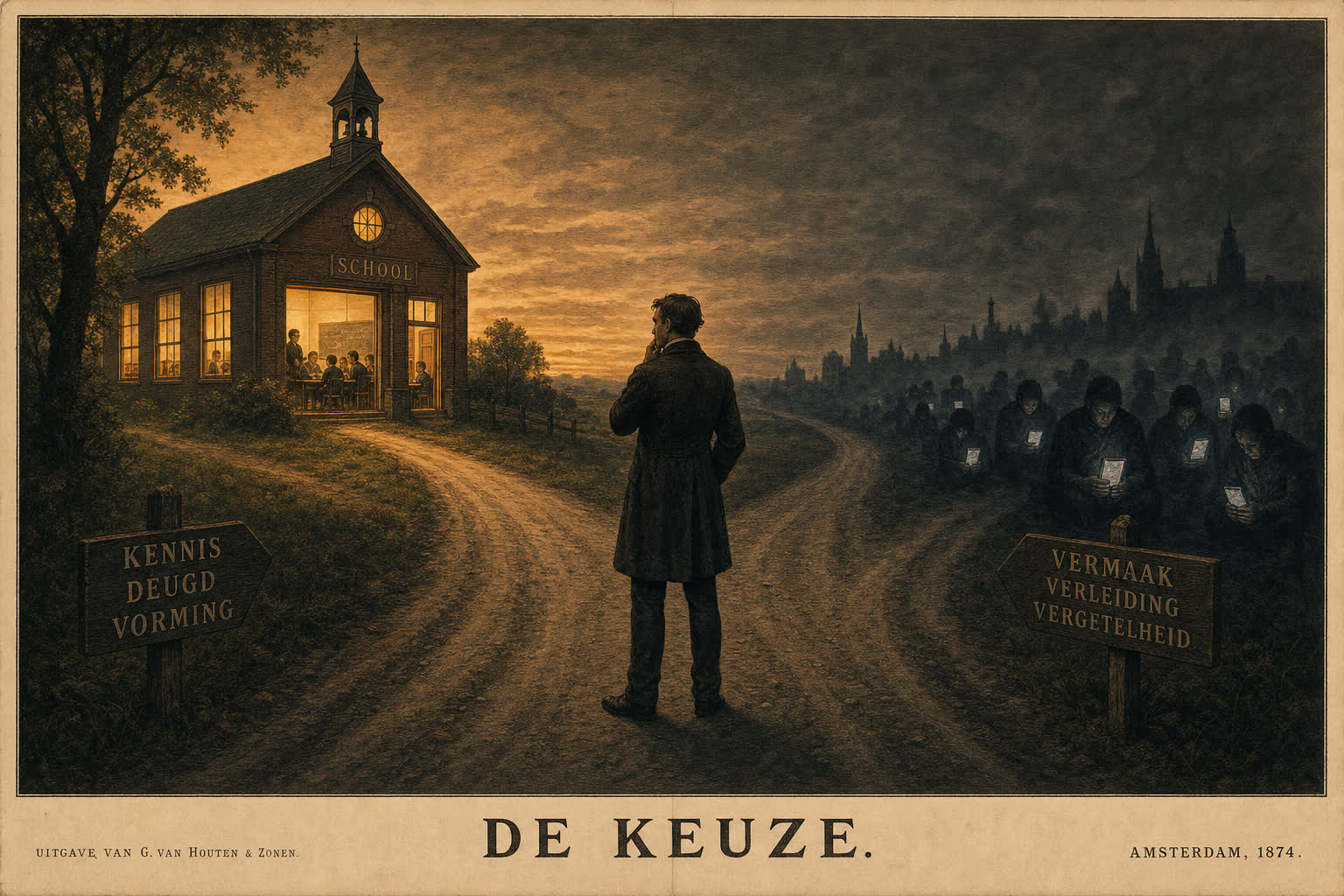
Choose a Side
What we can still save, what we can no longer save, and why you must speak up now.
By Jacobus van Merksteijn · 16 min read · 28 May 2026 · Edition 2
Conclusion of the series on the reconstruction of Dutch education
A trilogy on education
This is the third and final instalment. The first two parts appeared under different titles — those who have not yet read them will find them here.
The end of non-commitment
In my previous two pieces I described why our education system must change, and what sacrifices that will require. Many readers responded with agreement. Some indicated they were in principle on board — but. The ever-present but. But it is difficult. But it is complicated. But you cannot bring everyone along. But the matter has many sides.
I want to open this third piece by delivering you an unwelcome message. That non-commitment is over. Not because I say so, but because reality does. We have reached a point at which every reader of this piece — politician, teacher, student, parent, entrepreneur, retiree — will have to choose a side. And whoever chooses no side has thereby chosen one: the side of decline.
In this piece I am going to tell you three things you would rather not hear.
Three messages that will calibrate your position — and force you, by the end of this piece, to make a choice you have been able to avoid for thirty years.
What we can still save — and it is the children
The good news first.
The next generation — the children now in primary school, the teenagers now beginning secondary — they can still be saved. Unconditionally. Completely. If we act now.
An eight-year-old still has ten years before entering the labour market. In those ten years, every subject can be re-taught, every structure of thought re-built, every capacity for struggle re-practised. The child need not be a genius — it need only have a system around it that instils these things rather than strips them away.
We do not have that system. We have a system that fragments a child's attention via screens, outsources its thinking to algorithms, delegates its formation to institutions held accountable for numbers rather than outcomes, and leaves its character development to parents who have not yet worked out what they themselves want from life.
That system can be rebuilt. It costs money, it costs courage, it costs political will — but it is achievable. Every Asian country that has worked seriously on education over the past forty years has done it. Singapore. South Korea. Taiwan. Vietnam is doing it now. These are no mysteries, no miracles, no secrets — they are choices. Choices they made and we did not.
This is the prize within our reach. A Dutch generation of twenty-somethings in 2040 who can think, can build, can discern, can lead.
With that generation we have no more trouble with AI, with productivity, with international competition, with democratic decay. With that generation we are once again a country that matters.
But then we must now put the axe to the tree. Not next year. Now. Every month of delay costs us a cohort of children who are born into that same cohort with our competitors — and who, over there, receive the right formation.
What we can no longer save
And we must be honest about that.
Now the bad news. There is a group for whom the education route comes too late: people who are now roughly between fifteen and thirty-five.
This group bore the brunt of forty years of educational dismantling at precisely the age when it should have been building their formation. They are the first fully digital generation, raised in a culture that dared deny them nothing, and they are now being exposed to AI at a moment when their cognitive foundations were already shaky. I write this not to write them off — I write it because honesty demands it of me.
Within that group there is a minority who will save themselves. They have become self-directed in spite of the system, have preserved their curiosity, use AI as a lever rather than a crutch. They do not need us. They will become the steerers, and they will do well.
But the majority of this age group will become something else. They will become the structural consumers of what others produce for them. They will get work that does not challenge them, because the work that would challenge them is done by others or by machines. They will receive information that confirms their existing opinion, because the algorithm delivers what keeps them calm. They will vote for parties that promise them nothing they must do themselves.
We can set up lifelong learning programmes for them, offer retraining courses, devise AI-literacy trajectories. That will help the motivated minority within the group — who would have become steerers without us anyway. The large middle group will not show up, or will earn a tick without any formation, or will drop out early with the complaint that it was too hard.
This sounds harsh. It is harsh. But whoever does not say it aloud keeps spending resources on a group for whom it is too late at scale, instead of directing those same resources towards the group for whom it is not too late.
That is not compassion — that is misplaced shame about an unavoidable choice.
At the individual level, every person in this group can still be reached. Through confrontation. Through an employer who says: do it yourself or leave. Through a partner who says: put the phone down. Through one teacher, one mentor, one conversation that makes the penny drop. But that is not policy. That is culture, and we do not change culture through a subsidy scheme.
What seems impossible — and it is the government
Then comes the third piece of bad news, and this is the heaviest: our current governance structure is not capable of carrying out the reforms that are needed.
Understand me clearly. I am not accusing individual politicians of bad faith here. I am accusing a system of structural incapacity.
- A government that by definition thinks four years ahead cannot reform twenty-five years ahead.
- A coalition consisting of three or four parties that distrust one another cannot maintain a course for which they must jointly bear responsibility over a period during which none of them will still be governing.
- A civil service held accountable for avoiding mistakes rather than achieving results will not take risks for an outcome it will not live to see.
This is not a reproach. It is a diagnosis. And whoever refuses the diagnosis will not find the cure.
The question then becomes: if the government cannot do it, who can?
The answer is as uncomfortable as it is true: we ourselves must build parallel structures that work, and wait for the current ones to dissolve through their own ineffectiveness. Not fight what stands, but build what must come. Not revolution, but replacement.
That sounds measured, but it is in reality a radical statement. It means I am not asking you to cast your vote for a better party — there is no better party within the existing spectrum, and whoever tells you otherwise is selling you hope instead of truth. It means I am asking you to invest your energy in the institutions you yourself can build or strengthen: the school where you send your child, the association you belong to, the company you work for, the neighbourhood you live in, the newspaper you read, the people you gather around you.
That is not a passive stance. That is the most active stance you can take. Because you stop wasting your energy on a body that cannot solve it, and you begin investing that same energy in bodies that can.
Why you must speak up now
Here comes the part where I address you personally, and it is why I am writing this piece.
We live in a time when the majority speaks up about nothing, because it believes its voice makes no difference. That is the greatest lie of the age.
Your voice matters precisely more than ever, because so few speak up. In a field where no one stands, everyone who stands fills the field.
Whoever you are — what I ask of you is that you stop maintaining the fiction that you "have no opinion on politics" or "know nothing about education" or "don't know what to think about these new technologies". You do know. You do feel it. You see it every day. Your silence is not modesty — it is the openly made decision to leave the outcome to others, and those others are precisely the ones you would rather not see at the helm.
Choose.
None of the following choices is easy. But in each case, one of the two is honourable.
Choose.
Between the comfort of coalition negotiations and the necessary work that lifts you beyond your own term. Neither is easy, but one of the two is honourable.
Choose.
Between following the curriculum devised above you, and reclaiming the subject-matter authority that is rightfully yours. One of the two will allow you to look back at the end of your career on something you can be proud of.
Choose.
Between the ease of outsourcing and the effort of doing it yourself. One of the two builds a person; the other builds a façade.
Choose.
Between the short-term happiness of a child who gets what it wants, and the long-term success of a child who learns what it is capable of. One of the two is what a parent truly does.
Choose.
Between the comfort zone of your existing organisation and the risky step of building something that in twenty years could be the engine of this country. Neither is safe, but one of the two leaves you with something at the end that was worth the effort.
What I will do myself
We come to the end of this third piece in the series, and I want to be honest about where I myself stand.
I write this not as an observer. I write it as someone who has made the choices I am calling on you to make — not all of them perfectly, not all of them in time, but made nonetheless. I am in the process of building parallel structures in the field of education, in the field of innovation, in the field of industrial organisation. I write in this newspaper because I believe the public word still has a role to play — not to change the government, but to awaken the people who will themselves change what the government cannot.
I am not asking you to follow me. I am asking you to be yourself — but the version of yourself that speaks up rather than falls silent, that acts rather than waits, that chooses rather than lets itself be chosen.
Closing
It is late.
But it is not too late.
Not for the children.
Not for those who still speak up now.
Not for those who still stand up now.
To work — and this time with the awareness that whoever does not choose is chosen for the wrong side.
Jacobus van Merksteijn writes about education, innovation and democratic renewal in Het Open Vizier. This was the third and final part of his series on the reconstruction of Dutch education.