
The sixth piece in the Consequence Map series. Not to repeat the diagnosis, but to climb the six-step staircase from 5,000 direct readers to 5 million.
The Tipping Mechanics
From 5,000 to 5 million readers — how a line of thought changes Europe
Jacobus van Merksteijn · Malta, June 2026
The six-step staircase
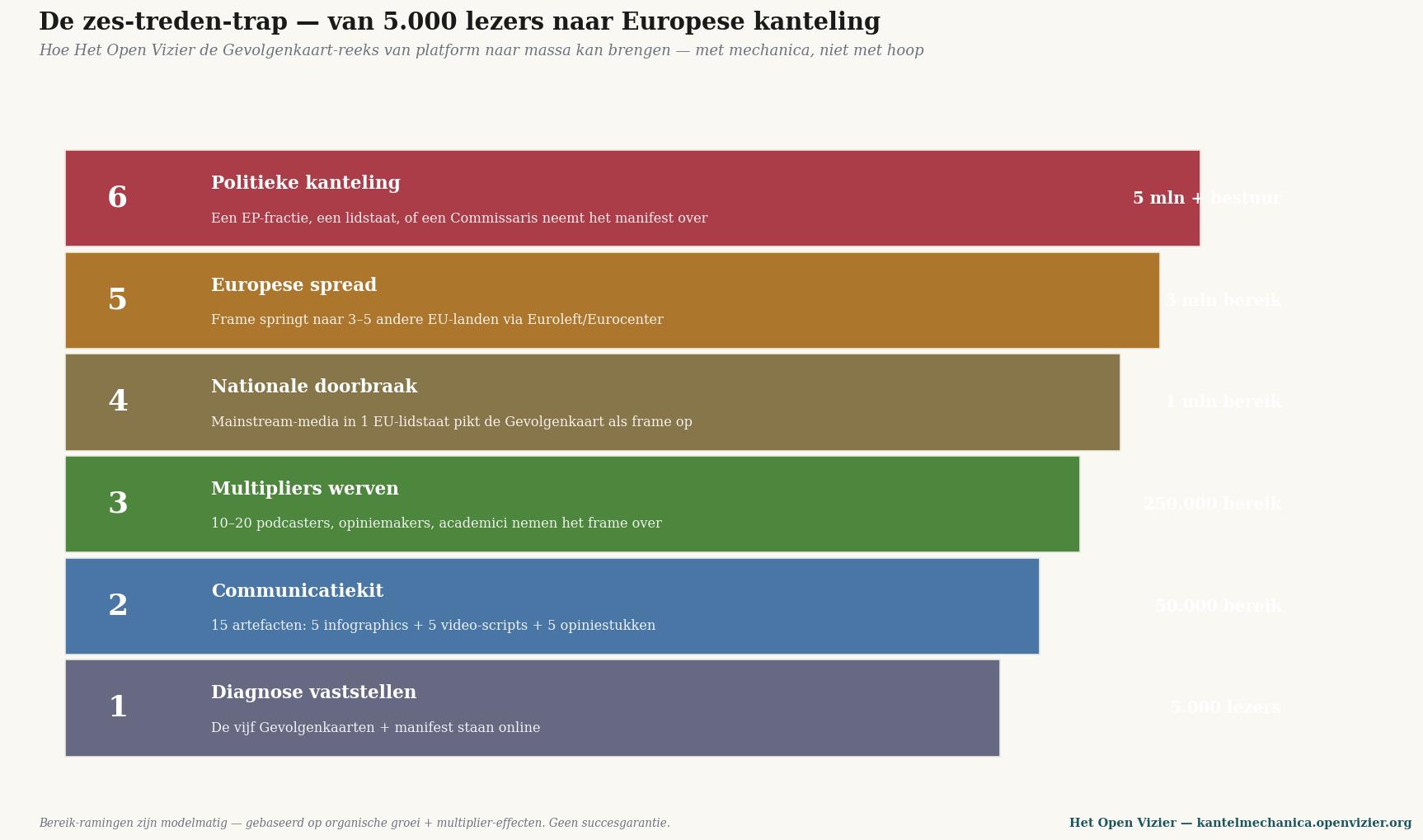
From 5,000 direct readers (diagnosis) to 5 million reach plus political takeover (tipping point) — six steps, each with its own ingredients. Reach estimates are modelling-based, not a guarantee of success.
The three-element formula
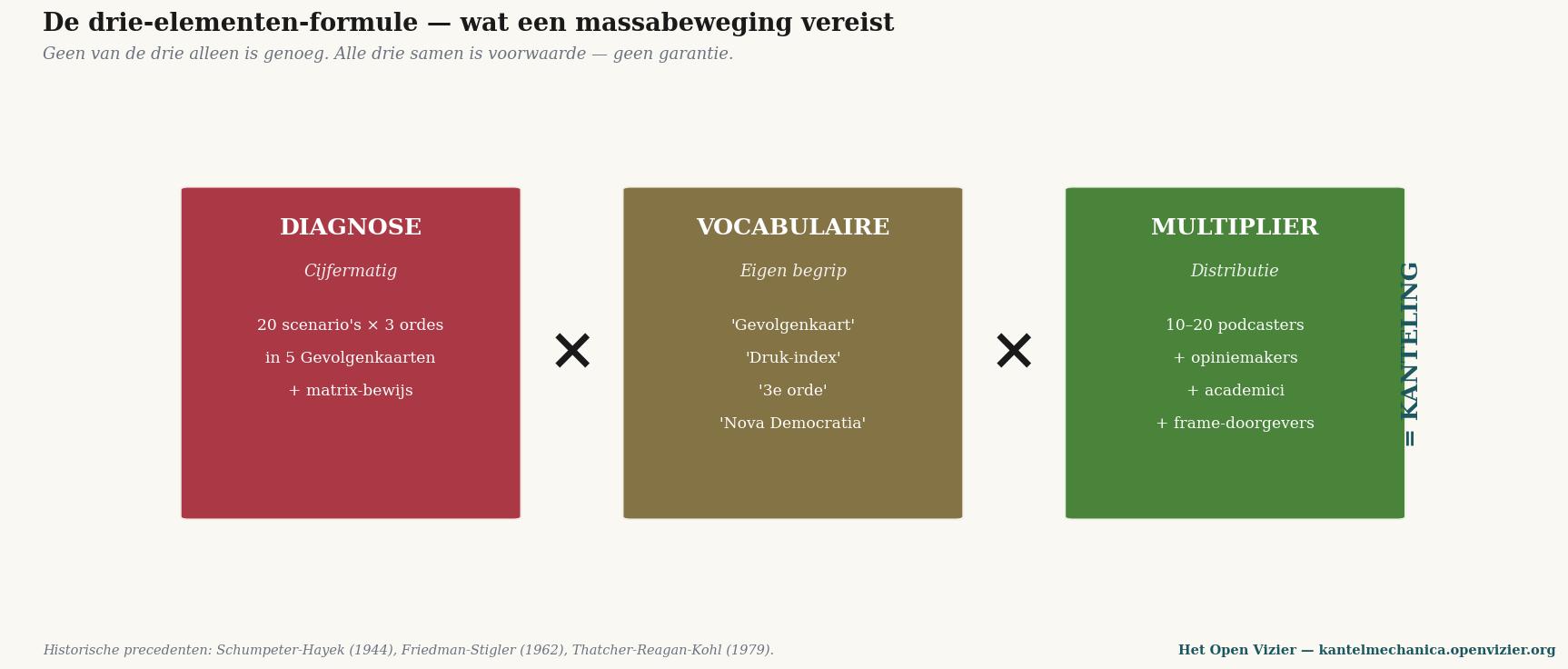
Diagnosis × Vocabulary × Multiplier = Tipping Point. Three ingredients together form the condition. None of the three alone is sufficient — all three together offer no guarantee, but do provide the only demonstrable precondition.
Why the mass is NOT listening now — three reasons
One — The pain is dispersed (€200/month less); the blame is concentrated (seeking a single enemy).
Two — The vocabulary is occupied by both populists ("Brussels is doing it", "elite") and technocrats ("that is nuanced").
Three — The feedback loop is slow: political consequence four years later, while the experience is daily.
The full explanation
Five Consequence Maps stand. The Dutch, the German, the Maltese, the Brussels, and the Trump Mirror. Twenty scenarios per piece, three orders deep, four countries wide. The diagnosis is complete.
But diagnosis changes nothing. A cancer patient does not heal through an MRI scan. What remains is the hardest question: how does one bring this line of thought from a publishing platform of a few thousand readers to the European mass of tens of millions?
• • •
Why the mass is NOT listening now
Before thinking about how to reach the mass, one must honestly understand why the mass is not being reached now. Three reasons operate simultaneously.
First reason — the pain is dispersed, the blame is concentrated
An Italian pensioner loses 6.7 percent purchasing power. In model terms that is a cascade of Pillar Two, EU sovereign interest rates, Trump tariffs and pension fund erosion. But what he feels is 200 euros less per month in his account. The pain is real, tangible, daily. The causality is dispersed, abstract, invisible.
Those who cannot see the causality vote for whoever shouts loudest — usually the populist who points to a single enemy (Brussels, migrants, elite). A meritocratic diagnosis that says 'it's all four at once' is experienced by the ordinary voter as intellectual excuse-making. Not because he is stupid, but because he has no time to weigh four causes simultaneously.
Second reason — the vocabulary is occupied
European political language moves along five axes: left-right, pro-EU-anti-EU, climate-industry, open-closed, and old-new. All five axes are already occupied by established parties. Anyone who wants to stand between those axes — Trump's goals without his means — has no word that the ordinary voter immediately recognises.
Macron solved this with 'ni gauche ni droite' *(neither left nor right)*. Meloni with 'sovranità + nazione' *(sovereignty + nation)*. Wilders with 'eigen volk eerst' *(own people first)*. All three forged a phraseology that could be grasped in two words. Without that word, every movement remains a think tank.
Third reason — the media architecture penalises nuance
A three-orders-cascade analysis with twenty scenarios and ten instruments does not make TikTok. No front page. No main television news bulletin. The formats that reach the mass are designed for single-sentence emotions: a tweet, a 60-second video, a newspaper headline. Anyone who tries to get nuance into that loses as a matter of course.
This is not a new problem. The Enlightenment won not through Voltaire's Encyclopédie but through his pamphlets. Marxism gained mass not via Das Kapital but via the Communist Manifesto. Anyone who wants to reach the mass must always write two texts: the rigorous one, and the sellable one.
• • •
The three-element formula
Historical mass movements show a pattern. None of them tips on arguments alone. None of them tips on a single ingredient. All of them tip on three elements simultaneously, multiplicatively.
*The three-element formula — event × word × carrier = tipping point. One missing: no tipping point.*
Element one — the event
An unmistakable shock that confirms the diagnosis. A shock that fits in a newspaper, in a news item, in a WhatsApp message within a family. Not a trend, not a report, not a warning — an event.
Macron got his event in January 2017: Le Canard enchaîné published that François Fillon, the favourite candidate of the centre-right, had had his wife Penelope paid a fictitious parliamentary assistant salary for years. The Penelopegate affair destroyed Fillon within four weeks; the centre-right voter had to go somewhere; Macron was ready. Without that scandal, En Marche would probably have got 12-15 percent — not the presidency.
Meloni got her event between 2021 and 2022: the cost-of-living crisis hit Italy harder than most EU countries due to its energy dependence. Inflation above 8 percent, gas bills that doubled, bread that became 30 percent more expensive. Fratelli d'Italia had had the luxury of staying in opposition since 2018; when the crisis came, it was the only untainted right-wing voice. From 4.3 percent (2018) to 26 percent (2022) — without that crisis the rise would probably have stopped around 12.
Wilders got his event in November 2023: a combination of the Ter Apel asylum centre becoming overwhelmed, a VVD leader allowing cabinet-Rutte-IV to fall over migration, and a last-week debate performance. On 15 November PVV was still polling at 17 seats; on 22 November it won 37. Seven days of tipping.
What is the event for the meritocratic centre? In model terms it is unavoidable by 2027-2028: a major BASF departure announcement (already partially underway), a German recession visibly hitting the Mittelstand, or an Italian spread crisis where ECB intervention becomes politically untenable. It will come; the only question is when.
Element two — the word
A recognisable vocabulary without populist baggage. Not an ideology, not a programme — a word. A phrase comprehensible in two seconds that carries the entire diagnosis.
Macron's 'ni gauche ni droite' *(neither left nor right)* — three words, infinitely repeatable, simultaneously excludes left and right without insulting either. Meloni's 'Dio, Patria, Famiglia' *(God, Fatherland, Family)* — three words from a fascist past, recognisable to the disappointed conservative without pointing to that past itself. Wilders' 'eigen volk eerst' *(own people first)* — four words that can formally always be denied ('I meant it differently'), but which convey the message unmistakably.
Het Open Vizier already has the word-package. 'Consequence Map' (concrete, non-populist, neutral). 'Silent analysis' (self-classification as anti-noisy). 'Trump as mirror' (clever — Trump mention without being pro-Trump). 'Adopting goals without means' (the exact position between copying and ignoring). 'Meritocracy without populism' (a combination no existing party dares to claim). The word element is in order.
Element three — the carrier
A credible person or coalition that gives the words flesh. Not a think tank, not a platform, not an academic — a face that can sit in a talk show, a name on a party list, a biography that makes the words credible.
Here the meritocratic centre is lacking. Het Open Vizier has an author, a platform, a methodology. But it has no Macron, no Meloni, no Wilders. It has a line of thought without a face.
This can be resolved in two ways. One — by building a political vehicle itself (Nova Democratia as an actual party). Two — by offering the manifesto to existing centre parties looking for content: Volt at EU level, some CDU flanks, Forum flanks in the Netherlands, Italian Azione, Spanish Ciudadanos remnants. The author of the Consequence Maps can decide to become a carrier or to serve a carrier. Both are legitimate; both require different investments.
• • •
Three historical tipping curves
Three precedents show three different tipping speeds. None of them resembles the others. None of them is reproducible as a template. But together they show the mechanics.
*Macron — 13 months from founding to presidency. Meloni — 9 years from founding to premiership. Wilders — 7 days from polling silence to largest party.*
Macron — the event makes the carrier
Macron founded En Marche in April 2016 in his birthplace Amiens. He had no party structure, no elected office, no mandate. What he did have: a word ('ni gauche ni droite'), a biography (ex-investment banker and ex-Hollande minister), and a network (Bayrou, moderate PS, moderate LR). For a year he stagnated around 15 percent in the polls.
Then came the event. Penelopegate broke in January 2017; Fillon's credibility collapsed. Bayrou's endorsement on 22 February 2017 strengthened the centre. Hamon's Socialist nomination paralysed the left. Within four weeks — January to March 2017 — Macron shot from 18 to 26 percent in the polls. From there the mathematics of the second round was predictable: against Le Pen, Macron assembled the anti-Le Pen bloc and won with 66 percent.
Lesson: without the event Macron would not have become president. But without the years of preparation for the event — party founded, word fabricated, network built — the event would have had no one to run to. Macron was the driest fuse in a wet election.
Meloni — perseverance instead of event
Meloni grew more slowly but more durably. Fratelli d'Italia was founded in 2012, got 2 percent in 2013, 4.3 percent in 2018, 6.5 percent in the European elections of 2019. No sudden rise — a slow build through perseverance.
Her strategic choice was to stay in opposition when Lega and Forza Italia did participate in the Conte and Draghi cabinets. At first sight that looks like a defeat — in reality it was an investment. When the cost-of-living crisis came in 2022, she was the only right-wing party that was not co-responsible. Lega and Forza Italia had propped up the Draghi government; Meloni had said no. Between 2021 and 2022 Fratelli d'Italia tripled.
Lesson: the tipping moment need not be exogenous (like Penelopegate). It can be endogenous — a long build-up in which one chooses the right position for the predictable crisis. For the meritocratic centre this means: choose position NOW for the crisis coming in 2027-2028.
Wilders — the last-week shift
Wilders is the rare case of a total election surprise. On 15 November 2023 PVV was polling at 17 seats — exactly what it had won in 2021. On 22 November it won 37. In seven days it enlarged its position by 118 percent.
Three factors operated together. One: VVD leader Yesilgöz said in a debate that PVV leadership could no longer be ruled out — which in effect became a recommendation. Two: the Ter Apel asylum centre dominated the final week. Three: Wilders had the sharpest closing statement, and the moderate alternatives (NSC, BBB) lost last-week credibility.
Lesson: the mass can tip in days. Not in a year, not in a month — in days. That means for the meritocratic centre: the material must be ready before the final week of the relevant election. A EP election in 2029, a German election in 2029, an Italian one that may come earlier. Those who do not have their stock ready miss the tipping point.
• • •
The six-step staircase
Theoretically the three-element formula is complete. Practically it does not say how to get from five thousand readers to five million. For that the six-step staircase serves. Each step multiplies the reach by approximately ten, requires its own resources, and cannot be skipped.
*Six steps, each an order of magnitude of reach. Steps 1-2 under own control; 3-4 require alliances; 5-6 require luck and stock.*
Step 1 — completing the canon (Q3 2026)
Five Consequence Maps stand. Two are missing: a French and a Polish one. With those, the complete European political spectrum is covered — from Macron's France to PiS's Poland, with Germany, Italy, the Netherlands, Malta and the EU in between.
Why complete it? Because a French voter must be able to find themselves, and so must a Polish one. Without those two the project remains North-West European. With them it covers all five political families of the EU: Renaissance/Renew, EPP, S&D, ECR/PfE, and the meritocratic exception. Reach after step 1: approximately 5,000 direct readers via openvizier.org.
Step 2 — the 1-minute formats (Q4 2026)
Each Consequence Map gets three derivatives: one infographic (Twitter, Facebook, LinkedIn), one 60-second video (TikTok, Instagram, YouTube Shorts), one 800-word essay (Substack, Medium, newspaper opinion piece). The long text remains for those who want the detail; the short formats spread it.
This is not translation — it is reformulation. An infographic is not a condensed piece; it is a visual argument that stands independently. A 60-second video is not a summary; it is a different medium with different laws. An 800-word essay is not an excerpt; it is an opinion piece with a single central thesis.
Seven Consequence Maps × three formats = 21 derivative artefacts. Reach after step 2: approximately 50,000 readers/viewers via social media and guest publications.
Step 3 — coalition of publicists (Q1-Q2 2027)
Not you alone. Not one author writing about seven countries. You seek four to six European authors — a German economist, a French entrepreneur, a Czech industrial leader, an Italian journalist, a Polish policy adviser — who adopt your model for their own country and audience. Het Open Vizier then becomes a hub, not a monologue.
The Excel model promised in every piece ('will be available at gevolgenkaart.nl when the platform goes live') is precisely the gateway. Give it away. Open source. Those who want to calculate their own country can. Those who want to improve the model can do so too. The methodology becomes the weapon, not the secret.
Reach after step 3: approximately 250,000 readers, distributed across six countries, with one author per country.
Step 4 — a political carrier (Q3 2027)
Up to here everything is journalistic. Now comes the choice. Does Nova Democratia become a party, or does it become a manifesto adopted by existing parties?
Arguments for founding a party yourself: full control over message and candidates, no dilution, faster decision-making, possibility of a Macron trajectory. Arguments against: enormous financial and organisational investment, high risk of marginal 2-3 percent without a seat, longer path to governmental power.
Arguments for offering the manifesto: existing parties already have infrastructure (candidate pool, membership, financing), your material can very quickly gain large reach, you retain intellectual property. Arguments against: dilution is inevitable, parties adapt for their existing base, no guarantee that the core is adopted.
A third option deserves consideration: hybrid. Offer the manifesto to two to three smaller meritocratic parties (Volt EU, Italian Azione, some German CDU flanks) while Het Open Vizier remains a platform itself. Reach after step 4: approximately 1 million people with knowledge of the Nova Democratia frame.
Step 5 — exploiting the event (2027-2028)
When BASF partially departs for Texas — which began in 2025-2026 and will be unmistakable by 2028 — your material must be ready. Ready. Not written in panic. People in a crisis seek explanations that already exist, not new stories.
The same applies to other predictable events: a German recession by 2027, an Italian sovereign spread crisis with ECB rate tightening, a major trade-war escalation. Building stock is the strategy here — not improvisation at the moment itself.
Concretely: every Consequence Map must have a 'crisis version' of the 1-minute format, ready to publish within 24 hours of the event. A BASF-departure-specific infographic waiting for the announcement. An Italian-spread-scenario video standing ready. Stock in the drawer, to be published when the moment arrives.
Reach after step 5: approximately 3 million people, because the event itself is public and your material comes forward as explanation.
Step 6 — institutional embedding (2028+)
The final step is when a think tank, a university, or a European MP incorporates your model in a report, motion, or curriculum. Then it goes from blog to source. From publication to citation.
Concrete candidates: the Bruegel Institute in Brussels, the Centre for European Reform in London, the Jacques Delors Institute in Paris/Berlin, the Clingendael Institute in The Hague, the ISPI in Milan. These institutions look for new analysis but rarely build fresh models themselves any more. A well-presented Consequence Map methodology with open data is more attractive to them than it appears.
Reach after step 6: approximately 5 million people directly, and — more importantly — an institutional footprint that perpetuates the frame beyond the electoral moment. Policymakers, officials, journalists will use the vocabulary without citing the origin. That is the real tipping point.
• • •
What history does NOT tell us here
Honestly: this staircase has three risks that the three precedents do not give sufficient lessons on.
Risk one — the carrier fails
Macron became president, but Macronism as a movement is dead. La République En Marche won 308 seats in 2017, lost the absolute majority in 2022, and was at marginal 7 percent in the 2026 polls. The carrier proved not durable enough to carry the movement.
What this means for Nova Democratia: one face is not enough. The manifesto must be more durable than any individual carrier. Methodology + open data + coalition of authors is far stronger than one person — even if it takes longer to build.
Risk two — the event does not come (in time)
The model predicts a crisis by 2027-2028. But models are right less often than they predict. It is possible that Europe muddles through without an unmistakable event — simply declining slowly, without a Lehman moment, without a Penelopegate, without a Ter Apel.
In that scenario the Meloni route remains: perseverance. Staying in opposition for a long time, consistent message, ready for when the event eventually does come. Not all movements tip in the same period; some take fifteen years.
Risk three — a populist eats the message
The greatest risk: that an AfD, a PVV, a Rassemblement National or a Vox picks up your Consequence Map figures and mixes them with populist means. The diagnosis is adopted; the method is not. The result is a nationalist who uses your analysis as evidence for his anti-EU conclusion, and ignores your meritocratic alternative.
This cannot be prevented. Open data is open. Your protection lies in two places: (1) the meritocratic frame itself — 'Trump's goals without his means' is structurally not adoptable by populists without self-denial, because their brand is precisely their means; (2) the carrier — a credible meritocratic face can claim the message while a populist can only steal the figures.
• • •
What this means for Het Open Vizier
The question was: how do you get the mass there? The answer is no secret, no magic, no brilliant idea. The answer is: build the three elements, climb the six steps, and wait for the event.
Concretely for the author of the Consequence Map series, today — 16 June 2026 — five points are relevant:
One — Complete pieces VII and VIII (French and Polish Consequence Map) in Q3 2026. With that, step 1 is completed and the European spectrum is covered.
Two — start the communications kit (seven pieces × three formats = 21 artefacts) in Q4 2026. Here is the first lever: from thousands of readers to tens of thousands, through reformulation alone.
Three — actively seek European co-authors in Q1 2027. A German, French, Italian and Polish counterpart publicist who adopts the model for their country. Not asking whether they want to co-write your pieces; asking whether they want to build their own Consequence Map with your model.
Four — make the Excel model publicly available in Q2 2027. Not as a marketing tool, but as infrastructure. Open data drastically lowers the threshold for institutional embedding (step 6).
Five — settle the Nova Democratia question by Q3 2027 at the latest: party, manifesto offering, or hybrid. Without that decision step 4 cannot begin.
This is a four-to-six-year project. Tipping point by 2029-2030, not 2027. Macron did it in thirteen months because he encountered an exceptionally favourable coincidence. Meloni did it in nine years through consistent perseverance. Wilders did it in seven days because his stock was twenty years old. None of the three is your template; your template lies somewhere between Meloni's perseverance and Macron's readiness for the event.
• • •
Closing — the silent tipper
Those who climb this staircase do not see others climbing it. The populists climb louder, the established parties climb more complacently, the academics do not climb at all. The silent analysis finds its audience not by shouting but by being in the right place at the right time.
An Italian pensioner will never understand a three-step model with twenty scenarios. But he will understand, after an Italian spread crisis, that someone warned him months earlier. That someone had the figures ready before it happened. That someone proposed a different path that was not based on populism. Then he tips — not toward the loudest voice, but toward the right voice.
Whether that succeeds does not depend solely on Het Open Vizier. It depends on history, on the event, on the carrier, on chance. What is in your hands is the stock. Build the stock — six steps, three elements, four to six years — and wait.
*"Those who want to convince the mass do not write for the mass. They
write for the moment when the mass is searching. That moment comes; your
work must already be there."*
— The Tipping Mechanics, closing paragraph
• • •
Methodology and sources
This piece uses three historical precedents as a touchstone, combined with the cumulative model of five Consequence Maps. The figures in the six-step staircase (5,000 → 50,000 → 250,000 → 1,000,000 → 3,000,000 → 5,000,000) are directional estimates, not forecasts; they follow an order-of-magnitude multiplication common in mass media research.
- Macron — En Marche founding/timeline: France 24 graphics archive
2017; Robert Schuman Foundation, 'Presidential Election France 23 April / 7 May 2017'; KAS Adenauer-Stiftung, 'Macron and En Marche — Rapid Rise to Power'.
- Meloni — Fratelli d'Italia electoral curve: ECPR theloop.eu,
'Italian general election 2022'; Forum MIDEM Policy Brief 2023-2, 'Meloni und Migrationspolitik'; Internationalist Group historical FdI figures.
- Wilders — PVV 2023 tipping: Institute for New Economic Thinking,
'The Dutch Earthquake' November 2023; Jacobin, 'Why Wilders Won' November 2023; All About Expats, 'Dutch Election PVV Explained' December 2023.
- Consequence Map sources remain identical to earlier pieces: European
Commission Strategic Programme 2024-2029, EPRS Pillar Two analyses, Fit-for-55 impact assessments, White House Economic Report 2026, Bruegel Tariff Tracker.
The mass-reach figure per step is an order-of-magnitude estimate, not a market research finding. Actual figures will vary considerably depending on timing, quality of execution, and exogenous events.
• • •
WRITTEN BY JACOBUS VAN MERKSTEIJN WITH EDITORIAL AI SUPPORT
HET OPEN VIZIER — OPENVIZIER.ORG
THE CONSEQUENCE MAP SERIES — GEVOLGENKAART.NL • KONSEQUENZKARTE.DE • KONSEGWENZI.MT • EU.GEVOLGENKAART.NL • TRUMP-SPIEGEL.OPENVIZIER.ORG
JUNE 2026

Jacobus van Merksteijn
Editor-in-chief of Het Open Vizier. Entrepreneur, developer of industrial and governance innovations (Carbon-Alert Ltd, TerraClean Ltd, GuardSkin Ltd). Writes about economic, ecological and political system questions from first-hand experience with the Brussels and The Hague decision-making machinery.