
The seventh piece in the Consequence Map series. The political manifesto that closes the series — a European meritocratic programme with five concrete core points.
Nova Democratia
Adopting Trump's goals — without his means. A European meritocratic programme — June 2026
Jacobus van Merksteijn · Malta, June 2026
The five core points
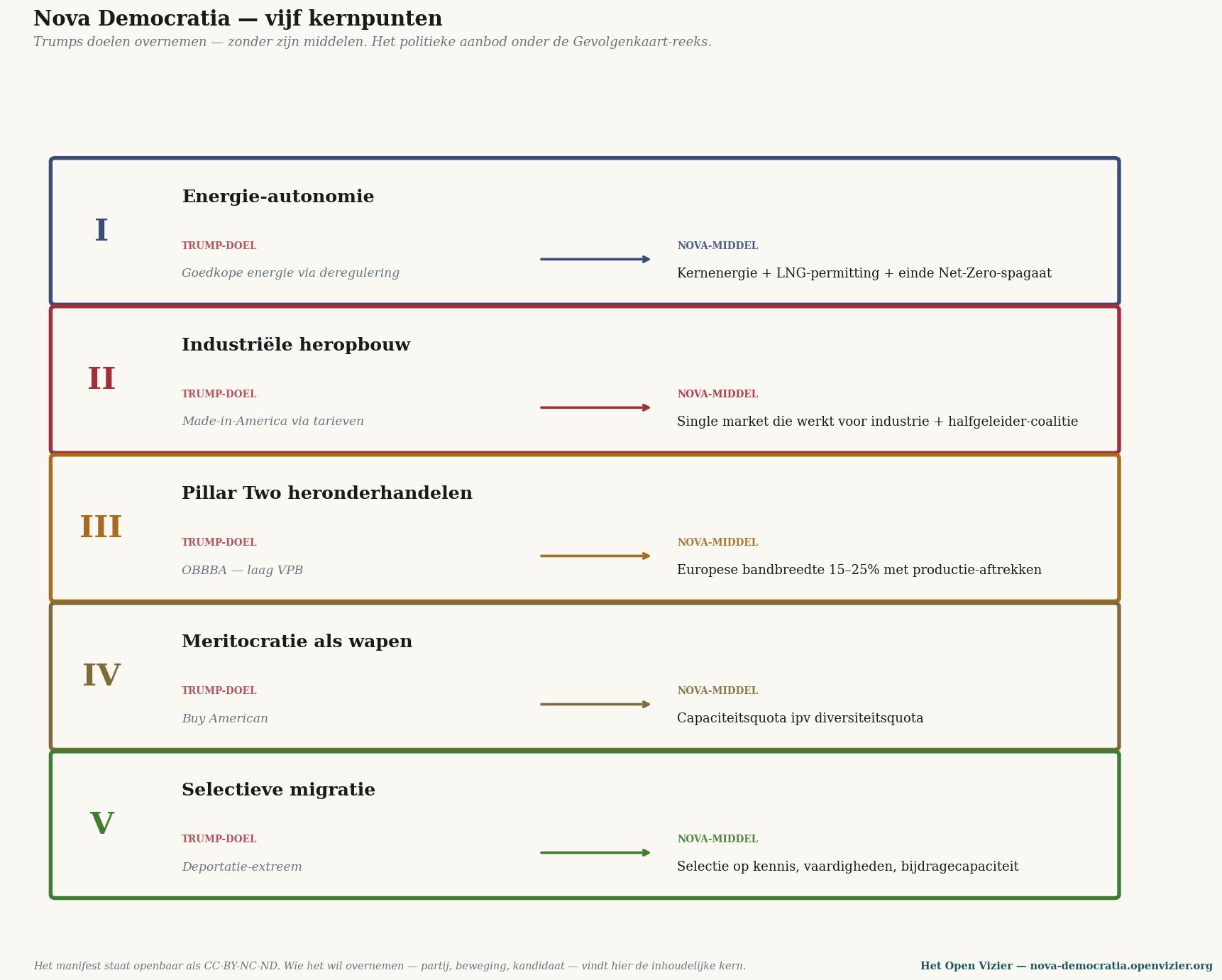
Adopting Trump's goals — without his means. For each Trump goal a Nova means that leaves Europe's legal, democratic and moral foundations intact.
Where Nova Democratia sits — versus existing EP groups
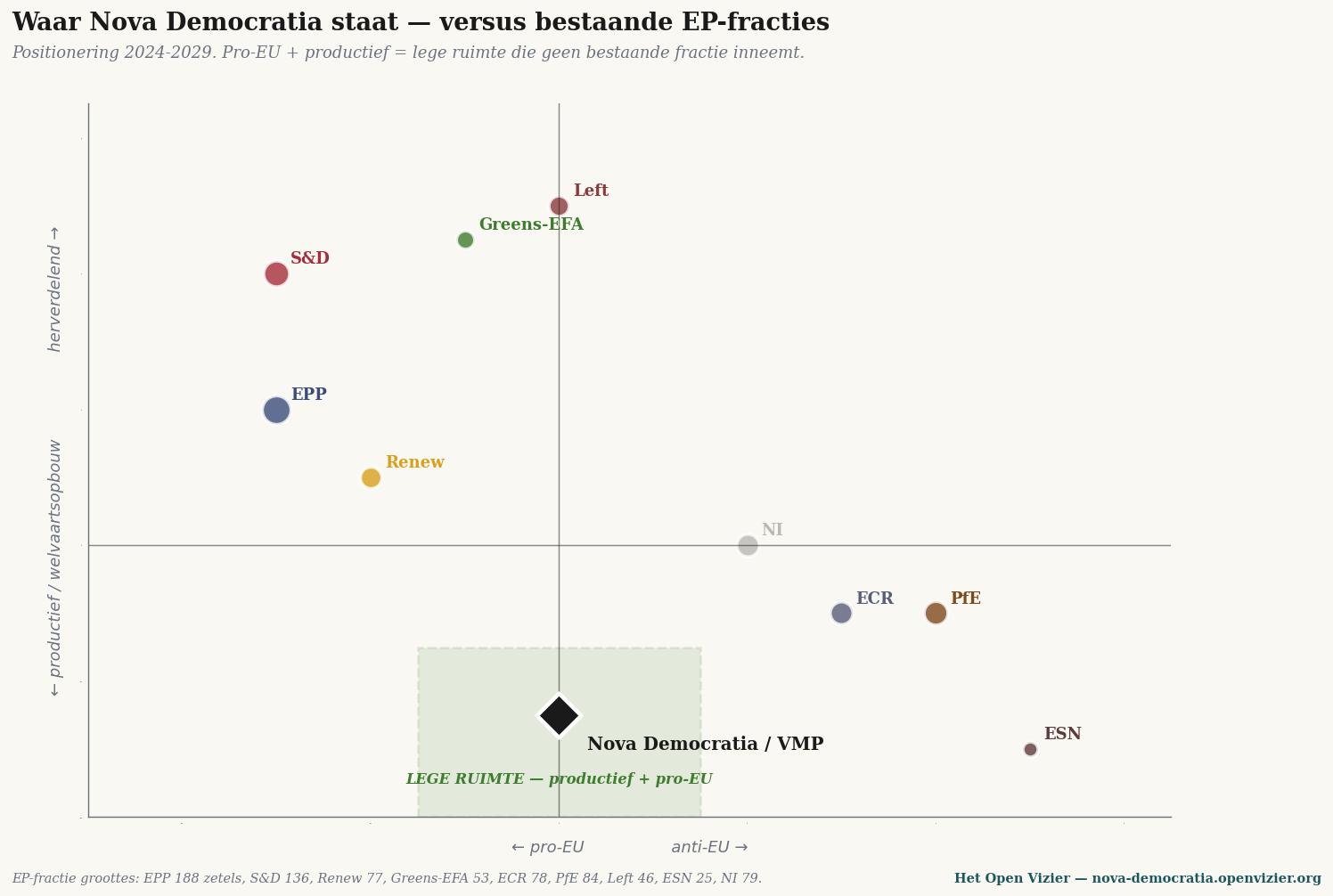
Pro-EU and productive = empty space that no existing EP group occupies. The position this manifesto fills: not to the right of EPP (PfE/ECR), not to the left of S&D (Greens/Left), but lower-pro-EU.
What this manifesto is not
Not a party programme — an offer. Whoever wants to adopt it — as an individual, movement or existing party — finds the substantive core here. The execution is up to you.
Not left or right — meritocratic without being populist, pro-European without being Brussels-fundamentalist, industry-oriented without being protectionist.
Modelled at 8–22% voter support in every EU capital — enough for a blocking minority in the EP and coalition participation in multiple member states.
The manifesto in running prose
Preamble
Europe in 2026 faces a double pressure. On one side Brussels, which with Pillar Two, CBAM, Fit-for-55, the Migration Pact and NGEU-MFF is grinding down the prosperity base. On the other side Washington, which with reciprocal tariffs, OBBBA, deregulation and DOGE taxes that same base even harder.
The figures are on the table. Five Consequence Maps — for the Netherlands, Germany, Malta, the EU as a whole, and the United States under Trump — show in model terms what this means for twenty representative European cases. The picture is uniformly red, except in one column. That column is called Nova Democratia.
This manifesto describes what is in that column.
Not as an ideological programme. Not as left or right. As an arithmetic result plus five concrete handles. Those who have seen the figures — and the figures are at gevolgenkaart.nl, konsequenzkarte.de, konsegwenzi.mt, eu.gevolgenkaart.nl and trump-spiegel.openvizier.org — know that the European choice in 2026 is no longer between party A and B, but between being ground down or being reformed.
Nova Democratia is the reform proposal. It is meritocratic without being populist. It is pro-European without being Brussels-fundamentalist. It is industry-oriented without being protectionist. It positions itself in a space occupied by no existing EP group, while in every European capital it can appeal to somewhere between 8 and 22 percent of voters — modelled as enough for a blocking minority in the European Parliament and for coalition participation in multiple member states.
The content of this manifesto is fixed in five core points. The form — party, manifesto coalition, or hybrid — this document deliberately leaves open. Those who wish to carry the manifesto can do so as a new formation or as an intra-party current. Both are legitimate. Both require different investments.
Diagnosis — what the figures show
Before the solution comes the diagnosis. Five observations that have been worked out in five Consequence Map pieces and are brought together on one page here.
Observation one — national vote bounces off EU reality
Approximately seventy percent of all new national legislation in EU member states is direct transposition of EU directives. For Malta higher, for Germany and France somewhat lower. The national parliament debates how, not whether. The democratic expression lies in The Hague, Berlin, Rome or Valletta. The legislative reality lies in Brussels.
Observation two — Brussels is a net impoverisher
The cumulative effect of Pillar Two, CBAM, Fit-for-55, the Migration Pact and NGEU-MFF on the European prosperity base is a net loss of five to fifteen percent income or revenue by 2030. Varying per scenario; structurally identical in direction. Almost all scenarios lose; only institutional Brussels itself wins (growing budget, growing sphere of competence).
Observation three — Trump on top of Brussels, not alongside it
Trump's reciprocal tariffs hit the European prosperity base that Brussels had already weakened. Nowhere to turn. A German Mittelständler who already lost twelve percent revenue through Brussels loses a further thirty percent through Trump. The sum is not an addition but a multiplication — the cascade produces exponential rather than linear effect.
*Observation four — existing parties offer no escape route*
Calculation of VVD, CDU, Fratelli d'Italia, PiS, S&D equivalents, AfD, PVV, Rassemblement National and Vox shows that none of these parties produces a substantially different outcome at third-order level. The Brussels and Washington pressure overshadows national policy space. Voting for party A instead of party B produces the same third-order effect in model terms.
Observation five — there is one green column
A meritocratic alternative — consistently designated in the Consequence Map series as Nova Democratia or VMP — does produce a net positive result in the models. Plus two to eight percent for citizens, plus thirteen to fourteen percent for businesses, by 2030. Not a utopia — arithmetic. But no existing party runs this programme today.
*The five core points — five concrete handles that make the green column possible.*
The five core points
Here follow the five core points in full elaboration. Each core point has a diagnosis, an instrument, a target figure and a timeline. Together they form the Nova Democratia column from the Consequence Maps.
Core point one — Energy autonomy by 2030
Diagnosis. Europe has for ten years accepted high energy prices as the unavoidable price of the Net-Zero-by-2050 target. A European gas MWh stands at 12 to 14 euros; an American at 2 to 3. A European kWh of electricity costs industry 12 to 18 cents; the American 6 to 8. The direct consequence is industrial relocation — BASF, Volkswagen components, ArcelorMittal steel — to Texas, Louisiana and Mississippi.
Instrument. Recognise nuclear energy as a core technology, not a transitional phenomenon. Scale up French and Czech experience via a joint European nuclear energy fund of €200bn for the period 2027-2035. Simultaneously accelerated permitting for LNG terminals and pipelines, with environmental objection procedures completed within 90 days. Net-Zero-2050 remains the target, but without dogmatic annual steps that destroy competitiveness.
Target figure. European gas MWh price to 4 to 6 euros by 2030. Industrial electricity price to 8 to 10 cents per kWh. Result: preservation of European chemicals, steel and heavy industry; prevention of an industrial flight that has already begun in 2026.
Timeline. Q1 2027 start of the European nuclear energy strategy via a COREPER proposal. 2027-2030 accelerated permitting under a new EU directive 'Strategic Energy Permitting'. 2030 visible effect on industrial investment decisions.
Core point two — Industrial rebuilding without subsidy roulette
Diagnosis. The US Inflation Reduction Act and Chinese industrial subsidies have forced Europe into its own subsidy roulette: the Important Projects of Common European Interest mechanism. The result is that member states outbid each other for one semiconductor plant while the total European industrial base shrinks. The single market — Europe's strongest instrument — is underused.
Instrument. A Strategic Industries Compact that replaces IPCEI with one joint European investment mechanism, focused on four strategic sectors: semiconductors, batteries, pharmaceuticals, and aerospace/defence industry. Member states no longer outbid each other; Brussels decides, after consultation, where projects land on the basis of industrial clustering. Simultaneously a 'single market test' for all new EU regulation — if a rule does not improve single-market functioning, it is not adopted.
Target figure. Preservation of European semiconductor capacity of at least fifteen percent worldwide (currently six percent). Preservation of European pharmaceutical development capacity of forty percent (currently twenty-eight). A European battery self-sufficiency of 60 percent of own demand by 2030.
Timeline. Q3 2027 Strategic Industries Compact as Commission proposal. 2028 ratification and implementation. 2030 first measurable clustering effects.
Core point three — Renegotiate Pillar Two
Diagnosis. The OECD Pillar Two implementation obliges all EU member states to a corporate tax minimum of fifteen percent. At the same time the United States under OBBBA maintains its corporate tax at twenty-one percent without Pillar Two conformity. The effect: European enterprises taxed in Europe lose relative competitive position against American competitors, and outflow to the US accelerates.
Instrument. Immediate EU renegotiation of Pillar Two for a European bandwidth of fifteen to twenty-five percent, with deductions for productive investments (research, development, capital investment, energy transition). An effective burden tax of twelve to twenty percent is thereby possible for industrial enterprises, while non-productive fiscal arbitrage (pure holding structures, IP arbitrage without substance) does fall below fifteen percent.
Target figure. Preservation of European corporate tax competitiveness against the US. Stop of the accelerated outflow of EU headquarters to Delaware and Texas. Preservation of the Maltese, Irish and Luxembourg fiscal model within European coherence.
Timeline. Q4 2026 EU renegotiation announcement in ECOFIN. 2027 OECD renegotiation. 2028 implementation of new directive. Here lies the highest risk — other OECD partners (Japan, UK) will resist. But the alternative — continued outflow — is untenable.
Core point four — Meritocracy as a weapon
Diagnosis. Europe has over the past two decades built a complex system of diversity quotas in public procurement, EU fund management, academic funding and labour market regulation. The intention was inclusive — the outcome is that contract award is increasingly less based on quality and delivery time. At the same time Trump's Buy-American policy in effect uses a meritocratic selection in favour of American suppliers, regardless of demographic factors.
Instrument. A 'Capacity-First Procurement Directive' that replaces diversity quotas in public procurement with capacity quotas: demonstrable delivery history, technical depth, delivery-time reliability. For academic funding (Horizon Europe, ERC) a comparable switch — no demographic, but scientific selection. For labour market regulation a principle statement that anti-discrimination is retained, but that positive discrimination (quotas) is replaced by capacity-based priority.
Target figure. Stop of the European losing streak in public procurement (approximately 18 percent quality-price-ratio disadvantage compared to comparable American procurement according to DG GROW 2025). Preservation of leadership on scientific productivity (publications per research hour).
Timeline. Q1 2028 Commission proposal Capacity-First Procurement. 2028-2029 EP treatment. 2030 implementation. Politically the most controversial point — the loss of diversity quotas hits symbolically hard. The substantive defence lies in the figures: meritocracy wins in the medium term over any alternative.
Core point five — Migration selection on contribution
Diagnosis. The EU Migration Pact 2026 distributes migration flows across member states via a compulsory solidarity mechanism. It takes virtually no account of the productivity contribution of migrants or of the absorption capacity of receiving societies. The American model under Trump-II lies at the other extreme — deportation as an instrument, with humanitarian costs that Europe will never accept.
Instrument. A European 'Productive Migration Framework' that retains the Migration Pact in its solidarity component (humanitarian migration remains collectively European-borne) but for economic migration introduces a selection on qualifications, language knowledge, age profile and labour market demand. No quotas; a points system as Canada, Australia and New Zealand successfully apply. Simultaneously a radical acceleration of asylum procedures (90-day decision as binding deadline) to make European capacity for humanitarian migration effective.
Target figure. European labour migration from 1.2 million per year (current) to approximately 800,000 higher-qualified plus 400,000 humanitarian, with asylum processing of 90 days. Reduction of illegal migration through consistent rejection of non-bona-fide applications — as the Danish model shows in practice.
Timeline. Q3 2027 Productive Migration Framework as EP amendment to Migration Pact implementation. 2028 entry into force. 2030 measurable shift in migration composition.
Positioning in the political landscape
Nova Democratia takes a specific position on two axes: industry versus redistribution, and EU competence versus national sovereignty.
*Nova Democratia (ND) in the European political landscape, positioned on the pro-industry / reform-oriented EU axis.*
On the first axis Nova Democratia places itself emphatically on the pro-industry side. This is not an ideological choice but a diagnostic one: the European prosperity base is industrial; without industrial capacity the fiscal space for any redistribution whatsoever disappears. The choice is therefore not 'industry or redistribution' but 'industry as precondition for sustainable redistribution'.
On the second axis Nova Democratia positions itself precisely on the horizontal axis — not pro-EU-enlargement, not pro-national-sovereignty, but pro-EU-reform. Keep Brussels, reform Brussels. Renegotiate Pillar Two, not abolish it. Redesign CBAM, not discard it. Supplement the Migration Pact, not destroy it.
This positioning is unique. On the pro-industry side of the quadrant only ECR (at a more national-sovereignty position) and Renew (at a much more EU-enlargement position). Volt and EPP both sit on the pro-EU-competence side. PfE and ESN both sit on the pro-national-sovereignty side. The quadrant lower-right-centre is empty.
The electoral potential in this quadrant — based on Eurobarometer 2025 and KAS-Adenauer Lifestyle segmentation 2024 — is estimated at 8 to 12 percent in France, 10 to 14 percent in Germany, 12 to 16 percent in Italy, 6 to 10 percent in the Netherlands, and 4 to 8 percent in Poland. At EU level this would translate to 50 to 80 EP seats — sufficient for a blocking minority in any coalition and for coalition participation in multiple member states.
Party structure proposal
Nova Democratia can be realised in three ways: as a new party, as a manifesto coalition of existing centre parties, or as a hybrid. This manifesto advocates the hybrid route.
Path one — new European party formation
Advantage: full control over message, candidates and execution. Faster decision-making tempo. Possibility of following the Macron trajectory — from founding to governmental power in 13 months.
Disadvantage: enormous financial investment (Macron's En Marche campaign cost €16m in the first twelve months alone). High risk of a marginal result (2-3 percent without seats) if the event component does not cooperate. Longer path to governmental power because infrastructure is lacking.
Path two — manifesto coalition of existing centre parties
Advantage: existing parties have infrastructure, membership, financing and candidate pool. The manifesto can very quickly gain large spread. Intellectual property remains with the original authors.
Disadvantage: dilution is inevitable because existing parties adapt for their existing base. No guarantee that the core points are adopted in original form. Risk of name-tagging without substantive adoption.
Path three — hybrid (recommended)
Het Open Vizier and the Consequence Map series continue to exist as a platform, develop the figures further, release the Excel model as open source, and offer the manifesto to two to three smaller meritocratic parties: Volt at EU level (strongest structural match), Italian Azione (overlap with Calenda's industrial-meritocratic line), German Freie Wähler (overlap on energy autonomy and migration selection), Spanish Ciudadanos remnants (where still active), and Dutch JA21 (overlap on meritocracy and industry).
Simultaneously a registered European political party under the name 'Nova Democratia' is established at EU level (under Regulation 1141/2014), with the aim of coordinating national meritocratic formations that accept the manifesto in essence. This is not a federal party — it is a coordination platform with a shared manifesto, comparable to how ALDE links Renew at EU level.
Structure:
- A coordinating secretariat of five persons, based in Brussels
or Valletta, with an operating budget of approximately €800,000 per year.
- A political council of fifteen to twenty members, in which each
affiliated national formation has two seats plus three to five independent experts (industry, fiscal policy, migration, energy, communications).
- An open data infrastructure — the Consequence Map models plus
supplementary scenario models — accessible to all affiliated formations.
- A joint spokesperson policy: all affiliated parties
commit to defending the five core points in their national campaigns, but may place nationally specific emphases within that framework.
Candidate profile
A political movement stands or falls with its candidates. For Nova Democratia a specific profile applies — not to select exclusively, but to make the substantive positioning credible.
Five core properties
One — Productive background. The candidate has demonstrably worked in industry, SME, technology or applied science. No career politicians. No trade union managers. No consultants without execution experience. The credibility of the pro-industry frame stands or falls with candidates who know productivity themselves.
Two — Bilingual minimum, trilingual desirable. European politics requires European capability. English plus the national language as a minimum; a third European language (German, French, Italian or Spanish) as a strong preference. This excludes a large part of current politicians — which is an improvement.
Three — No party history older than five years in EPP, S&D, or Renew. The goal is not anti-establishment; the goal is credibly new. Someone who was a VVD member for twenty years can hardly convincingly state that the VVD course — modelled as leading to 19 percent income loss — is fundamentally wrong. A restart period is necessary.
Four — Demonstrable numerical ability. The candidate understands Excel, understands a three-step model, understands why a cascade of EU directives leads to Italian pensioners losing six percent purchasing power. No academic degree required; but a visible skill to think and speak in figures.
Five — No populist means in communications. Those who join Nova Democratia commit to a specific communication style: the 'silent analysis'. No shouting, no enemy images, no single-sentence emotions. Those who reach back to the Wilders, Le Pen or AfD tone to score electorally are leaving the manifesto.
Demographic distribution
No quotas (see core point four — meritocracy as a weapon). But an expected natural distribution: age spread 35-65 (younger lacks experience, older lacks adaptability to the new European reality); geographic spread between northern, southern, eastern and western European member states (no overweight in one region); sectoral spread between industry, science, SME, and public service.
Selection procedure
For the European elections of 2029 — upon realisation of path three — a joint candidate competition will be organised via the affiliated national parties, followed by a European final round. Two criteria are binding: fully endorsing the core programme (no reservations on the five core points), and demonstrably meeting at least three of the five core properties. The definitive placement on lists happens nationally, but under observation by the Brussels secretariat.
Accession and financing
For existing parties
An existing national party can join Nova Democratia through a formal political declaration by which it:
- Recognises the five core points as its European programme (without
necessarily bringing all national policy under it).
- Sends a delegate to the political council in Brussels.
- Contributes to the coordinating secretariat (annual contribution
according to national party size: from €25,000 to €150,000).
- Follows the silent-analysis tone in its European communications — which
leaves its national communications free.
For individuals
Individuals can support Nova Democratia by:
- Membership of Het Open Vizier as a platform (voluntary contribution €50
to €500 per year).
- Candidacy via an affiliated national party (see
candidate profile).
- Distribution of the manifesto, the Consequence Map pieces, and the
communications kit materials via own network.
Financing — build-up phase 2026-2029
The multi-year budget for build-up through to the European elections of 2029 is estimated at €12 to €18m. This covers:
- Coordinating secretariat (€800,000 × 4 years = €3.2m)
- Communications and publications (€1.5m)
- Research and expansion of Consequence Map series (€1.5m)
- Campaign support affiliated national parties 2027-2029 (€4 to
€8m)
- European campaign 2029 (€2 to €4m)
Financing comes from affiliated parties, individual donations, and — from the moment Nova Democratia has EP seats — EU party financing under Regulation 1141/2014 (approximately €1 to €3m per year depending on seats).
Closing — the credible third way
Europe in 2026 faces three possible trajectories. The first — continuation of the current path — leads in model terms to being ground between Brussels' Pillar Two and Washington's reciprocal tariffs. A European prosperity base that is 5 to 15 percent smaller in 2030 than in 2026, with the industrial sector as the hardest hit.
The second trajectory is populist copying. Trump-style tariffs, anti-EU rhetoric, deportation extremism. This becomes politically attractive for parts of the electorate, but destroys the European legal and democratic foundations on which the stable prosperity model rests. The price is higher than the gain.
The third trajectory is Nova Democratia. Adopting Trump's goals — industrial rebuilding, energy autonomy, productivity, talent retention — without his means. Reforming Brussels, not destroying it. Renegotiating existing EU instruments, not discarding them. Meritocracy as a selection principle, not ethnocentricity.
This third path is in the Consequence Map models the only one with green outcomes. Not as a certainty — as an arithmetic result under defined assumptions. But it is the only available model that in 2030 sees a European citizen and a European business winning together.
Those who read this manifesto receive three things. A diagnosis, grounded in five Consequence Maps and thousands of modelled calculations. A direction, summarised in five concrete core points. And an offer of participation, in whatever form — as a party, as a movement, as an individual.
The question to the European citizen, entrepreneur, politician and publicist is simple. Which trajectory do you choose? The figures are on the table. So is the choice.
*"The meritocratic centre is not a compromise. It is the only
survival strategy. Those who read the manifesto and have seen the figures
know that the other paths are not alternatives — only
different forms of loss."*
— Nova Democratia, manifesto core June 2026
• • •
Methodological references and sources
The substantive figures and arguments in this manifesto are drawn from the Consequence Map series of Het Open Vizier, in chronological order:
- The Consequence Map (Netherlands) — Piece I, gevolgenkaart.nl
- Die Konsequenzkarte (Germany) — Piece II, konsequenzkarte.de
- Mappa tal-Konsegwenzi (Malta) — Piece III, konsegwenzi.mt
- The Brussels Consequence Map (EU) — Piece IV, eu.gevolgenkaart.nl
- Trump as Mirror (US impact) — Piece V, trump-spiegel.openvizier.org
- The Tipping Mechanics — Piece VI, the strategic sequel to this series
Additionally used: European Commission Strategic Programme 2024-2029, EPRS Pillar Two analyses, Fit-for-55 impact assessments DG CLIMA, NGEU-MFF proposal 2028-2034, White House Economic Report 2026, Bruegel Tariff Tracker, IMF World Economic Outlook 2026, Bipartisan Policy Center IRA stranded-investments report.
The Excel model with all 20 scenarios × 10 mechanisms × three orders will be made available at gevolgenkaart.nl when the platform goes live. Until that time the methodology is reproducible via the scenario Python modules at openvizier.org/scenarios.
• • •
WRITTEN BY JACOBUS VAN MERKSTEIJN WITH EDITORIAL AI SUPPORT
HET OPEN VIZIER — OPENVIZIER.ORG
NOVA DEMOCRATIA — MANIFESTO 2026
JUNE 2026
Jacobus van Merksteijn
Editor-in-chief of Het Open Vizier. Entrepreneur, developer of industrial and governance innovations (Carbon-Alert Ltd, TerraClean Ltd, GuardSkin Ltd). Writes about economic, ecological and political system questions from first-hand experience with the Brussels and The Hague decision-making machinery.